

Inside the world’s first single-piece 3D-printed rocket engine, the mobile launchpad that fits on a truck, and India’s audacious bid to become the last-mile delivery service for Low Earth Orbit.
Go to agnikul.in right now.
In the top right corner, there’s a button. Orange. Three words.
“Book My Launch.”
I want you to sit with that for a second. Book My Launch. As if you’re ordering a pizza. As if you’re reserving a table at a restaurant. As if space — actual, vertiginous, star-filled, vacuum-cold space — has been domesticated into something as ordinary as a Tuesday afternoon errand.
It hasn’t, of course. Space is still brutal and unforgiving and deeply, cosmically indifferent to human ambition. But something has fundamentally shifted. A group of engineers in Chennai have looked at a 50-year-old aerospace industry built on impossibly complex, absurdly expensive, criminally slow rocket engines — and decided to print their way out of it.
This is the story of Agnikul Cosmos, the Agnilet engine, and a quiet revolution happening not in a NASA hangar or a SpaceX megafactory, but inside a building at the IIT Madras Research Park in Chennai, where a German metal printer the size of a small car runs for 72 hours straight and produces something the world has never seen before: a complete rocket engine, weld-free, joint-free, printed in a single uninterrupted run.
One piece. No assembly. Just fire.
A Confession from a 3D Printer Obsessive
I need to be upfront about my bias here.
In 2014, I built a RepRap 3D printer from scratch. I ordered hardware from three different countries, soldered a RAMPS board by hand, spent three sleepless weekends calibrating and re-calibrating, and finally — finally — watched a hot-end drag a thread of molten PLA into the shape of a small plastic elephant. I have been hopelessly, unapologetically in love with 3D printing ever since.
I understand the theology of it. The way complex geometry collapses into a matter of hours and cheap feedstock. The way physical design becomes software. The way the gap between idea and object — a gap that has defined human civilization since the first flint knapper — narrows to almost nothing.
But even I did not see this coming.
Nobody prints rocket engines. You machine rocket engines. You weld and braze and heat-treat and inspect and assemble them from hundreds of precision-machined components, over months of careful work, in facilities that cost hundreds of millions to build. That’s how you’ve done it since Wernher von Braun. That’s how you do it at Aerojet Rocketdyne, at Safran, at RocketLab.
Except that’s not how they do it in namma Chennai.
Part I: The Problem With Rockets
To understand what Agnikul built, you first need to understand what’s broken about the rocket business.
The world is about to drown in satellites. Not metaphorically — 20,000 satellite launches are planned globally by 2030, driven by the demand for LEO (Low Earth Orbit) broadband networks, Earth observation, IoT connectivity, and a dozen other applications that have suddenly become economical at the small satellite scale. These aren’t the massive, bus-sized communications satellites of the last century. They’re CubeSats, microsats, nanosats — devices that weigh between 1 and 500 kilograms and can be built for tens of thousands, not hundreds of millions, of dollars.
The launch market has not kept pace.
When you need to put a 50-kilogram satellite into a specific, precise orbit, you have exactly two options. Option 1: wait for a large rocket operator (SpaceX, ISRO, Arianespace) to offer a rideshare slot — a shared-taxi arrangement where you book a spot on someone else’s rocket, go where they’re going, launch when they’re ready, and pray that your orbit requirements overlap with theirs. Option 2: pay $50–80 million for a dedicated launch on a conventional small rocket, which takes 12–18 months to book and another 6–12 months to actually prepare.
Neither option is ideal for an industry that increasingly needs “launch anywhere, anytime, affordably.”
That’s the gap Agnikul was built to fill. And their insight — the one that changes everything — is that the bottleneck isn’t the satellite. It’s the engine.
Part II: Enter Agnilet — The Engine That Broke the Mould
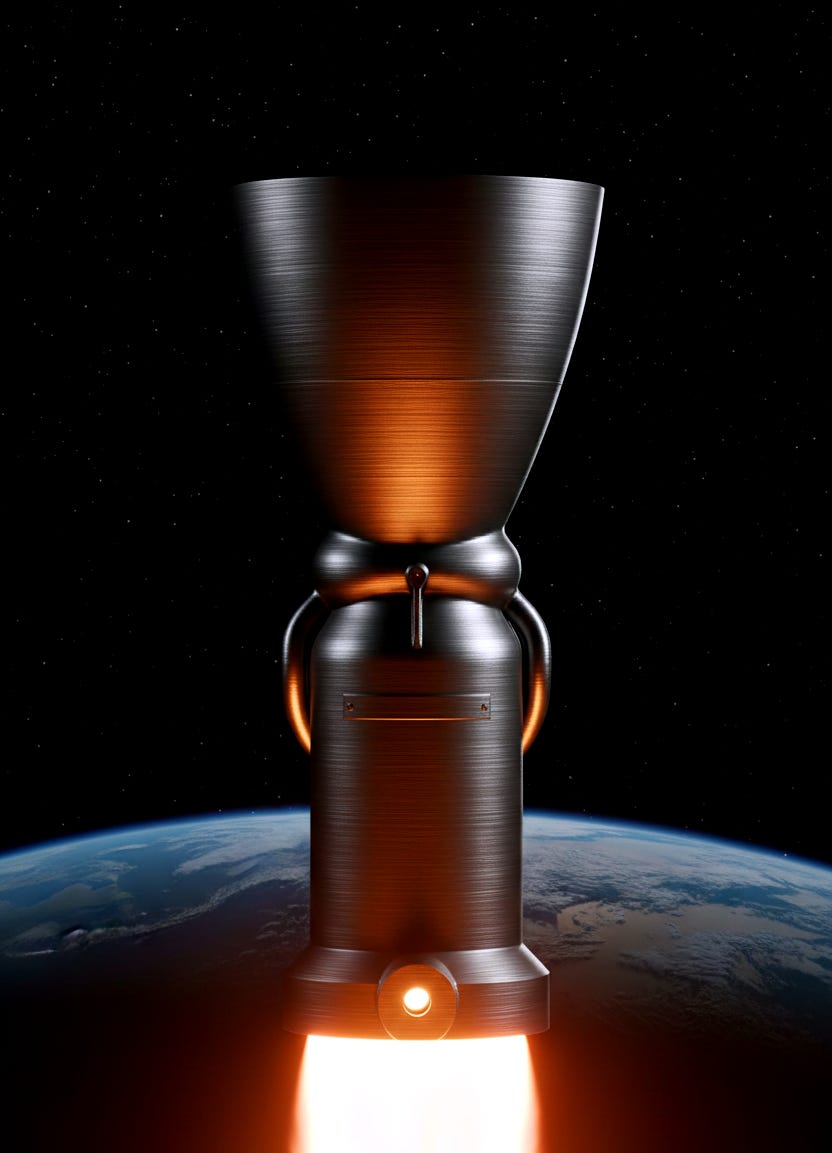
The Agnilet is a semi-cryogenic rocket engine that runs on sub-cooled Liquid Oxygen (LOX) and Aviation Turbine Fuel (ATF) — the same kerosene that powers commercial airliners. It produces 25 kilonewtons of thrust at sea level, with a specific impulse of 285 seconds (355 seconds in vacuum). These are unremarkable numbers in the context of large launch vehicles. What is remarkable — what is historically unprecedented — is how it’s made.
The Agnilet is printed in one continuous run on a Direct Metal Laser Sintering (DMLS) machine. The entire engine — fuel inlet, injector plate, regenerative cooling channels, combustion chamber, throat, exhaust nozzle — is fabricated as a single, seamless, monolithic piece of Inconel 718, one meter tall, with no welds, no bolts, no brazed joints, no assembly.
That sentence should not be possible to write. Let me explain why it is.
The Material: Inconel 718
Inconel 718 is a nickel-chromium superalloy that materials engineers use when they need something to not melt, not corrode, and not fail under conditions that would destroy most metals. It maintains its mechanical properties at temperatures above 700°C. It resists oxidation and hot corrosion. It handles the extreme cyclic thermal stress of rocket combustion without fatiguing.
It is also, traditionally, an absolute nightmare to machine. Inconel hardens as you cut it. It generates enormous heat. It wears out carbide tooling at a punishing rate. Traditional aerospace manufacturing handles Inconel components by machining them in dozens of separate pieces and then welding them together with extraordinary precision — a process that takes months and requires highly skilled specialists.
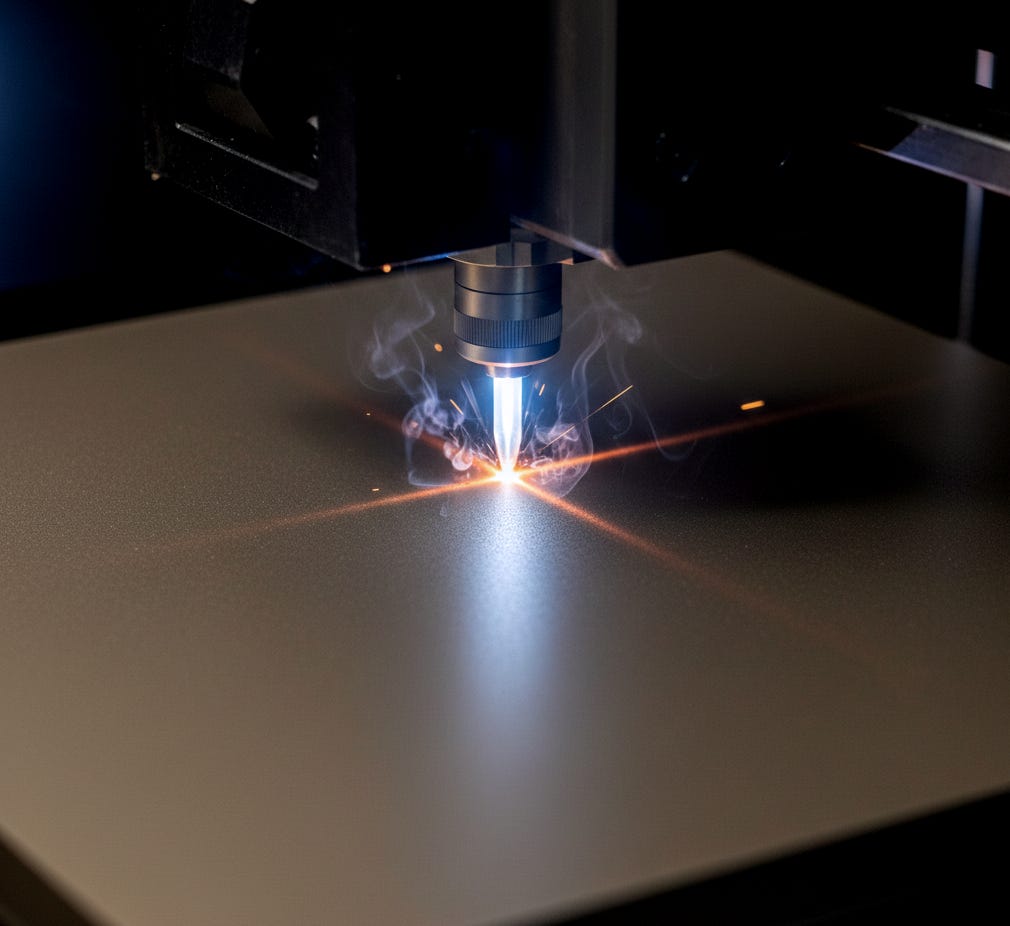
DMLS sidesteps all of this. The AMCM M 4K printer in Agnikul’s Rocket Factory-1 operates by spreading a fine layer of Inconel powder across a build plate, then using a high-intensity fiber laser to selectively melt and fuse the exact geometry specified in the CAD file. Layer by layer, from base to nozzle tip, the engine grows. The machine doesn’t care that Inconel is difficult to cut — it never cuts it at all. It builds up, not down.
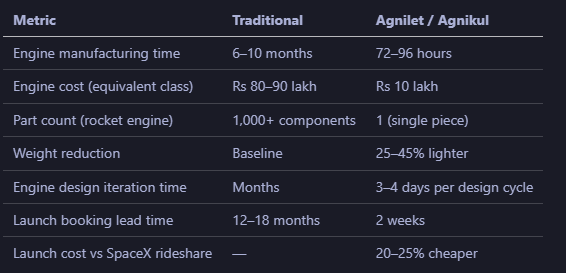
The print run takes 72 to 96 hours. Three to four days.
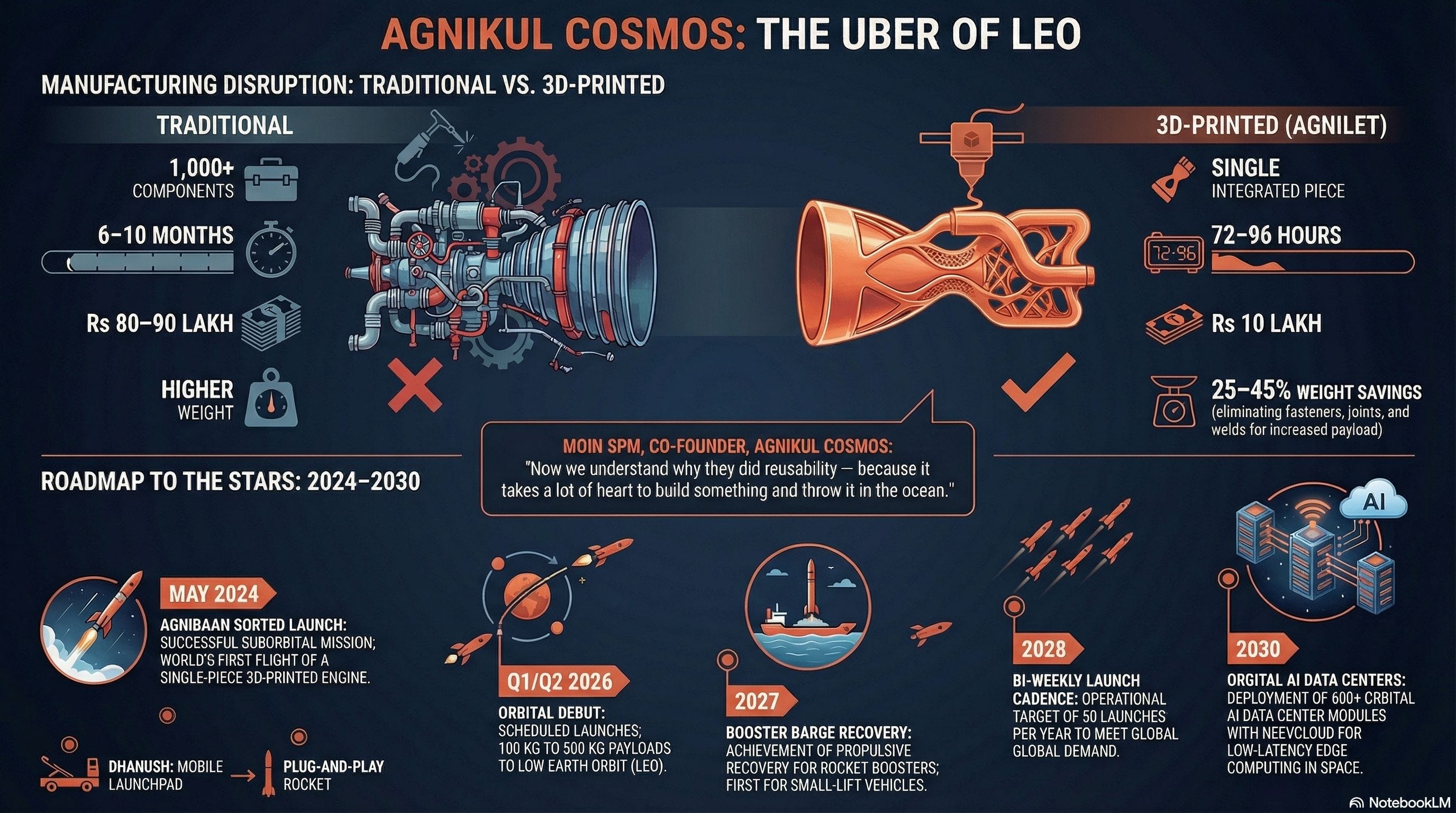
Compare that to a conventional rocket engine. Traditional manufacturing requires fabricating over 1,000 individual components, assembling them through welding and brazing, conducting inspections at each stage, and running the complete assembly over 6 to 10 months of production time. The cost? Approximately Rs 80–90 lakh (around $100,000) per engine.
The Agnilet, printed in four days, costs approximately Rs 10 lakh to produce. A 90% reduction in manufacturing cost.
But cost isn’t even the most important advantage. The most important advantage is what 3D printing means for the geometry of the engine.
The Single-Piece Advantage
Every weld in a rocket engine is a potential failure point. Under the extreme pressure, heat, and vibration of combustion — where gases burn at temperatures exceeding 2,000°C and chamber pressures exceed 20 atmospheres — each joint is a place where things can go wrong. Not just statistically. Catastrophically.
This is why rocket engine reliability is measured in test hours and why legacy manufacturers maintain vast quality control operations dedicated entirely to inspecting welds. The Saturn V’s F-1 engine, the most powerful single-chamber rocket engine ever built, had thousands of brazed joints in its injector plate alone. Each one was a bet placed against catastrophe.
The Agnilet eliminates this class of failure entirely. One piece. No joints. The rocket engine as monolith.
But there’s a subtler advantage too. When you design for assembly — when you know that an engine must ultimately be fabricated in separate components and welded together — you constrain your geometry to what can be machined and assembled by human hands. You can’t put a cooling channel where a welding torch can’t reach. You can’t create an internal passageway that requires a fitting where there’s no room for one.
DMLS has no such constraints. The printer doesn’t care how complex the internal geometry is. The Agnilet’s regenerative cooling system — a network of channels that circulates fuel around the combustion chamber to prevent the metal from melting — can be designed for thermal performance rather than assembly logistics. The injector geometry can be optimized for combustion efficiency rather than machinability. The result is an engine that’s simultaneously lighter (25–45% weight reduction vs. comparable assembled engines), more reliable, and more thermally efficient than what traditional manufacturing can produce.
There’s one more trick up the Agnilet’s sleeve: no turbopump.
Classic rocket engines use turbopumps — spinning machinery driven by burning a small fraction of the propellant — to pressurize the fuel before injection. Turbopumps are mechanically complex, hard to control, and represent another category of potential failure. Agnikul replaced the turbopump with electric motors and high-performance batteries. Electric pumps are mechanically simpler, much easier to throttle with precision, and enable something critical for the future: deep throttling for landing.
A rocket engine that can throttle down to a fraction of its rated thrust is a rocket engine that can slow a booster to a hover before setting it gently on a landing pad. This is how SpaceX lands the Falcon 9. The Agnilet was designed for reusability from the start.
Part III: Agnibaan — The Rocket Itself
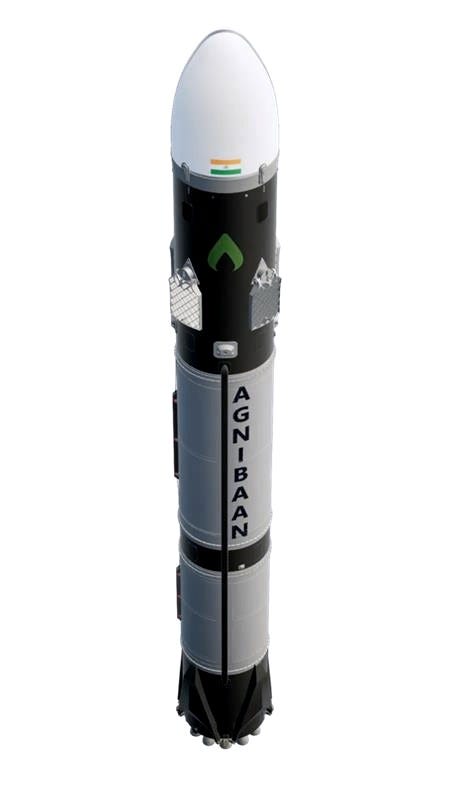
The engine, remarkable as it is, exists to power a rocket. That rocket is Agnibaan — Sanskrit for “arrow of fire” — an 18-meter, two-stage orbital launch vehicle designed for the age of small satellites.
Agnibaan weighs 14,000 kg at liftoff and can deliver 100 kg to a 700 km Low Earth Orbit in its baseline configuration. But the number that matters most isn’t the headline payload figure. It’s the configuration flexibility.
The first stage of Agnibaan can be clustered with 4, 5, 6, or 7 Agnilet engines, depending on what the customer actually needs to launch. Four engines for a 30 kg satellite. Seven for the full 100 kg. Agnikul’s in-house autopilot software reconfigures dynamically for each engine count without a software rewrite. The rocket scales to the mission, not the other way around.
This matters because of how launch costs actually work. If you’re a startup that built a 40 kg Earth observation satellite, you don’t need — or want — to pay for the same rocket as a customer launching 100 kg. With Agnibaan’s modular engine cluster, you pay only for the engines your payload requires. The economics follow the payload, not the vehicle.
Think of it as the airline seat pricing model applied to space launches: you book the seat you need, not the whole plane.
Dhanush: The Launchpad That Fits on a Truck
Agnibaan has a second trick that traditional rocket operators simply cannot match: its launchpad is mobile.
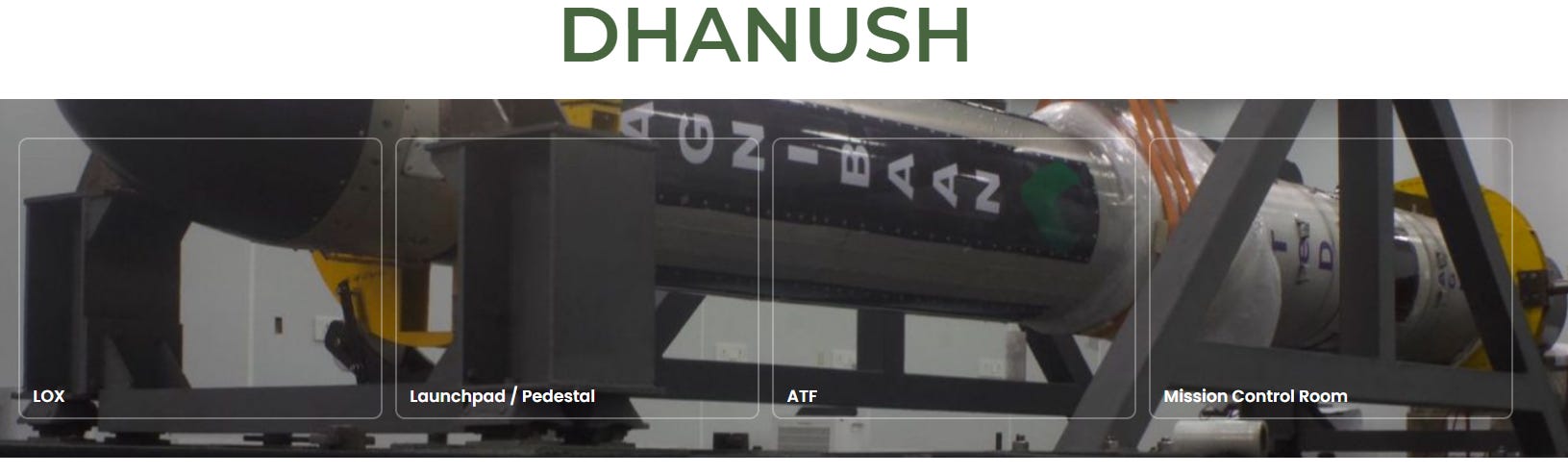
Dhanush (meaning “bow” — completing the archery metaphor) is India’s first private launchpad, and it’s dimensioned specifically to meet highway transport regulations. The entire launch system — pedestal, Mission Control Center, LOX storage, ATF storage, ground support equipment — can be disassembled, loaded onto flatbed trucks, and moved to any launch site on Earth.
Why does this matter?
The orbital mechanics of satellite launch depend heavily on launch latitude. If you want to deploy a satellite into an orbit inclined at 40 degrees to the equator, launching from 13° N (Sriharikota) wastes significant fuel on orbital plane changes that a launch from 40° N would avoid entirely. This orbital geometry premium can add 10–30% to your launch cost when you’re locked into a fixed launch site.
With Dhanush, Agnikul can move the launchpad to the optimal latitude for each customer’s mission. This geographic flexibility can reduce launch costs by up to 30% per mission — a meaningful competitive advantage when you’re trying to undercut SpaceX’s rideshare pricing by 20–25%.
The Indian Space Policy 2023, which permitted 100% FDI in space activities and opened ISRO’s facilities to private players, made this possible. Before the policy change, Agnikul was planning to launch from Alaska — because no private launchpad was permitted in India. The policy reform that enabled Agnikul’s Sriharikota presence is the same policy that will allow them to move Dhanush wherever the physics demands.
Part IV: May 30, 2024 — Four Attempts and a Tuesday Morning
At 07:15 IST on May 30, 2024, after four previous aborted attempts due to ground system anomalies, Agnibaan SOrTeD (Sub-Orbital Technology Demonstrator) lifted off from Dhanush at the Satish Dhawan Space Centre in Sriharikota.
The rocket climbed to approximately 8 kilometers over 66 seconds of powered flight, executed a programmed pitch-over maneuver, compensated for atmospheric wind shear at 60 seconds, and then arced gracefully into the Bay of Bengal.
In those 66 seconds, four things happened for the first time in human history:
A single-piece, fully 3D-printed rocket engine powered a flight. Not partially printed. Not printed and welded. One piece, printed in a single run, burning LOX and jet fuel at 25 kN of thrust.
India successfully flew a semi-cryogenic rocket engine — a propellant combination that had never flown on an Indian vehicle before.
A private Indian company launched from its own private launchpad — the first time a non-government entity operated launch infrastructure from Indian soil.
A space vehicle flew on Linux. Agnikul’s avionics use Linux-based flight computers and Ethernet internal communication — a modern software-defined architecture versus the hardwired legacy avionics that have defined spaceflight since the Apollo era.
The team watching from Mission Control felt all of this at once. Co-founder Moin SPM described the aftermath simply: “Too many emotions... the energy from that day has been infectious.”
And then came the realization that every rocket engineer who has ever worked on an expendable vehicle eventually faces. Watching Agnibaan’s first stage splash into the Bay of Bengal — months of engineering and days of printing, now at the bottom of the ocean — Moin said something that has stayed with me:
“Now we understand why they (SpaceX) did reusability — because it takes a lot of heart to build something and throw it in the ocean.”
The Agnilet engine’s electric pump architecture already makes reusability technically achievable. The plan is to recover the Agnibaan first stage on a barge — a world-first for a small-lift vehicle — with a target demonstration in 2027. After SOrTeD, this is no longer aspiration. It’s engineering.

Part V: The Platform Play — When the Rocket Becomes Infrastructure
Here is where Agnikul becomes something more than a launch company.
The upper stage of Agnibaan — after it deploys a payload and its job is nominally done — is currently discarded. In the industry, this is called the problem of “space debris.” In Agnikul’s engineering language, it’s an opportunity.
Sooraj is Agnikul’s patented orbital platform technology. Instead of deorbiting the spent upper stage, Sooraj integrates solar panels and communication arrays into the stage design, allowing it to remain in LEO as a functioning satellite bus — a power-generating, communication-capable platform in orbit, at zero additional launch cost.
Someone needs to deploy hardware on it.
Enter NeevCloud, an Indian sovereign AI cloud company. They have partnered with Agnikul to host India’s first space-based AI data center modules on the Sooraj platform. The pilot mission is scheduled for before the end of 2026, with commercial operations in 2027. By 2029–2030, the plan calls for a constellation of 600+ Space Data Centre Modules in LEO.
Why does AI computing work better in orbit?
Terrestrial AI data centers face two compounding problems that are getting worse with each passing year: energy costs and cooling costs. Training and running large AI models consumes vast amounts of grid electricity, and dissipating the heat requires equally vast amounts of water and cooling infrastructure. Neither of these problems disappears — they scale with compute demand, and compute demand is growing exponentially.
In LEO, a satellite basks in near-continuous solar irradiance. Cooling is passive — the vacuum of space is an infinite heatsink. And for AI inference workloads (which require reading data, processing it, and returning an answer), the reduced latency of edge processing from orbit offers real advantages for applications like autonomous vehicles, drone surveillance, and remote sensing.
There’s also a dimension of data sovereignty. Processing defense, financial, and government AI workloads on a Sooraj module means that data never touches a foreign data center. It never traverses undersea cables subject to foreign jurisdiction. It computes in orbit, under Indian control.
When Srinath Ravichandran, co-founder of Agnikul, describes this evolution, he frames it with characteristic clarity: “That’s the next step for a space transportation company — you build, launch, recover, and then extend into orbit.”
Agnikul is not just an Uber for LEO. It’s building the orbital equivalent of Amazon Web Services — the cloud infrastructure layer for space.
Part VI: The Numbers Behind the Dream
The global space launch services market is worth $16.4 billion in 2024 and is projected to reach $46.1 billion by 2033 — a CAGR of 11.28%. India currently captures about 2.9% of global launch revenue, expected to grow to $1.66 billion by 2030. Optimistic analysts believe India could capture 15–20% of the global space market over the next decade.
The underlying demand driver is satellites. An estimated 20,000 satellite launches are planned globally by 2030. Agnikul’s target: 50 launches per year by 2028, scaling to 100 per year by 2030.
To understand what it takes to get there, consider the factory math. Rocket Factory-1 at IIT Madras currently runs one to two Agnilet engine prints per week. To reach 50 rockets a year, Agnikul is building the 350-acre Agnikul Space Campus in Kulasekarapattinam (Tamil Nadu coast) — an end-to-end integrated facility for engine manufacture, rocket assembly, and launch. When this campus is operational, Rocket Factory-1 at IIT Madras becomes the prototype that proved it was possible. Kulasekarapattinam becomes the production line.
The funding structure reflects investor confidence: $67 million raised as of mid-2024, a November 2025 round adding another ₹150 crore ($17 million), and a current valuation of over $500 million — making Agnikul one of India’s most valuable space-tech startups before their first orbital flight.
Part VII: The 3D Printing Inflection Point in Aerospace
I want to step back and zoom out, because Agnikul’s story is not just about one company. It’s about a fundamental inflection point in how humanity builds machines.
For most of human history, manufacturing capability correlated directly with capital investment. To build a complex metal structure, you needed expensive machine tools, skilled labor, and supply chains optimized over decades. This is why aerospace manufacturing has historically been concentrated in wealthy nations with deep industrial bases — the US, Russia, Europe, Japan.
3D metal printing changes the capital barrier. A serious metal additive manufacturing facility can be established for $5–20 million in equipment, in a building that fits on a university campus. This is exactly what Agnikul did.
The deeper implication: any nation with engineering talent and access to industrial metal printers can now compete in rocket manufacturing. The barrier to space-adjacent technology has been compressed by an order of magnitude.
India is particularly well-positioned to exploit this inflection point. World-class engineering education (IIT system), a cost-competitive manufacturing ecosystem, IN-SPACe’s enabling regulatory framework, ISRO’s decades of institutional knowledge, and a growing pool of space-focused venture capital have created the exact conditions for Agnikul’s emergence.
The “Gurukul” in Agnikul’s name — the ancient Indian institution for transmission of knowledge through mentorship — turns out to be exactly right. What they built is a new kind of learning institution: one that translates 50 years of aerospace engineering knowledge into 72-hour print cycles.
So What?
The “Book My Launch” button on Agnikul’s website is not a marketing gimmick. It is a philosophical statement about what access to space should mean in 2026.
When Uber launched in 2009, the taxi industry said it was impossible — regulatory hurdles, safety concerns, the complexity of coordinating drivers and riders at scale. What Uber actually did was apply software and a consumer UX to a logistics problem that had always been solvable but had never been framed correctly.
Agnikul is doing the same thing to rockets. The question is no longer “can we launch a rocket?” The question is “what does a customer need to get their payload to the right orbit, at the right time, at a price that makes sense?”
And the answer is: a semi-cryogenic engine printed in four days from a single piece of superalloy, clustered in whatever configuration the payload requires, launched from a mobile pad positioned at the optimal latitude for the mission, by a company that will have your rocket ready in two weeks from contract signing.
The second validation arrives in 2026, when Agnibaan carries 100 kg — and then 300 kg — to LEO. The third is a barge landing in 2027 that would make Agnikul the first small-launch company to recover a booster at sea. The fourth is 600 orbital AI data centers by 2030.
For those of us who have been watching India’s space sector since the days of PSLV-C11 and Chandrayaan-1, Agnikul feels like the moment the second act begins. ISRO built the foundation. IN-SPACe cleared the regulatory runway. And now a company born in a combustion research lab at IIT Madras is printing the future.
One engine at a time. One piece. No welds.
The Numbers at a Glance
What’s Next for Agnikul
2026
Q1/Q2: First orbital Agnibaan launches (100 kg, then 300 kg to LEO)
Before end 2026: NeevCloud pilot orbital AI data center module launch
2027
First booster barge recovery attempt (world-first for small-lift class)
NeevCloud commercial orbital data centers begin operations
2028
50 launches per year target
Kulasekarapattinam space campus operational
2030
100 launches per year
600+ orbital edge data center modules (NeevCloud/Sooraj constellation)
The Polymathic Pursuit explores intersections: art & science, love & logic, human & artificial intelligence. If this India Positive deep dive connected with you, forward it to one person who needs to know that India is printing rockets.
— Rohit Nalluri