

Week 44 • Oct 27–Nov 2, 2025
+ND+A This Week
This week embodied India’s multi-pronged strategy for technological sovereignty and sustainable development. As Prime Minister Modi celebrated the Vikram 32-bit processor, India’s first fully indigenous semiconductor achievement, the nation simultaneously demonstrated mastery in digital payments, infrastructure delivery, and environmental conservation. The convergence of these milestones reflects a broader transformation: India is no longer importing solutions but designing, building, and scaling them at national scale.
Energy & Green Transition
India’s Solar Momentum Accelerates Into Q4 2025
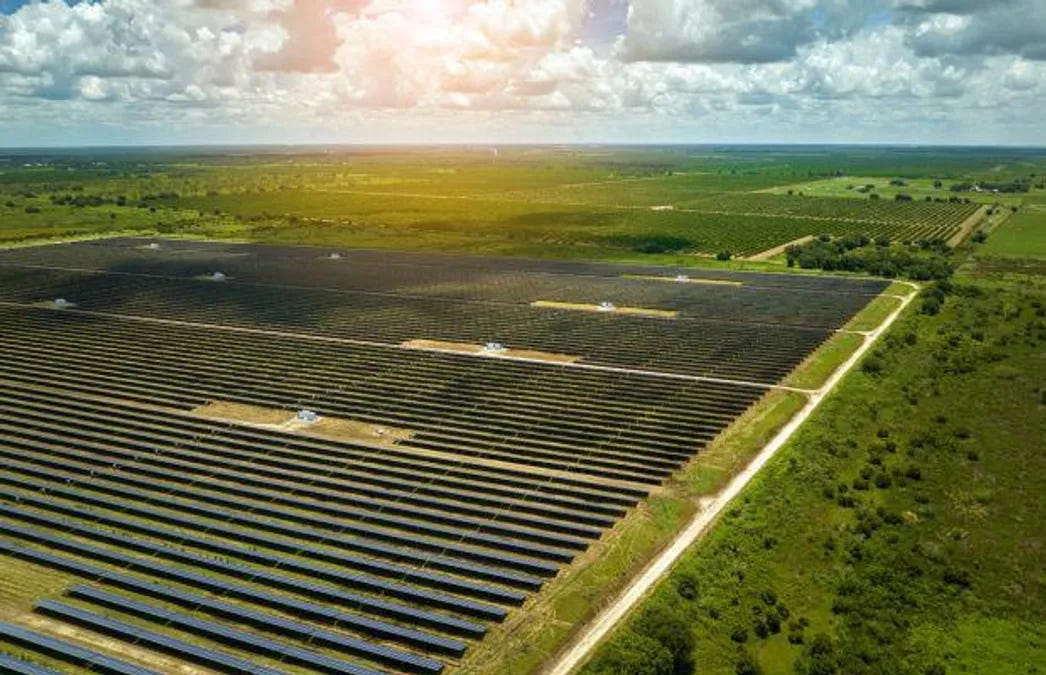
The renewable energy sector’s explosive growth trajectory continued unabated. India added 27 GW of renewable energy capacity during April–August 2025, with 20 GW commissioned through August and another 142 GW under construction across the nation. This represents a 31% year-over-year increase in solar capacity additions for the first half of 2025, with 11.3 GW added in Q2 2025 alone—a 145.4% surge compared to Q2 2024.
Solar now accounts for 64% of all new power capacity additions, cementing its role as India’s primary decarbonization engine. What distinguishes this quarter is the dramatic collapse in energy storage costs. Recent solar-plus-storage tenders have yielded tariffs as low as ₹2.7–2.76 per kWh, making renewable baseload power commercially viable for the first time.
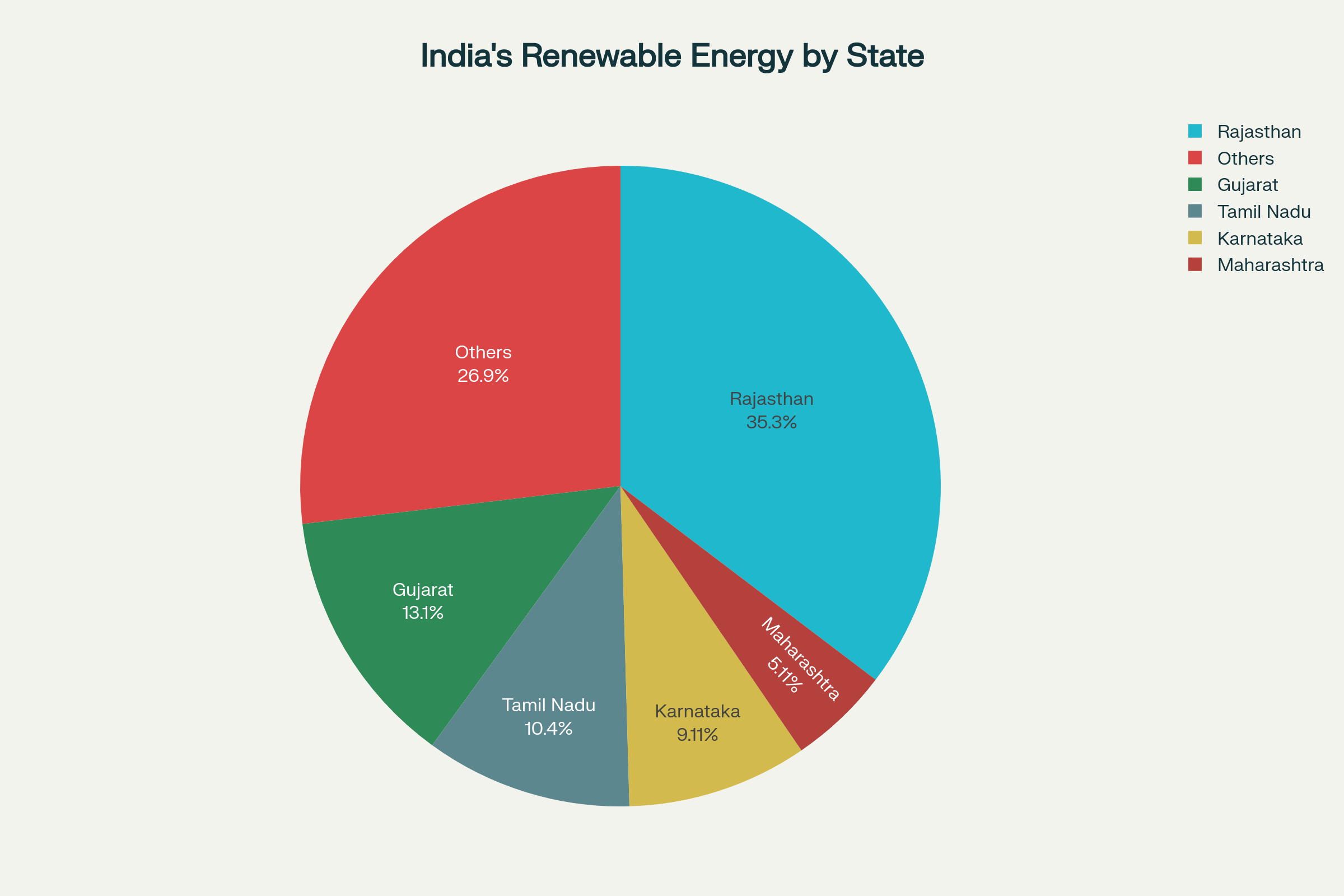
State-level performance reflects geographic diversification (top 5 states):
Rajasthan: 15.9 BU (billion units)
Gujarat: 5.9 BU
Tamil Nadu: 4.7 BU
Karnataka: 4.1 BU
Maharashtra: 2.3 BU
Bihar’s renewable ambitions merit attention: the state aims for 23.96 GW of renewable capacity and 6.1 GW of energy storage by 2029–30, alongside attracting ₹1.5 trillion in investments and generating 125,000 jobs.
While its one thing to carpet the country in solar panels, building the infrastructure that connects that sun-juice to consumers is a whole different ball game.
With 29 million smart meters already installed nationally through the National Smart Grid Mission, India is building the digital backbone required to manage variable renewable energy at scale.
Large hybrid and round-the-clock renewable projects are moving into execution, supported by the government’s ₹2.4 lakh crore transmission plan connecting renewable-rich regions with demand centers. Clean energy infrastructure revolution in action!
Defense Goes Green
The Indian Army is leading defense sector sustainability with remarkable green initiatives! The army has completed around 70 solar projects generating 85 MW of cumulative capacity, with installations even at the high-altitude Siachen Glacier. Plans are underway to introduce 60-70 electric buses, 400 electric cars, and 425 electric motorcycles across 30 stations by end of 2025.
Semiconductors & AI

Prime Minister Modi unveiled the Vikram 3201, a 32-bit microprocessor designed and fabricated entirely by ISRO’s Semiconductor Laboratory (SCL), at Semicon India 2025 in early September—with commercial production confirmed for December 2025. This marks a watershed moment for India’s semiconductor self-reliance.
The private sector is also contributing to the semiconductor push. Tata Electronics is constructing a massive $11 billion semiconductor fabrication unit in Dholera, Gujarat in collaboration with Taiwan’s Powerchip, designed to produce up to 50,000 wafers per month using advanced 28nm technology crucial for automotive, mobile, and AI applications, with commercial production anticipated by late 2026.
Meanwhile, Micron Technology’s Assembly, Testing, Marking, and Packaging facility in Sanand, Gujarat is on track to become operational by December 2025, representing a $2.75 billion investment in India’s semiconductor packaging ambitions.
Adding to this momentum, a collaboration between CG Power, Renesas, and Stars Microelectronics launched India’s first full-service OSAT facility in Sanand in August 2025, with plans to produce 15 million chips daily. Spectacular semiconductor surge, with the state of Gujarat leading the way.
India’s AI & Startup Ecosystem
In the last 10 days of this month, nine Indian startups secured over $421 million across diverse sectors, signaling robust investor confidence in India’s innovation pipeline. The week’s headline deal was Uniphore’s $260 million raise, positioning the AI platform as a unicorn competitor. Other notable closes included:
The Eye Foundation (healthtech): $75 million
UnifyApps (enterprise software): $50 million
Wonderland Foods (healthy snacking): $15.94 million
CapitalXB (trade finance): $15 million
Earlier in October, Zepto (quick commerce) raised $450 million at a $7 billion valuation, while Dhan (retail investing platform) turned unicorn after securing $120 million, and Dezerv (wealth management) raised $40 million in a Series C round. The festive season’s confluence with regulatory clarity has unleashed significant capital deployment.
Infrastructure

Delhi–Mumbai Expressway Reaches 80% Completion; Travel Time Cut to 10–12 Hours
The 1,386-km Delhi–Mumbai Expressway, India’s largest greenfield expressway project, crossed an historic milestone with 80% of the corridor now operational. The Delhi–Vadodara stretch (845 km) has seen 650 km operational, with another 35 km fully completed but awaiting inauguration. In the remaining 122 km, 90% of work is complete, and the critical Kota tunnel—cutting through the Mukundra Hills to avoid congestion—is nearing completion.
The expressway integrates PM Gati Shakti’s digital infrastructure masterplan, connecting 44 ministries and 36 states on one platform. This coordination is already visible in parallel projects: the National Highways Authority is rolling out 10,000 km of optical fibre cable alongside highways to support 5G/6G connectivity and connected vehicle ecosystems.
In parallel, Karnataka is leading India’s electric vehicle charging infrastructure revolution with 5,765 public charging stations—the highest of any Indian state as of end-2025. This infrastructure is critical for supporting India’s EV transition and reducing range anxiety among potential users.
Environment & Conservation
India Advances to 9th Globally in Forest Area; Maintains 3rd in Annual Forest Gains
India achieved a significant global environmental milestone, climbing from 10th to 9th position in total forest area, according to the FAO’s Global Forest Resources Assessment (GFRA) 2025, released in Bali last week. More impressively, India maintained its 3rd position globally in annual forest area gain, reaffirming its commitment to sustainable forest management.
National Red List Roadmap Launched for Evidence-Based Conservation
Complementing forest gains, India unveiled its National Red List Roadmap and Vision 2025–2030 at the IUCN World Conservation Congress 2025 on October 8. The framework, developed by the Zoological Survey of India (ZSI) and Botanical Survey of India (BSI) in collaboration with IUCN, will guide systematic assessment of India’s 8% of global fauna and 8% of global flora. India harbors over 104,000 faunal species, 18,000+ flowering plants, and 20,000 marine species.
Digital Payments: A Diwali Milestone
UPI Transactions Surge to ₹23.5 Lakh Crore in October; Record Single-Day Peak
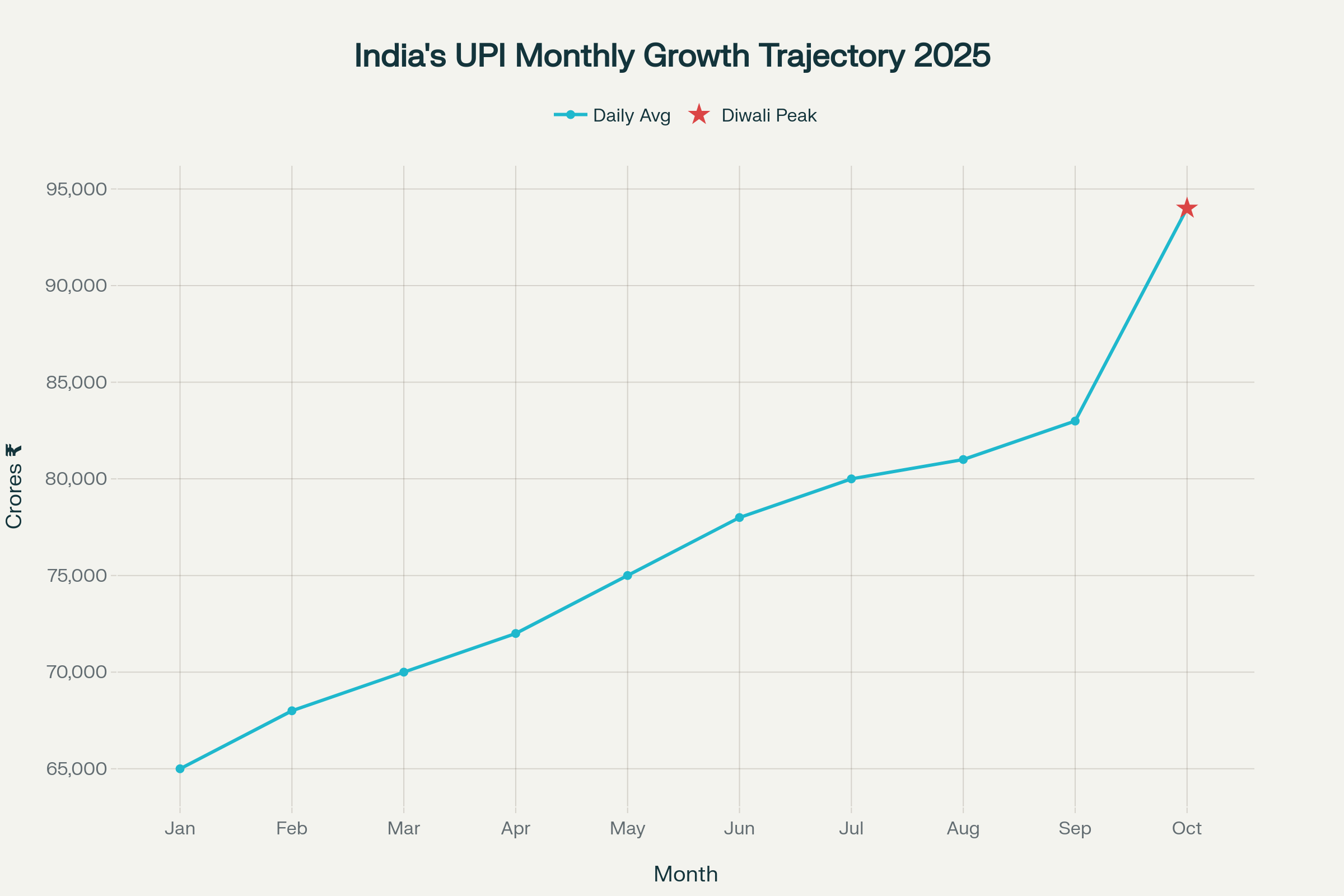
India’s digital payment ecosystem reached historic scale during the October 2025 festive season. UPI processed ₹23.5 lakh crore across 16.58 billion transactions for the entire month, with an average daily transaction value of ₹94,000 crore—a 13% increase from September’s ₹82,991 crore daily average. On October 18 (Diwali eve), UPI shattered previous records with 754 million transactions totaling ₹1.02 lakh crore in a single day.
Year-to-date, India’s UPI ecosystem grew by 35% in H1 2025 (January–June), reaching 106.36 billion transactions. More significantly, merchant payments (P2M) expanded faster than person-to-person (P2P) transfers, growing 37% to nearly 67 billion transactions versus 31% for P2P. This reflects structural deepening of digital payments across retail, e-commerce, and service sectors.
UPI now accounts for ~85% of all digital transactions in the country. India is going cashless!
ISRO

ISRO Chairman V. Narayanan announced on October 22, 2025 that India’s space sector has achieved over 200 significant milestones in 2025 alone—one of the most prolific years in the nation’s space history. A few highlights for now, with the promise that we will explore ISRO’s achievements and potential through our monthly deep dive issue, later this month:
The Aditya L1 Mission collected and released ~15 terabytes of scientific data about the sun to the global scientific community.
Through the Space Docking Experiment (SpaDex), ISRO successfully docked two small satellites in orbit, making India only the fourth nation in the world to achieve this complicated dance in vacuum.
The cabinet approved the establishment of a third launch pad at Sriharikota, aimed to be completed in 4 years. This directly aligns with India’s space ambitions as well as allowing it to expand its already envious capabilities in launching satellites for other countries.