Energy & Green Transition
India Enters ‘Clean, Green Highways’ Era with Bio-Bitumen
CSIR–Central Road Research Institute (CSIR‑CRRI) and CSIR–Indian Institute of Petroleum (CSIR‑IIP) have developed indigenous bio-bitumen via pyrolysis of farm residue, formally marking the start of an era of “clean, green highways” in India. The technology converts agricultural waste into a bio-binder for roads, along with gaseous fuel, bio‑pesticide fractions, and high‑grade carbon—making the process emission‑free and multi‑product. CSIR leadership notes that India has become the first country in the world to take bio-bitumen technology to industrial and commercial scale within the same year, with economic potential to replace imported bitumen worth ₹25,000–30,000 crore annually.
This Week’s Low-Carbon Milestones:
Bio-bitumen trial stretch: 100‑metre pilot laid on the Jorabat–Shillong Expressway (NH‑40) in Meghalaya, validating field performance.
Import substitution potential: Up to half of India’s bitumen demand—currently about 50% import-dependent—could gradually shift to domestic bio-bitumen.
Renewables and EV Momentum Continue
India’s renewable energy capacity stands at over 262 GW, with solar alone contributing about 133 GW, now forming more than half of total installed power generation capacity. Policy focus remains locked on the 500 GW renewable capacity target for 2030, reinforcing India’s role in global decarbonisation. On the transport side, India’s public EV charging network has expanded to more than 27,000 chargers, including nearly 9,000 installed under FAME‑II, supporting a 77% year‑on‑year rise in electric car sales to around 176,800 units in 2025.
Green Hydrogen Pipeline Strengthens
Under the National Green Hydrogen Mission, a ₹100 crore funding programme has been launched by BIRAC to support pilot‑scale biomass‑to‑hydrogen projects, giving consortia up to 18 months to build and demonstrate new pathways from agricultural residues and other feedstocks.
Technology & Digitalization
Silk–Collagen Gel Redefines Chronic Wound Care
Scientists at CSIR–Central Leather Research Institute (CLRI) have developed a silk fibroin–based gel blended with a synthetic collagen‑like protein that shows strong promise in treating chronic and fragile‑skin wounds. The material is stable at room temperature, patient‑friendly, and designed to promote faster tissue repair while avoiding the instability and allergy risks of animal‑derived collagen, making it especially suitable for rural and low‑resource settings where cold chains are difficult. Early studies show improved cell growth and tissue regeneration, and the team is now preparing for clinical trials on patients with chronic wounds, burns, and age‑related skin fragility.

Startup Ecosystem Maintain High Velocity
National Startup Day 2026 marked 10 years of Startup India, highlighting a decade of policy support that has enabled tens of thousands of DPIIT‑recognised startups across deep‑tech, fintech, climate, and health verticals.
Data Island - Startup Capital Flows This Week
Total funding: Indian startups raised about $269 million across multiple deals this week.
Sector highlights: Consumer health brand Pee Safe and deep‑tech venture EtherealX featured among notable fundraises, signalling continued investor appetite for both B2C and frontier technology plays.
Economy & Infrastructure
Bio-Bitumen Links Farm Economies to Highway Capex
The bio-bitumen breakthrough is not only an environmental innovation but also an economic strategy to convert farm residue into a value‑added input for India’s large road‑building pipeline. By integrating this material into national highway specifications over time, India can reduce stubble burning, cut bitumen imports, and create new revenue streams for farmers and local aggregators, tightly coupling rural livelihoods with infrastructure spending.
Rail and Road Projects of ₹3,250+ Crore Launched in West Bengal
On January 16–17, the Prime Minister inaugurated and laid foundation stones for multiple rail and road projects worth more than ₹3,250 crore in and around Malda, West Bengal. The package includes doubling and electrification works, station upgradation, and key National Highway sections, all aimed at decongesting corridors, improving freight movement, and enhancing regional connectivity for eastern India.
Watershed Projects and Rural Water Security
The Union Rural Development Minister launched watershed projects worth around ₹400 crore in Bihar, focusing on soil moisture conservation, groundwater recharge, and climate‑resilient agriculture in drought‑prone districts. Complementing this, Aakar Charitable Trust reported significant improvements in groundwater levels across over 100 villages through scientifically designed recharge wells and community‑managed watershed structures, demonstrating scalable models for NGO–government collaboration.
Environment & Conservation
River and Wetland Biodiversity Efforts Continue
Under the Namami Gange Mission, the Jal Shakti Ministry has launched specialised programmes for aquatic biodiversity conservation, including the Indian Skimmer Conservation Project implemented by the Bombay Natural History Society along key river stretches. In parallel, the Asian Waterbird Census 2026 is mobilising citizen scientists across wetlands to monitor migratory species, generating granular data that informs habitat protection and Ramsar‑site management.
Data Island – Conservation At Scale
Tiger reserves with global CA|TS accreditation: 23 across India, aligning with international best practices.
Elephant reserves: 33 reserves across 14 states, covering about 80,777 km² of critical habitat and corridors.
Geopolitics & Defense
India Unveils BRICS 2026 Lotus Logo and Website
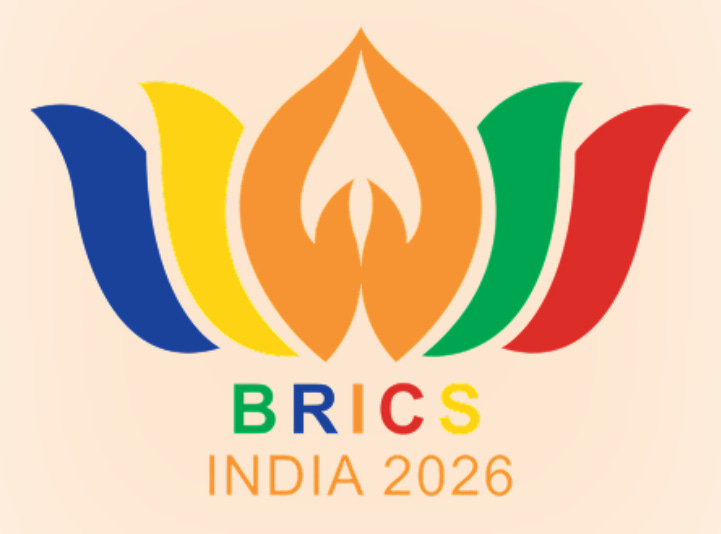
India launched the official logo and website for its BRICS Presidency 2026 in New Delhi, with External Affairs Minister S. Jaishankar outlining priorities for innovation, capacity‑building, and sustainable development. The logo features a lotus whose multicoloured petals represent the five founding BRICS members, with inner petals forming two hands joined in a Namaste, symbolising respect, unity, and India’s civilisational identity. The digital platform will serve as a central hub for summit information, ministerial meetings, and people‑to‑people initiatives throughout India’s chairship.
Army Declares 2026 “Year of Networking and Data Centricity”
The Indian Army has designated 2026 as the “Year of Networking & Data Centricity”, signalling a strategic shift toward integrated networks, real‑time data flows, and indigenous digital platforms across formations. This initiative focuses on secure communications, decision‑support tools, and sensor‑to‑shooter integration, strengthening operational readiness while deepening the role of Indian industry in defence digitalisation.
Quote of the Week
Bringing you one powerful quote a week from the depths of India’s many cultures and languages.