

On a wind-scoured plateau in Gujarat, new turbine blades are catching the subcontinent's strongest gusts. Three hundred kilometers away in Hyderabad, engineers are bolting together India's first private orbital rocket. And in New Delhi's semiconductor clean rooms, technicians are etching the circuitry that will power the next generation of Indian electronics. This is what one week of India's forward march looks like.
1. Deep Science & Indigenous Innovation
IIT Madras Pushes Lab-to-Market Pipeline at Technology Summit 2026
IIT Madras brought its research showcase to New Delhi on May 5, hosting the Technology Summit 2026 under the theme of transforming lab breakthroughs into market-ready products. Union Education Minister Dharmendra Pradhan used the platform to underscore India's ₹1 trillion push to build a research and innovation ecosystem that can compete globally.
What makes this more than another academic conference is the institute's track record. IIT Madras has consistently ranked among India's top technology transfer performers, spinning out startups and licensing patents at a pace that most peer institutions struggle to match. When research institutions shift from measuring success in citations to measuring it in products shipped, the entire innovation pipeline accelerates — and the summit is a clear signal that India's elite engineering schools are no longer content with publishing papers. They want to build companies.
2. Energy & The Green Transition
India Adds Record 6.05 GW of Wind Capacity in FY26, Surging 46%
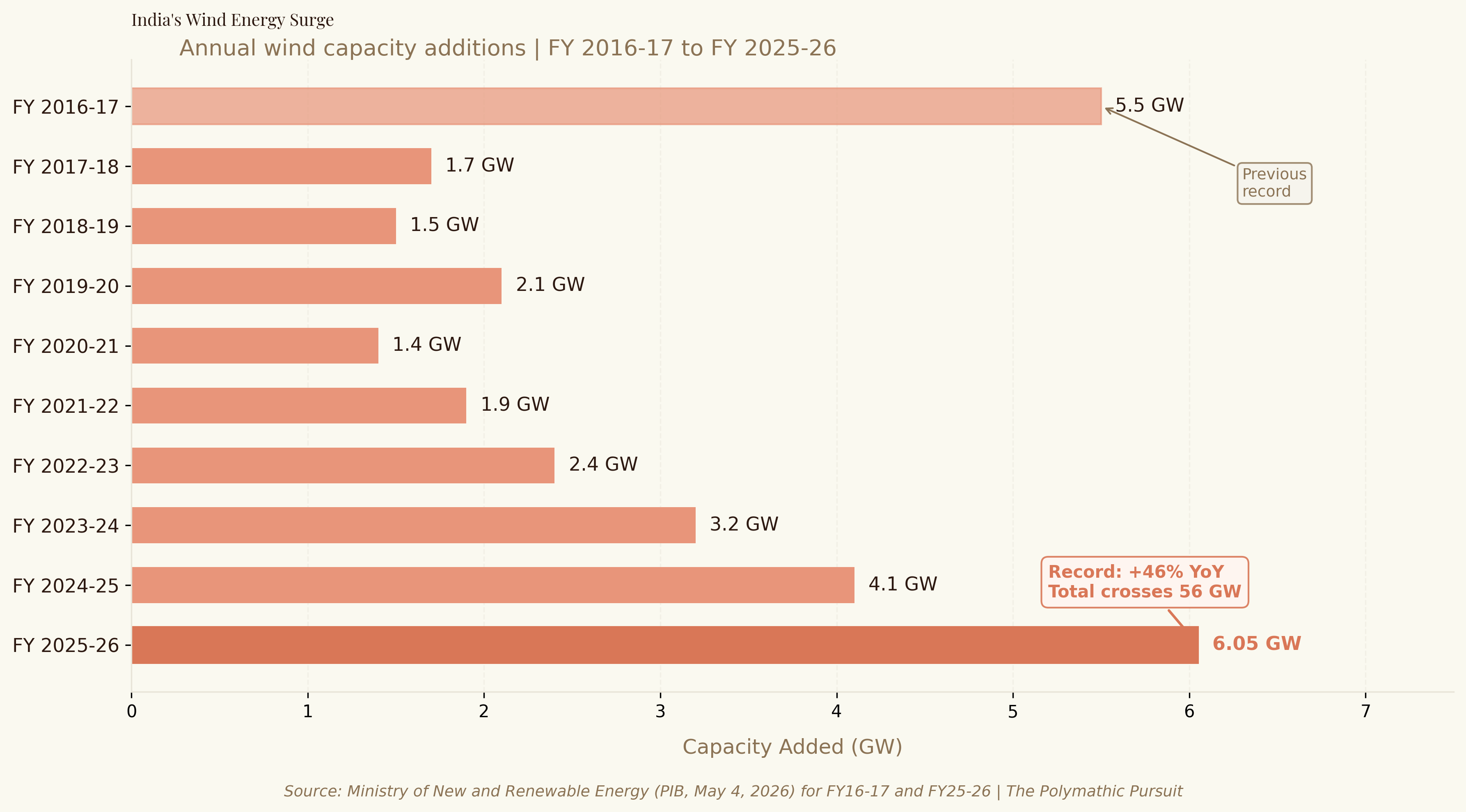
India installed a record 6.05 GW of wind power capacity in FY 2025-26, shattering the previous peak of 5.5 GW set way back in FY 2016-17. The Ministry of New and Renewable Energy announced the milestone on May 4, noting that total installed wind capacity has now crossed 56 GW.
Gujarat, Karnataka, and Maharashtra led the capacity additions. The surge was driven by a mature project pipeline, improved transmission connectivity, and the growing popularity of wind-solar hybrid installations that squeeze more generation out of the same land and grid connection.
The 46% year-over-year jump matters because wind has historically been the laggard in India's renewable story. Solar stole the spotlight for a decade. Now wind is roaring back. At this pace, India's target of 500 GW of non-fossil fuel capacity by 2030 looks less like ambition and more like arithmetic — every gigawatt of wind added is a gigawatt of coal that does not get built, and the states that moved early on wind infrastructure are now reaping dividends the laggard states can copy.
MNRE Backs Green Hydrogen Pilots for Steel Decarbonization
The Ministry of New and Renewable Energy approved three pilot projects to inject green hydrogen into steel production, backed by ₹3.47 billion in government funding. The projects, expected to commission within three years, will test hydrogen injection in blast furnaces and direct reduced iron units.
Steel is one of the hardest sectors to decarbonize. It accounts for roughly 8% of global emissions, and India's steel industry is among the world's largest. Green hydrogen offers a pathway to near-zero emissions steel, but the economics have been prohibitive. These pilots are designed to prove the technical viability, begin driving down costs, and if they succeed, India could become the first major steel producer to commercialize green hydrogen-based production. That is not just a climate win — it is a massive export advantage in a world where carbon border taxes are becoming the norm.
3. Infrastructure, Agriculture & Economy
RBI Holds Rates Steady, Upgrades FY26 GDP Growth to 7.6%
The Reserve Bank of India held the repo rate at 5.25% in its first bi-monthly meeting of FY 2026-27 on May 7, with the six-member Monetary Policy Committee voting unanimously for the pause. Governor Sanjay Malhotra upgraded the FY26 GDP growth forecast to 7.6%, a bump from earlier estimates of 7.3-7.4%.
The upgrade comes with a warning. Malhotra flagged the Strait of Hormuz conflict as a material risk, noting that India imports over 85% of its crude and routes roughly half through that vulnerable chokepoint. Higher oil prices and a weaker rupee could complicate the inflation-growth balance. India's forex reserves at $697.1 billion provide an 11-month import cushion, enough to absorb short-term shocks, and the RBI is clearly betting that domestic growth momentum is strong enough to withstand global volatility. If the 7.6% forecast holds, India will remain the world's fastest-growing major economy by a wide margin. But the Hormuz risk is real, and energy security deserves more attention than it gets in India's macroeconomic narrative.
4. Digital Public Infrastructure & Tech
Cabinet Clears Two Semiconductor Units Worth ₹3,936 Crore in Gujarat
The Union Cabinet approved two new semiconductor projects under the India Semiconductor Mission on May 5, with a combined investment of ₹3,936 crore. Both facilities will be built in Gujarat.
The projects are Crystal Matrix Limited's GaN-based mini/micro-LED display facility and Suchi Semicon Private Limited's semiconductor packaging unit. Together they are expected to create 2,230 skilled jobs. The approvals take the total number of sanctioned ISM projects to 12, with cumulative investments approaching ₹1.64 lakh crore.
Gallium Nitride (GaN) technology is the quiet revolution in semiconductors. It enables faster switching, higher power efficiency, and smaller form factors than traditional silicon. A commercial GaN facility in India puts the country on the map for next-generation chip manufacturing, not just legacy node packaging. Twelve projects in three years is not Silicon Valley scale, but it is credible momentum, and India's semiconductor bet is slowly converting from promise to production. The question now is whether the execution timeline matches the announcement pace.
6. Defense
HAL Order Book Swells to ₹2.54 Trillion
Hindustan Aeronautics Limited [NSE: HAL] ended FY 2025-26 with an order book of ₹2.54 trillion, up from ₹1.89 trillion a year earlier. The flagship orders include 97 LCA Tejas Mark 1A fighters and 156 LCH Prachand attack helicopters, together worth ₹1.3 trillion.
CMD C.B. Ananthakrishnan revealed that HAL is on the verge of securing its first major export order, a milestone the company has pursued for decades. The company also aims to deliver 83 Tejas units one year ahead of the contracted 2028-29 schedule, a sign that India's aerospace manufacturing base is maturing faster than planned. A ₹2.54 trillion order book means nearly a decade of revenue visibility for India's largest defense manufacturer, and more importantly, it validates the Make in India defense strategy. When foreign governments start buying Indian fighter jets, the narrative shifts from self-reliance to global competitiveness.
7. ISRO & Space Tech
ISRO Returns to Launch Operations in May After January Setback
ISRO Chairman V. Narayanan confirmed on May 3 that the agency is returning to launch operations this month, following the January 12 PSLV-C62 anomaly that grounded India's space program for nearly four months. Multiple missions are planned for the new fiscal year.
The Integrated Air Drop Test-2 (IADT-2) for the Gaganyaan human spaceflight program is progressing on schedule, and the NavIC satellite navigation constellation remains on track. Narayanan also reiterated India's long-term ambitions: lunar missions, a space station by 2028, and active partnerships with roughly 60 countries. Four months is a long gap for an agency that operates on tight budgets and tighter timelines, so ISRO's ability to recover quickly from the PSLV anomaly, diagnose the root cause, and return to the launchpad is a testament to engineering discipline. In space, resilience matters as much as innovation.
Skyroot Becomes India's First Space Tech Unicorn
Skyroot Aerospace became India's first space tech unicorn on May 7, raising $60 million at a $1.1 billion pre-money valuation. The round was co-led by Sherpalo Ventures and GIC, with structured debt from BlackRock-managed funds. Alphabet board member Ram Shriram will join Skyroot's board.
The Hyderabad-based startup is preparing for the maiden orbital launch of its Vikram-1 rocket in June 2026, which would make it the first Indian private company to reach orbit. The rocket was already transported to Sriharikota in April for final integration and flight qualification. A $1.1 billion valuation for an Indian space startup is not just a funding milestone — it is proof that global capital believes India can build a private space ecosystem to rival what the United States has cultivated over two decades. The Vikram-1 launch in June will either validate that bet or recalibrate it.