

⚡ Clean Energy & Climate
India’s power capacity will double to 1,121 GW by 2035-36 — that’s the headline from the CEA’s 20th Electric Power Survey midterm review released March 19. Solar isn’t just participating in this transition; it’s leading it. The projection: 509 GW of solar (45% of total capacity), alongside 315 GW of coal (28%), 155 GW of wind, and 22 GW of nuclear.
This is structural transformation, not incremental improvement. Non-fossil fuel capacity is projected to hit 786 GW — nearly 70% of India’s installed base. The subcontinent is building not just power plants, but generational energy architecture.
Meanwhile, the government has mandated local solar wafers and ingots for all government projects from June 2028 — a hard push toward silicon sovereignty. This isn’t protectionism; it’s vertical integration at national scale. Solar manufacturing ecosystem = domestic production + supply chain resilience.
And the National Green Hydrogen Mission is moving: a tender for ~10,000 tonnes annually signals concrete procurement toward the $2/kg cost target. Green hydrogen at parity with grey — that’s when the transition becomes self-sustaining.
The through-line: India isn’t waiting for clean energy to become economical. It’s engineering the conditions where it must become economical.
🚀 Space & Technology
ISRO acknowledged 129 pieces of Indian space debris currently orbiting Earth — 23 defunct LEO satellites, 26 in GEO, 40 PSLV rocket bodies, 4 GSLV, 3 LVM3, and 33 fragments from a PSLV-C3 breakup.
This isn’t embarrassment. This is accountability as policy. India responded with the Debris Free Space Mission (DFSM) — targeting zero debris creation by 2030. ISRO now reserves extra fuel margins for post-mission disposal and has institutionalized responsible practices before regulators forced them.
This is space power with foresight — recognizing that orbital sustainability isn’t an environmental luxury but a strategic necessity. At speeds approaching 10 km/s, a single collision generates thousands of new fragments. The Kessler Cascade isn’t theoretical; it’s arithmetic.
India is acting like a leader should - before the arithmetic becomes catastrophic.
⚔️ Defence & Aerospace
Rajnath Singh called for mission-mode action to make India a global drone manufacturing hub by 2030 — citing the Russia-Ukraine and Iran-Israel conflicts as object lessons in drone-centric warfare.
“Indigenous drone production ecosystem is a must for strategic autonomy, defence preparedness and self-reliance.”
But the real headline this week: A jet engine the size of a backpack.
Dr. R. Prathapanayaka, Chief Scientist at CSIR-NAL, unveiled the NJ100 — an indigenous small turbojet engine delivering 100 kgf thrust for UAVs, drone interceptors, and compact cruise-missile class platforms. This isn’t imported technology adapted for Indian use. This is Indian engineering from first principles — a significant stride toward Atmanirbhar Bharat in advanced aerospace propulsion.
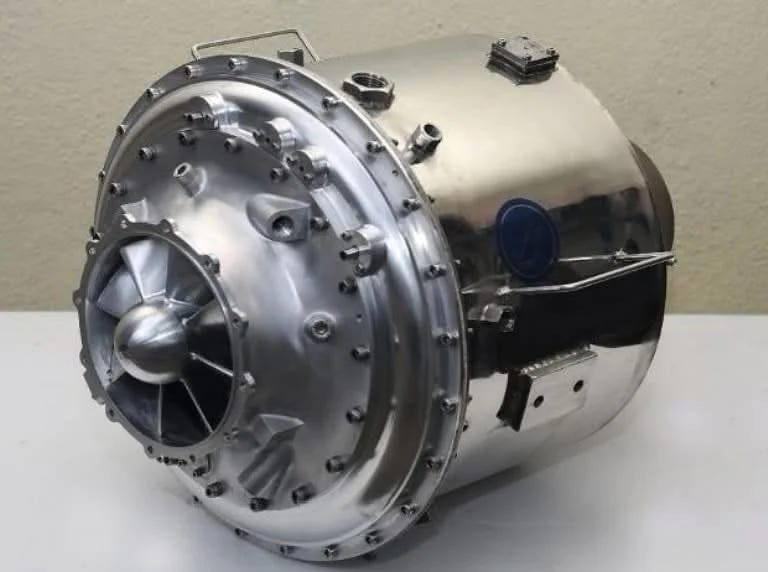
Interested in the architecture, the propulsion system, and the history of the NJ100? Leave a comment to let me know, and I will do a deep dive on it.
The NJ100 means India can power its own unmanned strike platforms without technological dependency. Propulsion sovereignty = operational autonomy.
Meanwhile, AI has reached India’s military core: From the NDA curriculum overhauled in 2022-23 to wargaming simulations to network-centric battlefield integration. A retired Lieutenant-General put it plainly:
“AI has changed how we plan, train and fight. Operation Sindoor showed these complexities.”
India’s approach: Don’t adopt AI as bolt-on advantage. Embed it into institutional DNA — from cadet training to command decisions.
🔬 CSIR Labs: Science at the Frontier
India’s Council of Scientific and Industrial Research (CSIR) had a remarkable week — demonstrating that public research institutions remain the backbone of national innovation.
CSIR-CMERI: Sal seeds to livelihoods — Scientists developed affordable, rural technologies to process sal seeds into high-value sal butter, enabling forest-based communities to generate sustainable incomes. This is innovation rooted in nature, scaled through technical rigor.
CSIR-NGRI + SRI: Geothermal energy partnership — A new MoU advances India’s geothermal energy capabilities, exploring the subcontinent’s untapped heat reservoirs for clean baseload power. Read more →
CSIR-IICT: Plastic waste to fuel — Partnering with 2 Degrees Clicon, IICT is converting plastic waste into fuel — closing the loop on polymer pollution while generating energy. Circular economy as a chemistry problem. Read more →
CSIR-IMMT: Eco-friendly high-temperature bricks — Researchers developed sustainable bricks that withstand extreme temperatures — critical for industrial furnaces, kilns, and metallurgical applications without the environmental toll of traditional refractory materials. Read more →
The pattern: CSIR isn’t doing vanity research. It’s solving India’s specific problems — rural livelihoods, waste management, industrial sustainability, aerospace autonomy — and delivering deployable solutions.
💊 Health & Science
Chiranjiv — India’s genomic health platform pushing toward personalized medicine based on DNA.
This shifts healthcare from reactive symptom-treatment to predictive genetic counseling. The implications: earlier intervention, tailored therapies, population-scale preventive health.
And the digital health infrastructure keeps expanding: AI diagnostics deployment, preventive screening advocacy, BCG’s framework for the next chapter. India’s health stack isn’t just digitizing existing systems — it’s inventing new care models.
📈 Economy & Markets
India’s startup framework received major reforms (February 2026) — Ministry of Commerce revisions aimed at “supporting innovation and strengthening the ecosystem.”
The timing matters: SEBI’s Kamlesh Chandra Varshney highlighted that post-correction valuations create attractive entry points for foreign investors — particularly from Russia and emerging market funds repositioning toward India.
Family businesses remain growth-driven but tech-cautious — Inc42’s analysis shows the opportunity: 50,000+ sizable SMEs yet to list, with SME investing poised as a major wealth creation avenue over the next two decades.
🏛️ Governance & Policy
The new Income Tax Act, 2025 takes effect April 1 — simplifying sections, reducing complexity, and reframing the relationship as “taxpayer as partner” rather than adversary. Finance Minister Sitharaman’s framing: move from enforcement to compliance through fairness.
Uttar Pradesh’s transformation completed nine years — an economy that tripled during the tenure, expressway network expansion, and a repositioning from “weak law and order” to one of India’s fastest-growing state economies. Trust and technology as “twin engines.”
And India’s West Asia diplomacy navigated the Iran-Israel conflict without taking sides — engaging all stakeholders while avoiding diplomatic adventurism. Strategic autonomy in practice. This topic is especially close to this author’s heart: stay tuned on how India is projecting incredible soft power to become the arbitrator of the world.
Subscribe to stay in the loop!