

In a concrete test bay at Hyderabad’s Scramjet Connect Pipe Test Facility, a combustor ran for 1,200 seconds on the morning of May 9. Twenty uninterrupted minutes at temperatures exceeding 2,000 degrees C, inside a full-scale scramjet designed to breathe at Mach 5-plus. The engineers from DRDO’s Defence Research and Development Laboratory watched their timers climb past every previous duration in their own programme, and by most accounts, past most programmes anywhere. Nobody called it a world record in the press release. They didn’t need to.
It was that kind of week. National Technology Day fell on May 11, the anniversary of Pokhran-II, and India’s lab ecosystem, its state energy grid, its conservation diplomats, and its semiconductor ministry all seemed to decide simultaneously that this was the moment to show receipts.
---
DEFENSE: FIRE THAT DOESN’T QUIT
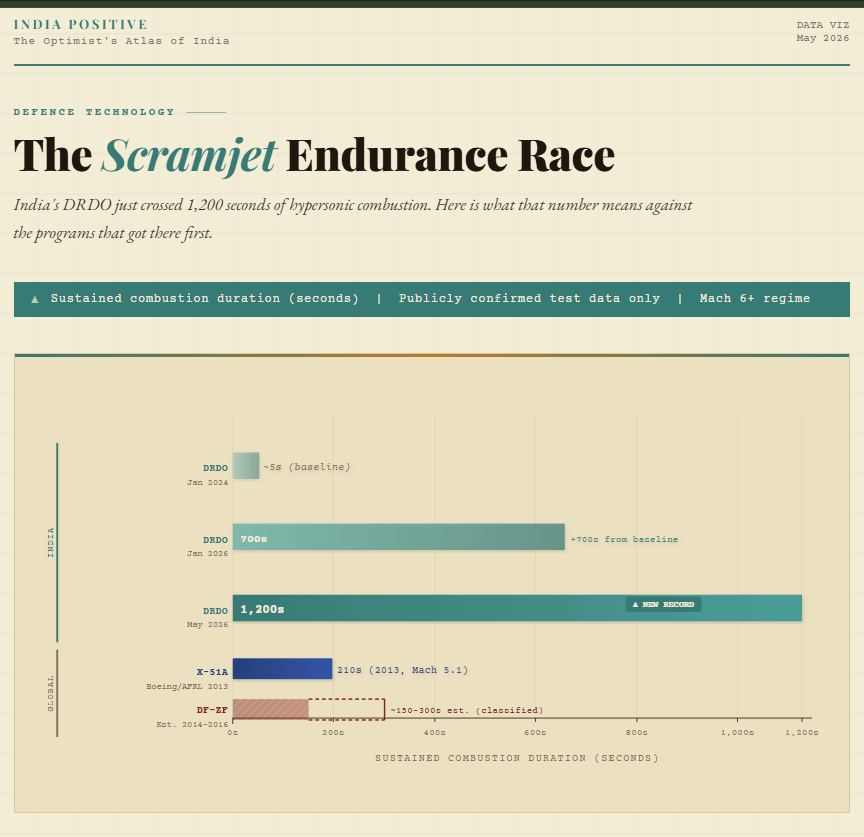
DRDO set the tempo for the entire week on May 9 with a sustained 1,200-second test of its Actively Cooled Full Scale Scramjet Combustor in Hyderabad. Four months earlier, in January 2026, the same facility had run the same combustor for 700 seconds, itself a programme milestone. The May test ran 71% longer. A scramjet has no moving parts: it compresses incoming air at hypersonic speed and burns fuel in that compressed flow. The engineering problem is that everything wants to melt. Sustaining combustion for 20 minutes means the thermal management system, the fuel injection geometry, and the active cooling circuit all held simultaneously, at scale, in a way that matters for an actual weapon system.
For reference: the US X-51 Waverider, the most celebrated Western hypersonic demonstrator, achieved roughly 200 seconds of hypersonic flight during its 2013 record run. India’s combustor test in a ground facility is not identical to flight, but the combustion physics are the same. India’s Long-Range Anti-Ship Missile (LR-AShM) hypersonic programme and its hypersonic cruise missile variant are both downstream of this combustor work. Flight trials are drawing closer.
Why Duration Is The Right Metric of Success
Scramjet speed records are theatrical. Every nation can pulse a scramjet to Mach 8 for a fraction of a second - what matters is how long it sustains combustion, because combustion time is proxy for mission range. At Mach 6, one second of burn equals roughly 1.8 km of powered flight. DRDO’s 1,200-second mark translates to over 2,100 km of theoretical powered range - enough to cover every Chinese carrier group operating in the Indo-Pacific from Indian territory, without a single refuelling event or booster stage.
DEEP SCIENCE: NATIONAL TECHNOLOGY DAY DELIVERS
The Lab-to-Land Moment at CSIR-CBRI
India observes National Technology Day every May 11, the anniversary of Pokhran. This year, CSIR-Central Building Research Institute (CSIR-CBRI), Roorkee used the occasion to transfer 13 indigenous building technologies to industries and startups at CSIR Headquarters, New Delhi.
The portfolio spans five material categories:
Fire-resistant intumescent coatings that expand under heat to seal wood surfaces, protecting structures where timber is structural rather than decorative.
IPN coating technology for reinforced concrete, protecting the steel rebar that holds India’s urban skyline upright.
Low-carbon footprint brick manufacturing: at roughly 50 billion bricks per year, India is the world’s second-largest brick producer, and even a small carbon-intensity reduction multiplies across that volume.
A hybrid solar-assisted heat pump system for commercial and institutional buildings.
Prefabricated high-strength steel cord reinforcement for faster, stronger construction.
Dr. N. Kalaiselvi, Director General of CSIR, oversaw the ceremony. Her framing matters: these are not prototypes in search of a market. They are transfer agreements, meaning companies and startups have agreed to take them to production. The lab-to-land gap that has historically swallowed Indian innovation is narrowing, one notarised technology transfer agreement at a time.
India’s Rs 1 Lakh Crore Deep Tech Fund Opens Its Wallet
On May 13, the Technology Development Board (TDB) signed its first agreements under the Rs 1 lakh crore Research, Development and Innovation (RDI) Scheme and made the first actual disbursement. Five deep tech startups working across space, robotics, batteries, drones, and advanced healthcare received the inaugural tranche. IISTEM Research in Bengaluru received Rs 50 crore as its first draw.
The structure is deliberate: loans at 3-4% interest over 12-15 years, or equity participation up to 25%, or hybrid structures. The government is not gifting capital: it is pricing it so that startups can pursue 10-year R&D cycles without the quarterly pressure that kills deep tech. From the first call for proposals in February 2026, the board received 124 proposals worth over Rs 25,000 crore by April 30. The demand is real. The Rs 1 lakh crore corpus, spread over years, begins here: five agreements, five companies, one May afternoon.
ENERGY: THE GRID LEARNS TO REMEMBER
Gujarat’s 870 MW Moment
Gujarat operationalised 870 MW of battery energy storage across five locations: Modhera, Lakhpat in Kutch, Charal near Ahmedabad, and two additional sites, making this India’s largest single-state grid storage deployment to date.
Modhera leads this list with particular resonance. India’s first solar-powered village, where rooftop panels and a community battery have kept homes running since 2022, now anchors a state-level BESS network designed to do the same thing at grid scale: capture the midday solar glut and release it at the 6 PM demand peak. 13 more BESS projects are already approved across Ahmedabad, Gandhinagar, Banaskantha, Patan, and Kutch. The storage wave India has been building toward is now a measurable physical reality in the ground across Gujarat.
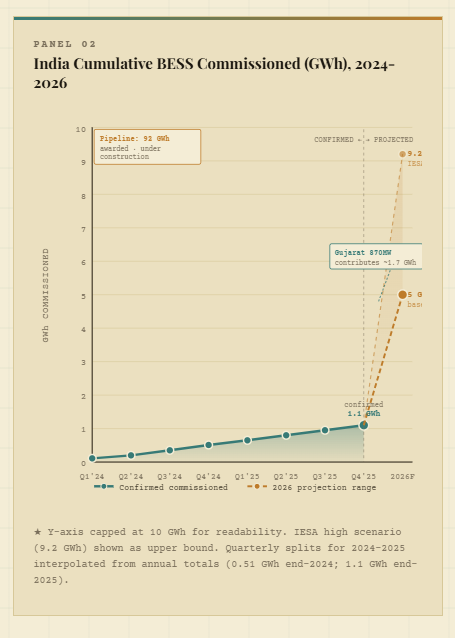
India’s total BESS commissioning in 2026 is projected to reach 9.2 GWh, up from virtually nothing two years ago. The 870 MW Gujarat network is the largest single contribution to that number so far.
Why Gujarat Is The Storage Bellwether
Kutch district receives over 6.2 kWh/m²/day of solar irradiance - among the highest in the world. But solar without storage is a morning-to-afternoon phenomenon. Every watt that Gujarat generates at noon and can’t store is a watt it sells cheap or wastes entirely. BESS closes that arbitrage. The Modhera integration - a grid-connected solar village with its own battery buffer - is the template India is now replicating at 870 MW scale, with 4 GWh more under the GUVNL Phase VII tender alone. The chart on the right tells the national story: India commissioned barely 1.1 GWh total through end-2025, a five-year crawl. The 2026 projection of 5-9.2 GWh represents a potential 5-to-8x single-year leap - the moment the pipeline stops being a pipeline and starts being infrastructure.
POWERGRID Extends the Grid’s Memory South
Power Grid Corporation of India [NSE: POWERGRID] floated a tender on May 15 for a 150 MW / 300 MWh battery energy storage project at Kalikiri in Andhra Pradesh. This is one package within a national programme to deploy 1,000 MW / 2,000 MWh of BESS across Andhra Pradesh, supported by viability gap funding through the Power System Development Fund (PSDF). Andhra Pradesh hosts some of India’s highest-capacity solar parks, including in Kurnool and Anantapur, but the grid has long struggled to evacuate and store that power. The Kalikiri BESS is the grid’s answer: store locally, dispatch when the grid needs it. POWERGRID builds the backbone; Gujarat proves the model. The two stories this week are two layers of the same transformation.
INFRASTRUCTURE: TELANGANA’S RS 9,400 CRORE DAY
Prime Minister Narendra Modi flew to Hyderabad on May 10 and dedicated infrastructure and industrial projects worth Rs 9,400 crore to the nation at the Hyderabad International Convention Centre.
The headline project is the IOC Malkapur Greenfield POL Terminal, a petroleum product storage and distribution facility built by Indian Oil Corporation [NSE: IOC] at Malkapur, Hyderabad for Rs 610 crore. Its total tankage capacity is 1,65,000 kilolitres, connected directly to the Paradip-Hyderabad cross-country pipeline. By FY 2029-30, it will handle an estimated 1,891 TMTPA, nearly 7,964 kilolitres of fuel per day flowing through Hyderabad’s distribution arteries without the delays and losses that characterise truck-dependent supply chains. Hyderabad’s tech economy runs on stable fuel, reliable logistics, and uninterrupted power. This terminal is load-bearing infrastructure for that ecosystem.
Modi also inaugurated sections of the Kazipet-Vijayawada Multi-Tracking Rail Project, expanding freight and passenger capacity on one of Telangana’s busiest rail corridors. Modi laid foundation stones for the Hyderabad-Panaji Economic Corridor (NH-167) at Rs 3,180 crore and the Zaheerabad Industrial Area at Rs 2,360 crore, with the area sitting in a corridor that several semiconductor and electronics manufacturers have been eyeing for expansion. Modi also dedicated Sindhu Hospital (1,500 beds, 29 advanced operation theatres, 2.1 million sq ft), one of India’s largest oncology-focused quaternary care facilities, in a city that already draws medical tourism from five states.
DIGITAL AND SEMICONDUCTORS: FOUR FABS BY DECEMBER
Union Minister Ashwini Vaishnaw confirmed on May 11 that the India Semiconductor Mission’s third chip packaging facility will be operational by July 2026 and a fourth by December 2026, joining two already running. All four are approved under the Rs 76,000 crore India Semiconductor Mission.
The fourth facility adds a new dimension: commercial production of micro-LED displays within 22 months. India’s first “Made in India” semiconductor chips entered commercial availability earlier in 2026. Packaging is the step between silicon and system: chips etched elsewhere, encased and tested in Indian facilities, building the workforce and process knowledge that precedes full-stack fabrication. Four operational packaging facilities by year-end means India has stopped theorising about semiconductor sovereignty and started booking production capacity.
BIODIVERSITY: TIGER DIPLOMACY
India hosted an international workshop titled “Shared Stripes: Shared Future” at Nehru Zoological Park, Hyderabad on May 12, with delegates from Malaysia, Russia, Sri Lanka, Thailand, and the United States. The event was jointly organised by the Ministry of Environment, Forest and Climate Change and the Ministry of External Affairs under the International Big Cat Alliance (IBCA). The MEA’s involvement is significant. This was not purely a conservation conference. It was conservation as foreign policy.
The data that framed the room: India’s wild tiger population now stands at 3,682, up from roughly 1,400 in the early 2000s. India hosts more than 70% of all wild tigers on Earth. That number did not appear by accident. It required 50-plus years of Project Tiger, 53 dedicated tiger reserves covering 75,000 square kilometres, sustained anti-poaching enforcement, and corridor ecology that keeps fragmented forests biologically connected.
Workshop discussions covered AI-assisted monitoring, trans-boundary corridor protection between India and Bhutan, and anti-poaching intelligence sharing. The delegates from Russia and Malaysia carry this knowledge home to landscapes where Amur and Malayan tigers are critically endangered. India is writing the playbook and distributing it.
ISRO: THE PIPELINE THAT BUILDS THE PIPELINE
ISRO Chairman V. Narayanan inaugurated YUVIKA 2026 on May 11, simultaneously across 9 ISRO centres, including two new additions: IPRC Mahendragiri (ISRO’s propulsion testing heart in Tamil Nadu) and RRSC West, Jodhpur (the remote sensing western hub). 456 students from 28 states and 8 union territories, selected from 1.06 lakh applicants, began a two-week residential immersion: model rocket assembly, live RH200 sounding rocket launches, Chandrayaan-3 DIY activities, and unmediated time with ISRO scientists.
The expansion to Mahendragiri is worth noting. IPRC is where India tests the engines that go to orbit: the Vikas engine, the CE-20 cryogenic engine. Putting Class 9 students inside that facility, around those machines, does something that no textbook accomplishes. It recalibrates what feels achievable. ISRO’s next crewed Gaganyaan mission and the Bharatiya Antariksh Station will be built by engineers who are currently 14 years old. Some of them are in Mahendragiri this week.