

The Week India Built a Ring Around Its Capital—and Bet $240 Billion on AI
New Delhi doesn’t do subtle. When this city decides to move, it moves at a scale that redefines possibility. This week, that movement came in the form of a ring—a 59-kilometer steel and concrete loop that finally closes the Delhi Metro’s Pink Line, creating India’s first fully operational circular metro system. But that was just Tuesday’s headline. By Thursday, we were staring at a $240 billion India AI investment commitment that made the Ring Metro look like pocket change.
This is +ND+A: India Positive. Let’s dig into the week that was.
🚇 Delhi Ring Metro Complete: India’s First Circular Metro System
At precisely 10:30 AM on March 8, Prime Minister Modi will inaugurate what Delhi’s commuters have waited years for: the completion of the Pink Line’s eastern extension. The 12.3-kilometer stretch from Majlis Park to Maujpur-Babarpur doesn’t just connect two endpoints—it completes a circle that transforms how North Delhi moves.
The Delhi Metro Ring numbers are staggering in their implications:
8 new stations: Burari, Jharoda Majra, Jagatpur-Wazirabad, Soorghat, Nanaksar-Sonia Vihar, Khajuri Khas, Bhajanpura, and Yamuna Vihar. Names that barely register on most Delhiites’ mental maps—until now.
1 double-decker viaduct over the Yamuna: Metro tracks soar above, road flyover runs below. Infrastructure stacked like Jenga blocks, maximizing scarce urban real estate.
₹18,300 crore in total project value, including the Magenta Line extension to Krishna Park.
1 Rajiv Chowk bypass: Commuters can now traverse North, East, and South Delhi without ever touching that overheated interchange that handles more daily traffic than some cities’ entire metro systems.
But here’s what the press releases won’t tell you: Delhi just leapfrogged every other Indian city in urban rail design.
Mumbai’s suburban network is legendary, but it radiates from a center like spokes on a wheel.
Bangalore’s metro expansion is admirable, but piecemeal.
Delhi now has a loop—the same topology that makes Tokyo’s Yamanote Line and London’s Circle Line the backbones of their respective systems. When you’re building network infrastructure, topology matters as much as scale.

🤖 India AI Impact Summit 2026: $240 Billion Investment Commitment
In the aftermath of the India AI Impact Summit, a staggering number has emerged from analysts still catching their breath:
$240 billion in investment commitments from Reliance, Adani, Google, Lightspeed, Tata Group, and others.
Let’s break that India AI investment down, because scale without context is just noise:
$200 billion specifically earmarked for AI infrastructure, hardware, and applications. That’s roughly the GDP of Greece, committed to silicon and algorithms in a single summit.
600,000 attendees. Not a typo. For context, Davos caps at around 5,000. Web Summit Lisbon hits 70,000. This was nearly ten times that.
100 countries represented, with a deliberate tilt toward the Global South.
20,000 additional GPUs added to India’s sovereign compute capacity through the IndiaAI Mission.
The summit’s framing was deliberate: the M.A.N.A.V. framework—ethical, inclusive AI that serves humanity rather than replacing it. PM Modi positioned India not as a consumer of AI developed in San Francisco or Shenzhen, but as a shaper of AI governance for the 3 billion people in the Global South who have been largely absent from the conversation.
This is the bet: while the US and China wage their AI supremacy battle, India will build the infrastructure that lets everyone else participate. Not altruism—strategy. If AI is the new electricity, India wants to be the grid.
🌍 India Stack Global: Digital Public Infrastructure Exports to 24 Countries
Lost in the AI Summit’s shadow was another announcement that might prove equally transformative: India Stack Global—a portal and partnership framework exporting India’s digital public infrastructure to 24 countries.
The India Stack numbers here tell a story of exponential growth:

The JAM Trinity—Jan Dhan + Aadhaar + Mobile—created the rails on which everything else runs. Now that model is being packaged and exported to nations that watched India’s digital transformation with envy and skepticism.
The proposition: You don’t need to accept Western Big Tech’s terms or China’s surveillance-state model. There’s a third way—open, interoperable, scalable, democratic.
🚀 Space: Private Orbital Rockets and Bodyguard Satellites
Skyroot Aerospace is preparing to do something no Indian private company has done before: reach orbit. Their Vikram-1 rocket—named for India’s space program founder—is a three-stage, solid-fueled vehicle designed to carry 300 kg to low Earth orbit.
What’s more interesting than the specs is the strategy. While SpaceX and others play the “train” game—aggregating customers for common orbits—Skyroot wants to be the cab.
I wrote about another India spacetech startup just last week, and called it the Uber of Low Earth Orbit. You don’t want to miss this:
Agnikul Cosmos: The Uber of LEO

Inside the world’s first single-piece 3D-printed rocket engine, the mobile launchpad that fits on a truck, and India’s audacious bid to become the last-mile delivery service for Low Earth Orbit.
Skyroot’s co-founder Pawan Chandana’s analogy is apt: “Think of SpaceX as a transcontinental train. We’re aiming to become the cab or business jet that drops you at a specific slot in a unique orbit.”
It’s niche, but it’s defensible. Not every satellite needs rideshare; some need bespoke deployment windows and specific orbital parameters. With MoUs already signed with French operator Promethee, Skyroot is betting on a market gap that the big players can’t efficiently serve.
Meanwhile, ISRO is preparing for a different kind of space mission: defense. The bodyguard satellite program—revealed after a 2024 incident where a foreign spacecraft came within 1 km of an Indian military satellite—is moving from concept to hardware. First test launch expected by June 2026.
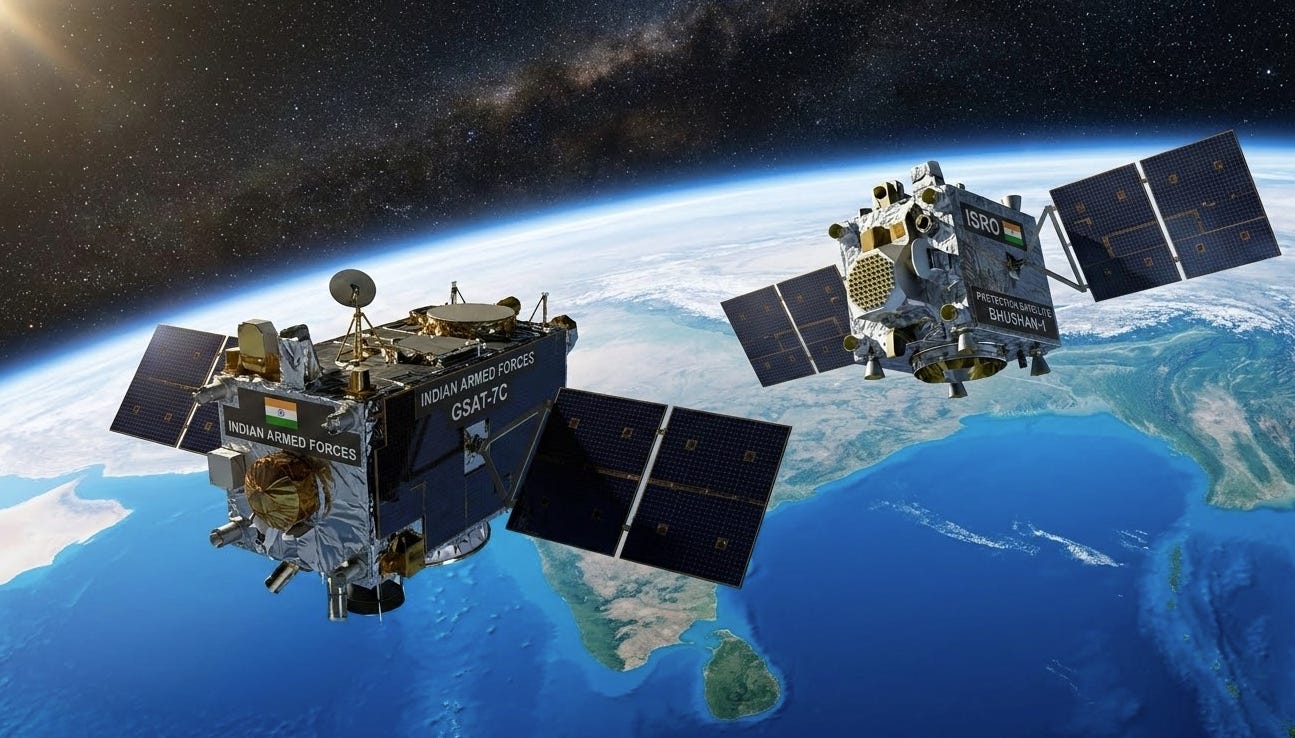
Space is no longer just about exploration. It’s becoming a contested domain, and India is tooling up for that reality.
I am very curious about the bodyguard satellite. How do they work? What do they do exactly? How will they know which satellite to protect? If you want a deep dive on this, join the chat and let me know.

💰 Indian Startup Funding: $98 Million Raised This Week
Startups raised $98 million this week across 10+ deals. The headline grabber: Rozana’s $22.5 million Series A for rural e-commerce—a signal that investor appetite extends beyond India’s metros into its 650,000 villages.
SEDEMAC, a deeptech startup, closed its IPO with 2.68x oversubscription and lists March 11. In a funding winter, quality still finds capital.
🌿 Wildlife: Tiger-Rhino Encounter in Dudhwa Tiger Reserve
Forest officials in Dudhwa Tiger Reserve stumbled upon a scene that left them stunned: a tiger atop a 2.5-tonne rhino carcass in a marsh. Such kills are extraordinarily rare—adult rhinos are formidable opponents, and tigers typically avoid them.
The likely explanation is opportunism: the rhino got trapped in marsh mud, became vulnerable, and the tiger seized the moment. Nature doesn’t follow scripts.
What this tells us: Dudhwa’s ecosystem is healthy enough to support both predator and megafauna populations in sufficient density for such encounters to occur. In conservation, rare events can be positive indicators.