

In the Mahabharata, Yudhishthira gambled away his kingdom in a game of dice. In 2026, India is gambling that a game of cricket can win one back.

I keep returning to this photograph from 1921. The Maharaja of Jodhpur, Sir Pratap Singh — hawk-nosed, turbaned, magnificently upright on horseback — is hosting the Prince of Wales at his polo grounds in the Thar Desert. The British heir apparent has traveled six thousand miles to play sport in the sand, and the Maharaja has built him a world-class arena to do it in.
This was not recreation. This was statecraft.
The polo match at Jodhpur was a negotiation conducted on horseback — a way for an Indian sovereign to meet a British prince on terms of perceived equality, without the humiliation of a formal audience where one party was clearly the supplicant. The Maharaja understood something that modern India has turned into a $18.5 billion industry: that the field of play is, and has always been, a sovereign space.[1][2]
What follows is the story of India's sports diplomacy — how a civilization transformed sport from a colonial inheritance into the most successful exercise of soft power in the post-colonial era — from the chariots of the Mahabharata to the mega-auctions of the IPL, from the mud pits of village kabaddi to the metaverse of competitive esports. It is a story of appropriation, reinvention, and breathtaking commercial ambition. But it is also a story with cracks in the foundation — cracks that, if ignored, could turn India's sovereign asset into a strategic liability.
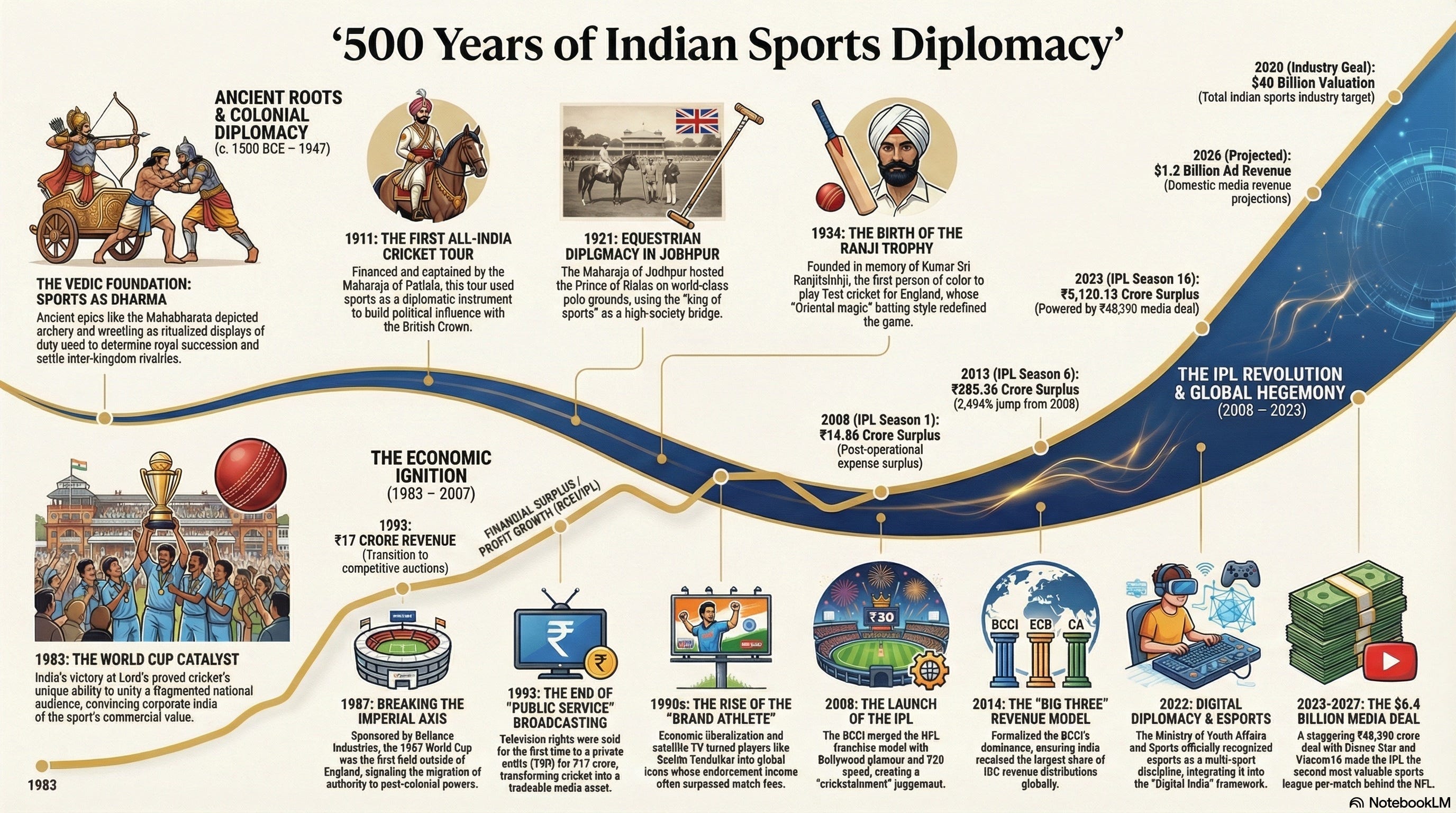
I. The Civilizational Foundation: 3,000 Years of Indian Sports Diplomacy
The practice of using sport for diplomatic ends in India is not a modern innovation. It is ancient — older than the Colosseum, older than the Olympics.
In the Mahabharata, contests of archery and wrestling were formal mechanisms for determining royal succession.[3] When Arjuna strings his bow at the swayamvara of Draupadi, he is not merely demonstrating skill — he is asserting the legitimacy of his claim to rule. The outcome of that single shot determines the alliance structure of the entire epic. These were highly ritualized displays of Dharma (duty) and martial virtue, where the result of a match could avert — or precipitate — a broader military conflict.
This is worth pausing on. Three thousand years before the IPL auction, India had already developed a theory of sport as statecraft. The dice game at Hastinapura — arguably the most consequential sporting event in Indian literature — didn’t just determine who controlled a kingdom. It determined whether there would be a war that killed millions.
When the British East India Company introduced cricket, polo, and hockey to India in the 18th and 19th centuries, the Indian aristocracy did something that would become the country’s signature move across five centuries of sports history: they indigenized it.
The Maharajas mastered the sports of the empire not because they loved cricket, but because they understood that demonstrating the technical and moral qualities required for high-level play — discipline, strategic thinking, “fair play” — was a way of subtly challenging the civilizational justifications for colonial rule.[4][5]
The sports field became the one arena where colonial hierarchies could be quietly subverted.
If an Indian could play cricket as well as an Englishman, what exactly was the basis for British superiority?
II. The Golden Age: Polo, Cricket, and the Art of Princely Diplomacy
The late 19th and early 20th centuries were the golden age of Indian sports diplomacy, and three princely states dominated the field: Jodhpur, Jaipur, and Patiala. Each developed a distinct approach to the art of using sport as a sovereign instrument.
Jodhpur: Brand Diplomacy Before Branding Existed
Jodhpur’s weapon of choice was polo. Under Maharaja Sir Pratap Singh and later Maharaja Hanwant Singh, the state developed more than half a dozen world-class polo fields, including the original “Chammi” grounds that hosted the Prince of Wales in 1921 and Lord Mountbatten shortly after.[6]
But the most brilliant piece of Jodhpur sports diplomacy happened not on a polo field, but at a tailor’s shop. When the Maharaja traveled to England for Queen Victoria’s Diamond Jubilee, his riding breeches — wide at the hip, tight at the calf — became a sensation among the British aristocracy. They called them “Jodhpurs.”[6]
This was brand diplomacy decades before the concept had a name. A piece of Rajasthani equestrian culture was exported as a symbol of aristocratic sophistication, permanently embedding the name of an Indian city into the global lexicon of style. Today, more people worldwide know what “jodhpurs” are than could locate Jodhpur on a map — and that asymmetry of cultural penetration is precisely the point of soft power.
The tradition continues. Yuvraj Shivraj Singh and Maharaja Gaj Singh II host international events like British Polo Day, attracting global business leaders to the “Blue City.”[7][8]
The horses have changed; the game hasn’t.
Jaipur: Governance as the Long Game
Where Jodhpur exported style, Jaipur exported institutions. Maharaja Sawai Man Singh II and his successors understood that glamour fades but governance endures.
The Jaipur royal family’s critical contribution was institutional: the introduction of the Jaipur World Cup Trophy and Maharaja Sawai Bhawani Singh’s instrumental role in the 1982 formation of the Federation of International Polo (FIP).[9] By taking a leadership role in global polo governance, Jaipur ensured that Indian cultural heritage remained a central pillar of the international game — not as a guest, but as an architect of the rules.
This is the move that modern India would replicate at scale with the BCCI: don’t just play the game — write the rulebook.
Patiala: The Man Who Built the Machine
If Jodhpur and Jaipur were the artists of Indian sports diplomacy, Maharaja Bhupinder Singh of Patiala was the engineer.
His reign (1900-1938) saw the decisive shift from sporadic royal patronage to the creation of a centralized national sporting infrastructure. Bhupinder Singh captained the first All-India cricket team to England in 1911, served as President of the Indian Olympic Association from 1928 to 1938, and — crucially — was a key figure in the 1927 Delhi meetings that led to the formation of the Board of Control for Cricket in India (BCCI).[10][11][12][13]
Let that sink in. The institution that would become the richest and most powerful cricket board in the world — worth ₹18,760 crore in 2026 — was born in a meeting room organized by a Maharaja who understood that institutional power outlasts personal charisma.[15]
Bhupinder Singh also donated the Ranji Trophy in honor of Kumar Sri Ranjitsinhji, creating a permanent domestic competition structure that would outlive the princely states themselves.[13][16] The Netaji Subhash National Institute of Sports in Patiala, his other lasting gift, continues to train India’s Olympic athletes.[12]
He built the world’s highest-altitude cricket pitch at his summer palace in Chail — 2,444 meters above sea level — because the Maharaja of Patiala did nothing by halves.[14]

III. Ranjitsinhji: The Man Who Was Two Things at Once
No figure better embodies the tensions of Indian sports diplomacy than Kumar Sri Ranjitsinhji, the Jam Sahib of Nawanagar - the first person of color to play Test cricket for England, and a man who spent his entire life negotiating the impossible space between being an English sporting hero and an Indian sovereign.[16][18]
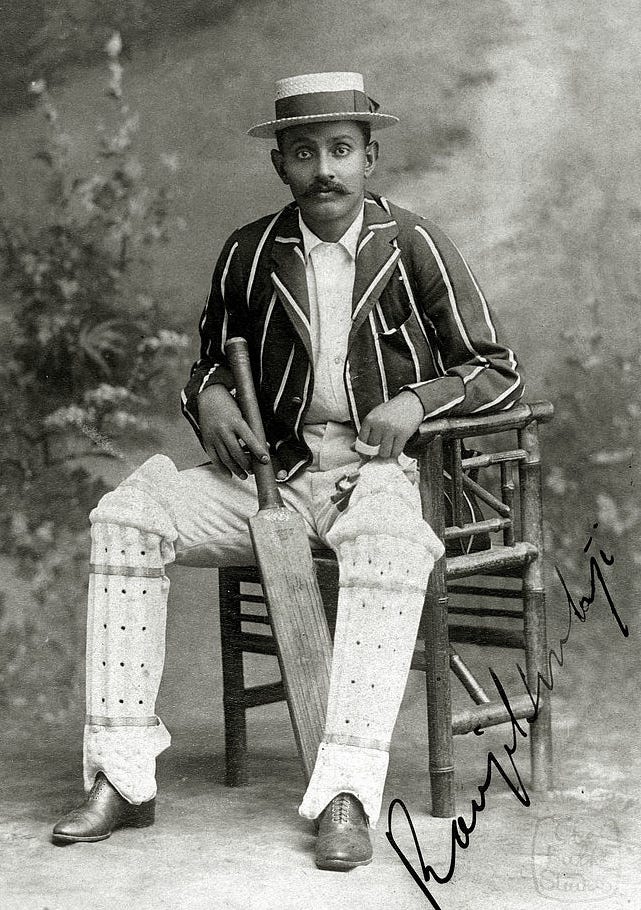
At Cambridge, “Ranji” invented the leg glance - a shot the English interpreted as an infusion of Eastern “magic” into their stolid national game.[4] His batting was described in terms that mixed admiration and Orientalism in equal measure: graceful, deceptive, “conjuring runs from nothing.” He became the most famous Indian in the Victorian world.
But Ranji’s celebrity was always instrumental. Cricket gave him social access that his brown skin would otherwise have denied him in 19th-century England. When he succeeded to the throne of Nawanagar in 1907, his sporting fame transmuted into diplomatic capital - he represented Indian interests at the League of Nations between 1920 and 1923, advocating for the Indian diaspora in South Africa and mediating European conflicts like the Corfu incident.[18]
Here is the tension that still haunts Indian sports diplomacy today: Ranjitsinhji was simultaneously India’s greatest cultural export and an “absentee ruler” criticized for prioritizing British social life over his state’s development.[18] He was, in the language of modern soft power theory, a masterful “nation brand” - but the brand and the nation didn’t always align.
The Ranji Trophy, founded in his memory in 1934, remains the bridge between his personal legend and the institutionalization of the game in India. It is also, perhaps, a reminder that sports diplomacy works best when it serves the nation, not just the diplomat.
IV. The Pivot: 1947, 1983, and the Commercial Big Bang
Independence in 1947 ended the Maharajas’ political power and eventually their privy purses. But it did not end the pattern they had established - the use of sport as a vehicle for national identity and international standing. It simply transferred that function from princes to institutions.
The Post-Colonial Symbolism Machine
In the decades following independence, cricket matches against England became rituals of post-colonial assertion. Every victory was celebrated as proof of national dignity. The “spin quartet” and players like Kapil Dev represented what scholars call a “plural national identity” — regional, diverse, meritocratic, and defiantly non-British.[5]
But the real revolution was economic, not symbolic. And it had a precise date.
June 25, 1983: The Day Everything Changed
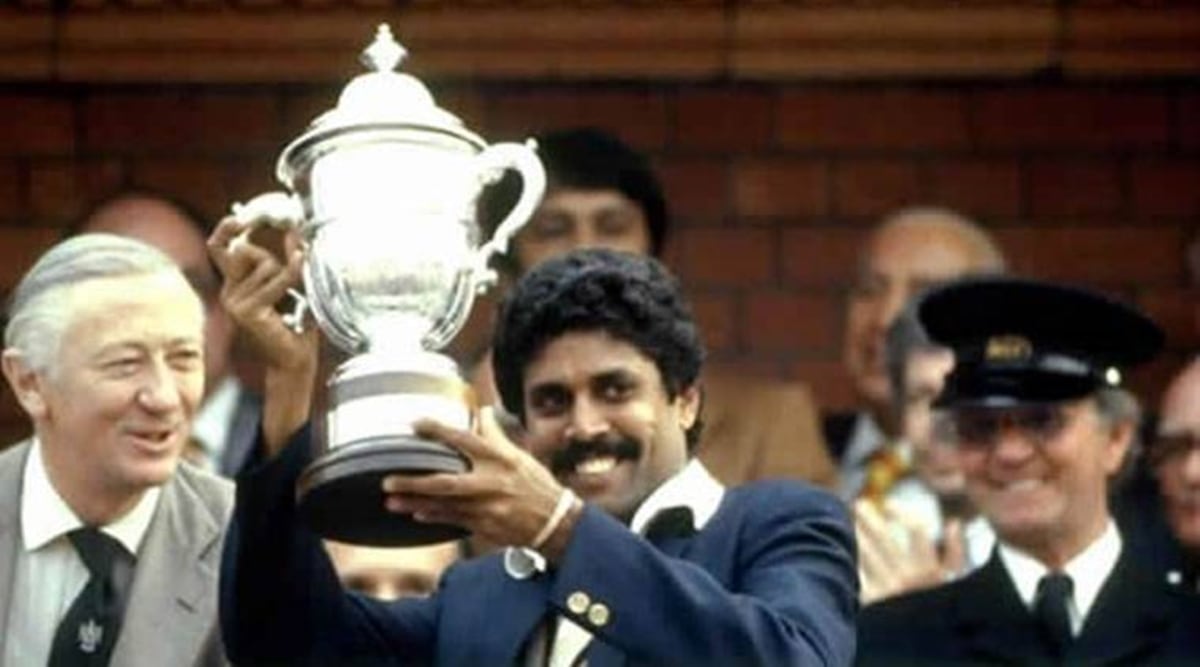
When Kapil Dev lifted the Prudential World Cup at Lord’s, the immediate impact was emotional. A cricketing minnow had defeated the mighty West Indies on the sport’s most hallowed ground.
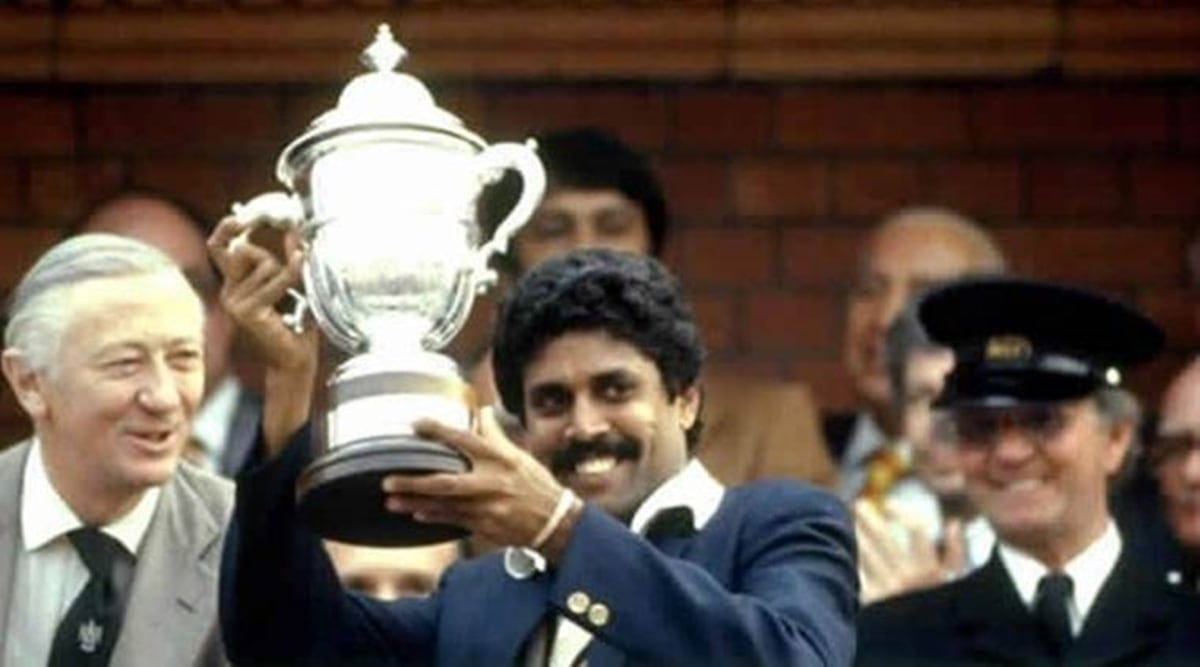
The lasting impact was commercial. The 1983 victory proved to corporate India that cricket possessed a unique ability to unify a market of 800 million people — more effectively than any advertising campaign, political movement, or cultural event. This led directly to three cascading consequences:
1987: The World Cup was hosted outside England for the first time — in India, sponsored by Reliance Industries.[5]
1993: Television rights were sold to Trans World International (TWI) for ₹17 crore, ending the “public service” era and beginning the era of cricket as a tradeable media asset.[5]
2008: The IPL launched, and the world changed.
[DATA VIZ: Line chart — “The 1983 Inflection Point” — Y-axis: Indian cricket revenue (₹ crore, log scale). X-axis: 1950-2026. Show near-flat line from 1950-1983, gentle rise 1983-2008, then a near-vertical rocket from 2008-2026. Annotate key events along the curve.]
V. The IPL Franchise Model: How India Rewired the Global Cricket Economy
The Indian Premier League, launched in 2008, is not a cricket tournament. It is a commercial operating system for global sport — and in 2026, its total business valuation has reached $18.5 billion, with a standalone brand value of $3.9 billion.[2][32]
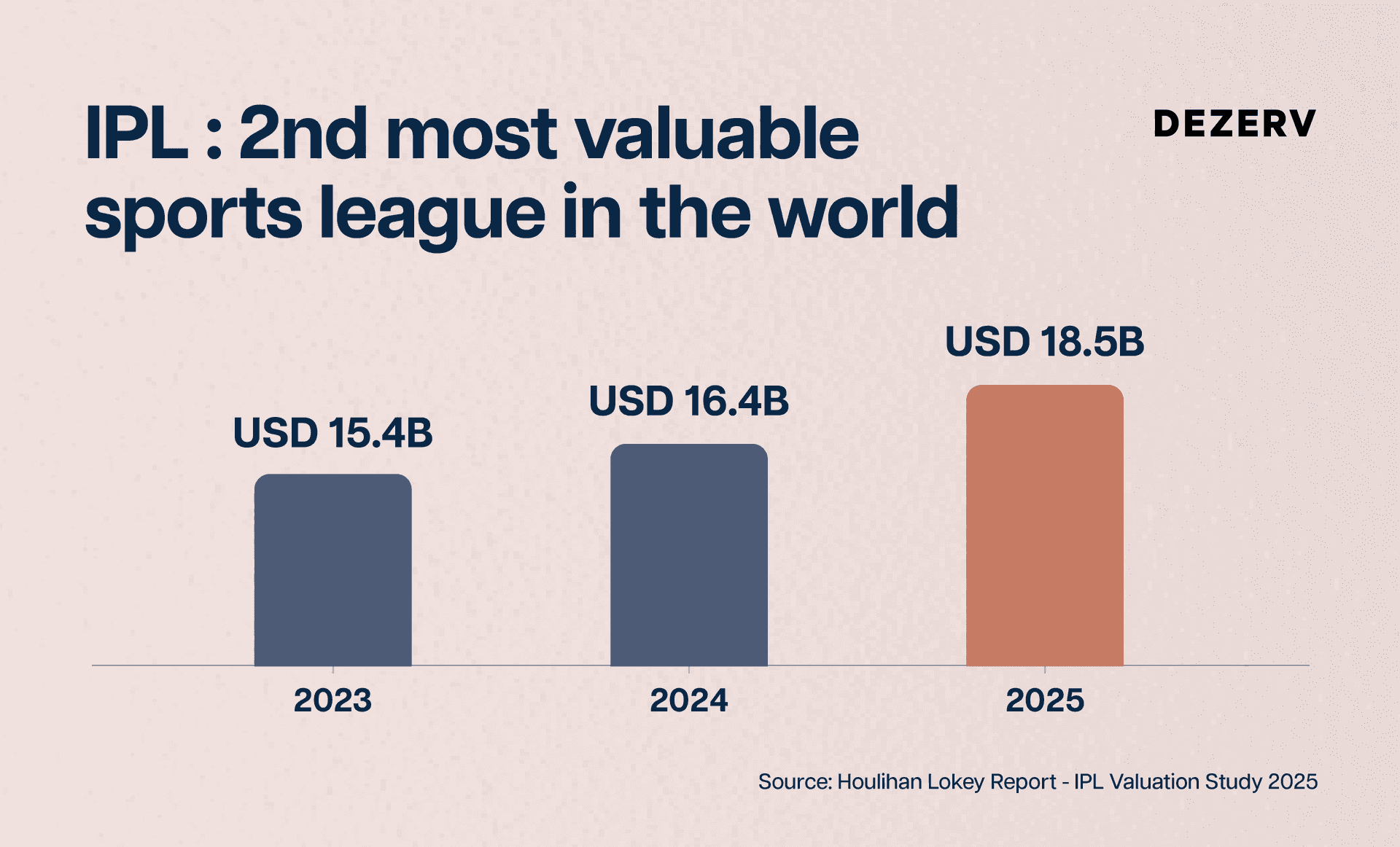
To understand what the IPL did, you need to understand what it disrupted. Before 2008, cricket was organized around nation-states — India vs. Australia, England vs. Pakistan. The IPL replaced national identity with franchise identity, compressed five-day Tests into three-hour spectacles, and fused cricket with Bollywood to create a new market category that the BCCI termed “cricketainment.”[19][20]
It was, in the language of Blue Ocean Strategy, a textbook case of creating uncontested market space by making the competition irrelevant.[20]
The Numbers That Rewired Global Sport
Let me lay out the scale of what India has built:

That last line — the 18% player revenue share — is the number that should make you pause. IPL players collectively receive roughly one-fifth of league revenues. In the English Premier League, players receive close to 70%.[35]
The IPL has created an ownership paradise and a player pay ceiling. This is not an accident — it is a structural choice. The BCCI’s dual role as league owner AND regulator means there is no independent entity advocating for player interests. The auction system treats players as tradeable assets in a way that would be unrecognizable to the NFL Players’ Association or the Professional Footballers’ Association.
The IPL is, in effect, a gig economy with billion-dollar branding.
Here’s Polymarket predicting this year’s winner:
Mumbai Indians are leading the trend, with last year’s winners RCB at second spot (at the time of writing). I rarely find any predictions for Indian topics on Polymarket. The fact that I could even find such a trend on Polymarket for something so Indian, is a strong indicator of the pervasiveness of IPL.
The Franchise Diaspora: India’s Cricketing Empire
But the IPL’s most consequential innovation is not domestic — it is global. IPL franchise groups have built a year-round international cricket circuit that extends Indian commercial interests across five continents:
Mumbai Indians operate across 5 leagues: IPL, MI Cape Town (SA20), MI Emirates (ILT20), MI New York (Major League Cricket), and more.[36]
Knight Riders span the IPL, Trinbago Knight Riders (CPL), Abu Dhabi Knight Riders (ILT20), and LA Knight Riders (MLC).[36]
All six SA20 teams are owned by IPL investors.[36]
Four of eight teams in The Hundred (England’s marquee T20 competition) are part-owned by IPL franchise owners.[37]
And in September 2026, the Champions League T20 returns as the “World Club Championship” — an ICC-approved tournament pitting franchise champions from the IPL, PSL, BBL, SA20, and The Hundred against each other.[38]
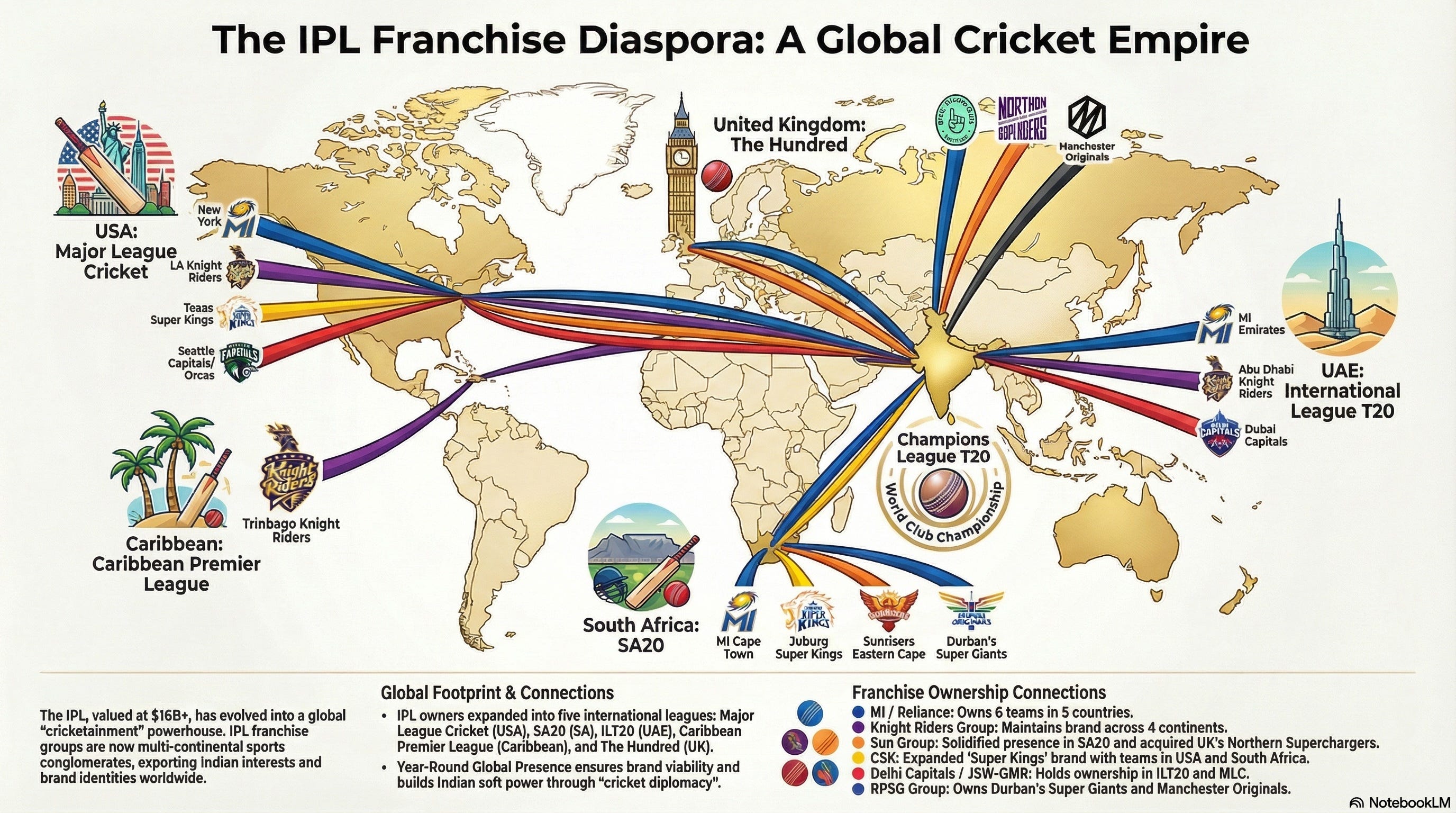
India has done something that no non-Western nation has achieved before. It has created a sporting ecosystem that exports its commercial model to the former colonial powers. When Reliance buys a team in England’s Hundred, the directional flow of cricketing capital has reversed.
The colony is now the metropole.
VI. Why Cricket Dominates 89% of Indian Sports - and Why That’s a Problem
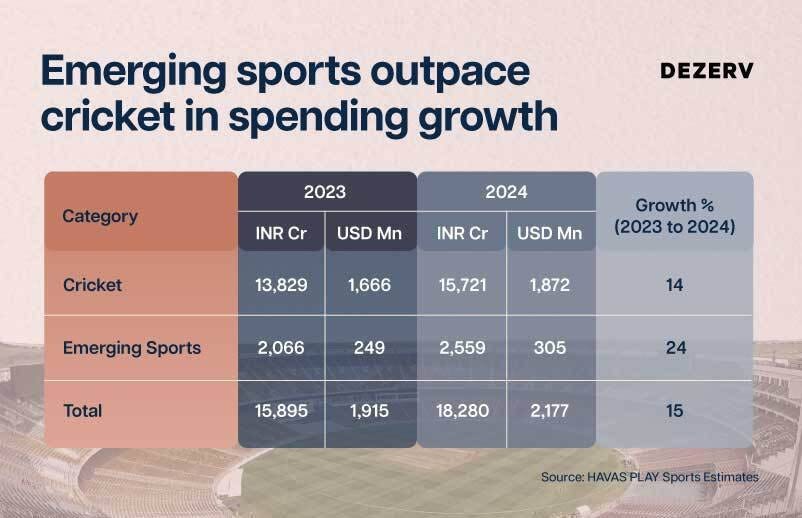
89% - That is cricket’s share of India’s sports business in 2025 - up from 85% in 2024.[39]
While the IPL rockets upward, football, hockey, and badminton are losing ground. Cricket is not just dominant in India; it is a gravitational singularity that bends the trajectory of every other sport in its proximity.
The most dramatic evidence of this is the Indian Super League’s near-death experience.
The ISL Collapse: A 97% Crash
In 2023, the ISL’s media rights were worth ₹275 crore per season. In 2026, FanCode won the broadcasting rights for ₹8.62 crore — a 97% collapse.[40]
Read that again. Ninety-seven percent.
The ISL’s Master Rights Agreement with Football Sports Development Limited (FSDL) expired in December 2025, and no one came to replace it. The AIFF floated a tender for commercial partners in October 2025. Zero bids came in.[41] The season was delayed five months. Players — Indian and foreign — wrote to FIFA, calling it a “humanitarian, sporting, and economic crisis.”[42]
The ISL eventually limped back to life in February 2026 with a reduced 91-match format, but the message was devastating: the franchise model without cricket’s gravitational pull is a house of cards. The same commercial playbook that turned the IPL into a $18.5 billion empire couldn’t keep Indian football alive at 0.003% of that value.

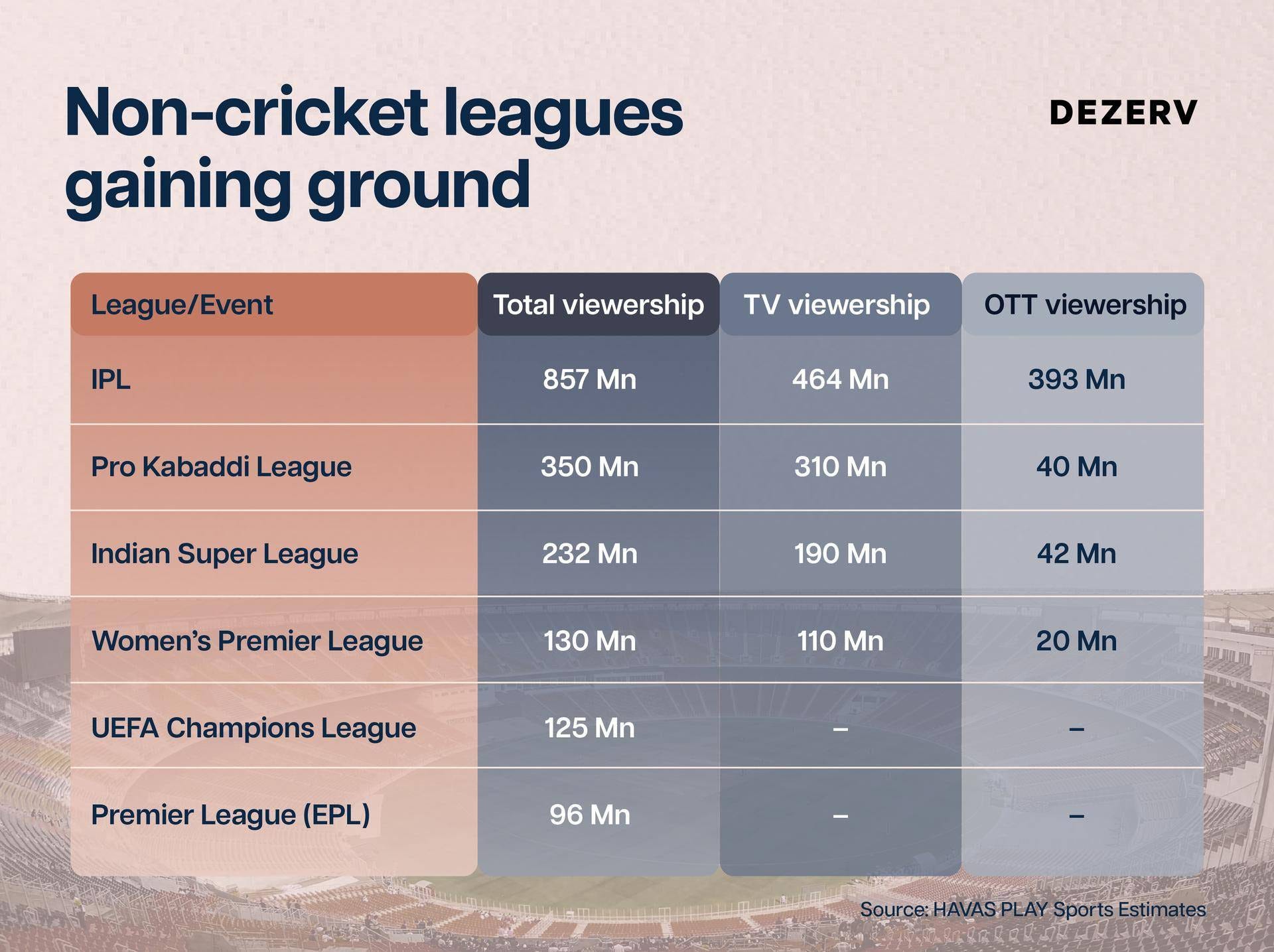
The contrast is startling. Pro Kabaddi, Hockey India League, and Ultimate Kho Kho are all growing — but none of them are anywhere close to challenging cricket’s 89% share.
VII. From Kabaddi to Esports: India’s Indigenous Sports Renaissance
And yet, there is a genuinely exciting counter-narrative to the cricket monoculture — one rooted not in imported franchise models but in the professionalization of India’s own ancient games.
Pro Kabaddi: When Rural India Went Prime-Time
The Pro Kabaddi League, launched in 2014, took a traditional, rural “raw power” game — played in mud, decided by physical instinct — and transformed it into a prime-time broadcast product using the IPL’s playbook.[25][26]
Season 12’s opening week in 2025 saw a 56% surge in TV viewership (43.5 crore viewers) and an 18.5-fold increase in online visitors.[43] Eight kabaddi players have now crossed the ₹1 crore annual salary threshold — a figure that would have been unimaginable when the sport was played in village tournaments for trophies and bragging rights.[44]
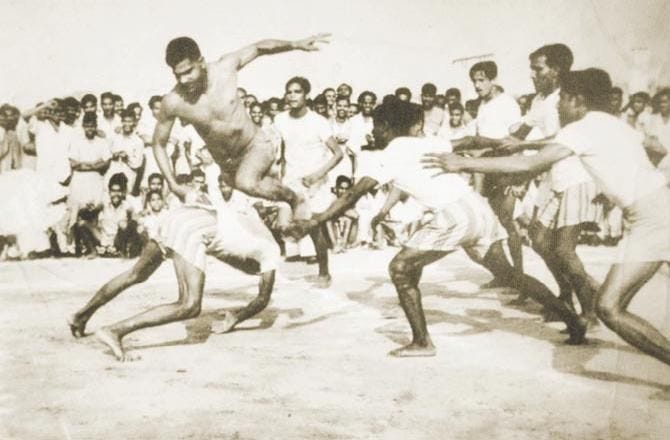
The transformation was not just commercial — it was strategic. Traditional kabaddi relied on natural instinct and brute strength. Professional kabaddi introduced data analytics, video analysis, specialized player roles, and tactical innovations like the “Do-Or-Die” raid that ensure the fast-paced, high-stakes action required for a modern broadcast product.[27]
PKL is also looking beyond India, with plans for kabaddi matches in Melbourne by 2026. The sport that once needed no equipment beyond a patch of dirt is now a cultural bridge connecting India’s rural heartland with urban audiences and global investors.
Kho Kho: The 3,000-Year-Old Startup
Even more remarkable is the trajectory of kho kho — an ancient tag-based pursuit game that the Kho Kho Federation of India has modernized into Ultimate Kho Kho, a franchise league with modified rules, powerplays, and a ₹200 crore investment from Sony Pictures Networks over five years.[45]
The debut season drew 64 million viewers. A Kho Kho World Cup was held in Delhi in January 2025, with 23 countries participating.[45]
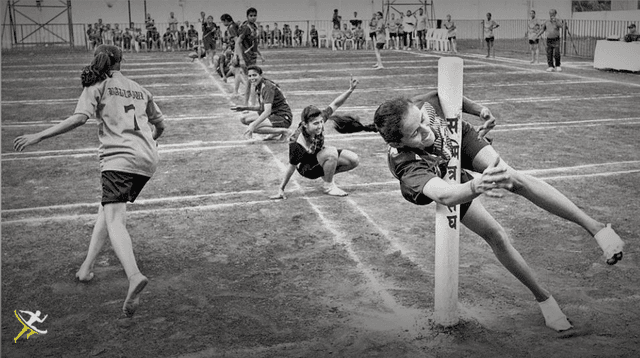
Think about what this means. India is simultaneously running the world’s second-most-valuable sports league (IPL) and professionalizing 3,000-year-old indigenous games that most of the world has never heard of. This dual capability — hypermodern commercial machinery applied to ancient cultural assets — is something no other nation can replicate. Saudi Arabia can buy Newcastle United, but it cannot conjure a traditional game with civilizational roots and turn it into a global broadcast product.


Esports: The Digital Frontier
The newest addition to India’s sporting arsenal is competitive gaming. In August 2025, Parliament passed the Promotion and Regulation of Online Gaming Act (PROGA), officially separating esports from gambling and recognizing competitive gaming as a legitimate sport.[46] Esports has been added to the Khelo India games as a demonstration sport, and India’s Ved Bamb became the country’s first esports world champion at the Pokémon GO World Championship.[47]
The Frontiers in Communication journal published a 2026 paper analyzing esports as “soft power diplomacy,” noting that India presents an emerging model in which “esports is tied to national development narratives and aspirations of digital modernity.”[48] The government’s AVGC-XR strategy frames gaming not just as entertainment but as a driver of economic growth, cultural diplomacy, and technological innovation.
From the chariot races of the Mahabharata to the metaverse. The medium changes; the strategic logic doesn’t.
VIII. India 2036 Olympics: Can India’s Sports Machine Pass the IOC Test?
India’s bid to host the 2036 Olympics in Ahmedabad is the ultimate test of whether its sports infrastructure can match its sports ambitions.
The IOC has been blunt. In high-level meetings, it identified three “fundamental concerns” with India’s bid: governance issues within the Indian Olympic Association, anti-doping failures, and lackluster Olympic performances.[49] The IOA has scrambled to address these — Sports Minister Mansukh Mandaviya intervened to resolve a leadership dispute, and the government has increased the Ministry of Youth Affairs allocation to ₹4,479.88 crore in the 2026-27 budget, launching the decade-long Khelo India Mission.[50]
India’s main competitor is Doha, Qatar — backed by the same petrodollar machine that delivered the 2022 FIFA World Cup.[49] The competition with Doha is, in a sense, a microcosm of the broader contest between two models of sports diplomacy: India’s organic, commercially-driven ecosystem vs. the Gulf’s state-funded spectacle acquisition.
A decision is expected in late 2027. If India wins, it will validate the entire arc described in this article — from Maharaja Bhupinder Singh’s Olympic presidency in 1928 to the Olympic flame arriving in Ahmedabad a century later. If it loses, the IOC’s governance concerns will serve as a pointed reminder that commercial power alone is not sufficient; institutional credibility matters too.
IX. India’s $130 Billion Sports Economy: What Needs to Change
India’s sports economy is currently valued at $52 billion and projected to reach $130 billion by 2030 according to Deloitte and Google, creating 10.5 million jobs and generating $21 billion in indirect tax revenue.[51] KPMG’s more conservative estimate targets $40 billion, but even that figure represents a transformation of national scope.[52]
To get there, India needs to solve three structural problems:
1. Diversify beyond cricket. The 89% share is not a strength — it is a vulnerability. If the IPL stumbles (and all commercial enterprises eventually do), there is no backup. The PKL, HIL, and UKK are promising but still subscale.
2. Fix governance. The BCCI’s dual role as commercial operator and regulator is a conflict of interest that the Lodha Committee identified in 2016 but that has never been fully resolved. The ISL collapse is a governance failure, not a market failure.
3. Decide what sport is for. India cannot simultaneously use cricket as a tool of attraction and an instrument of coercion. The 2036 Olympics bid, the Champions League T20 revival, and the franchise diaspora all depend on India being perceived as a good-faith actor in global sport. Every time the BCCI weaponizes cricket for foreign policy, that perception erodes.
Conclusion: The Sovereign Asset
I started this piece with a photograph from 1921 — the Maharaja of Jodhpur hosting the Prince of Wales at a polo match in the desert. I want to end with a thought experiment.
Imagine the Maharaja could see what India has built a century later. A single cricket league worth more than the GDP of many nations. Indigenous games played in village mud now broadcast to 200 million viewers. Franchise owners from Mumbai buying teams in London and Los Angeles. A bid to host the Olympic Games — the one thing the Maharajas never achieved — backed by the world’s fifth-largest economy.
He would recognize every move. The hosting, the hospitality, the strategic deployment of sport as a language that transcends the hierarchies of formal diplomacy. The Maharaja knew what modern India has turned into doctrine: that the field of play is sovereign territory, and the nation that controls the game controls more than the score.
The question for the next decade is not whether India can build a sporting empire — it already has. The question is whether it can govern one.
In the 21st century, the field of play has become as vital as the halls of parliament in shaping the international order. For India, sports are no longer just a passion. They are a sovereign asset — powerful, lucrative, and, like all forms of sovereignty, only as enduring as the institutions that protect them.
Don't forget to checkout the accompanying podcast in Hindi! Trying something new for those who'd like to listen instead of read: https://indiapositive.substack.com/p/from-maharajas-to-megabucks-the-evolution?utm_source=share&utm_medium=android&r=5h5o0