

Technology & Digitalization
UPI Achieves All-Time High, Signals Deepening Digital Adoption
India’s Unified Payments Interface hit an unprecedented milestone in October 2025, processing 20.7 billion transactions worth ₹27.28 lakh crore (approximately $32.7 billion USD).
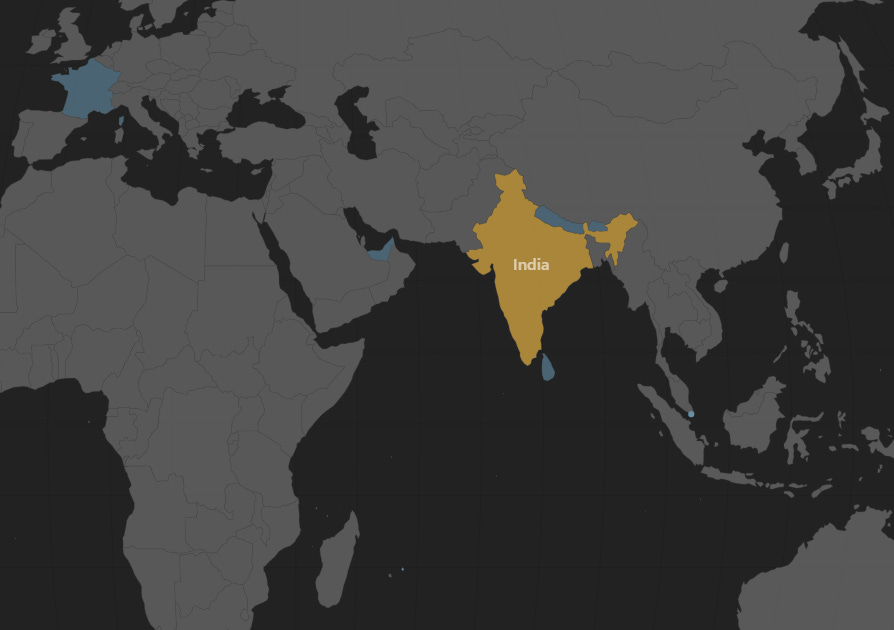
UPI Now Operates Globally: Already live in seven countries—the United Arab Emirates, Singapore, Bhutan, Nepal, Sri Lanka, France, and Mauritius—UPI’s expansion into France marks its first European foothold, enabling frictionless payments for Indian travelers abroad.
Person-to-Merchant (P2M) Transactions are leading the UPI growth story: P2M transactions have surged 37% to reach 67.01 billion, driven by what analysts term the “Kirana Effect”—the mainstreaming of digital payments among India’s backbone of small and micro businesses.
Energy & Green Transition
Brookfield’s Historic 1,040 MW Hybrid Project Receives Record REC Sanction
In a landmark moment for India’s renewable energy infrastructure, the Rural Electrification Corporation (NSE: RECLTD) sanctioned a record ₹7,500 crore ($900 million) for Brookfield’s 1,040 MW hybrid renewable energy project in Kurnool, Andhra Pradesh. This represents the single-largest REC sanction ever extended to a private-sector project.
The project, developed by Evren—a joint venture between Brookfield (51.49%) and Axis Energy—integrates 640 MW of wind power, 400 MW of solar capacity, and battery energy storage systems. The total investment stands at ₹9,910 crore.
Critically, this is India’s first Firm and Dispatchable Renewable Energy (FDRE) project combining wind-solar hybrid technology with state-level grid connectivity and a dedicated power purchase agreement (PPA), ensuring round-the-clock renewable supply.
Brookfield’s broader 8,000 MW pipeline across Andhra Pradesh carries a ₹50,000 crore total investment commitment, with Evren already advancing over 3 GW of renewable projects across Kurnool and Anantapur districts, establishing Andhra Pradesh as an emerging clean energy hub.
Andhra Pradesh Unveils Green Hydrogen Ambitions
Further declaring its renewable ambitions, Andhra Pradesh released its Green Hydrogen Valley Declaration back in July 2025. The newly formed AP Green Hydrogen Valley Advisory Board met last week to chart a pathway to position the state as India’s green hydrogen leader by 2030.
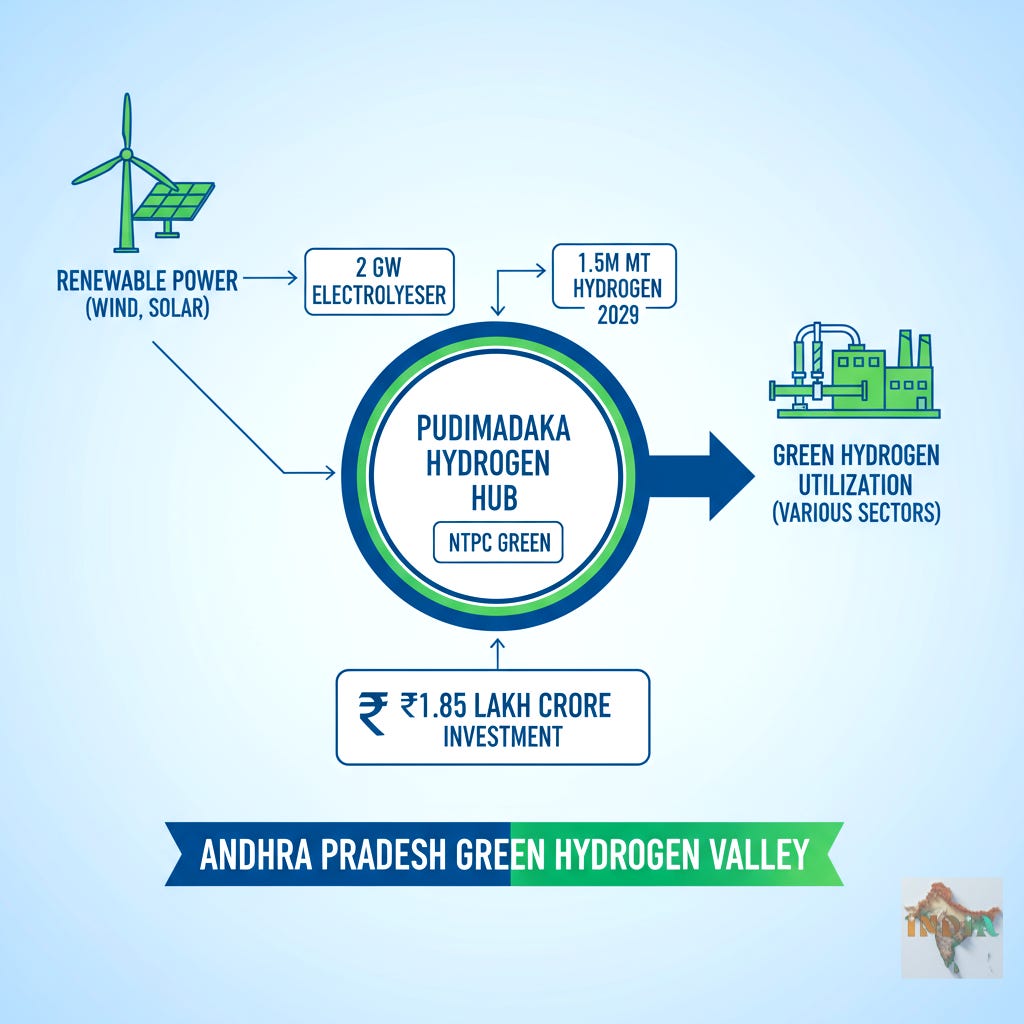
The declaration targets 2 GW of electrolyser manufacturing capacity by 2027 and 1.5 million metric tonnes of annual green hydrogen production by 2029. A cornerstone project under development is the hydrogen hub at Pudimadaka near Visakhapatnam, to be established by NTPC Green Energy Limited (NSE: NTPCGREEN), designed to produce 1,500 tonnes of green hydrogen daily using 20 GW of renewable energy with an investment of ₹1.85 lakh crore.
Green hydrogen (GH2 or GH2) is hydrogen produced by the electrolysis of water, using renewable electricity. Production of green hydrogen causes significantly lower greenhouse gas emissions than production of grey hydrogen, which is derived from fossil fuels without carbon capture.
India Progresses Steadily Toward 500 GW Non-Fossil Target
TERI Director-General Vibha Dhawan confirmed India remains on track for its 500 GW non-fossil energy target by 2030, propelled by the National Green Hydrogen Mission and Production-Linked Incentive (PLI) schemes for solar and battery manufacturing, which are reinforcing domestic value chains.
[■■■■■■■■░░░░░░] 235.7 GW / 500 GW [47.1%]
Technology & Startups: Deep Tech Surge
India Deep Tech Alliance Secures $2 Billion in Capital Commitments
Nvidia (NASDAQ: NVDA) joined the India Deep Tech Investment Alliance (IDTA) as a founding member and strategic advisor, alongside Qualcomm Ventures, InfoEdge Ventures, and new participants including Activate AI, Chirate Ventures, and Kalaari Capital. Combined, these new additions brought more than $850 million in fresh capital commitments, elevating the alliance’s total pledge to over $2 billion.
Nvidia will provide technical guidance, training, and policy input through its Deep Learning Institute to help Indian deep-tech startups adopt AI and computing tools. The alliance targets sectors including semiconductors, space technology, quantum computing, robotics, and artificial intelligence, with members committing to invest across Indian deep-tech over the next five to ten years.
This development comes just days after India’s government established a $12 billion (₹1 lakh crore) Research, Development, and Innovation (RDI) Scheme to fund investment in technology, with PM Modi announcing on Monday that India will host the AI Impact Summit in February 2026.
Outstanding news, and a much needed shot in the arm for the Indian Tech & AI industry. This newsletter will keep a close eye on the IDTA and the AI Impact Summit and report back on any advances made.
Economy & Infrastructure
India-EFTA Pact Operationalized; India-EU Trade Negotiations Accelerate
The India-EFTA Free Trade Agreement became operational in October 2025, unlocking $100 billion in investment commitments. The EFTA represents the countries of Iceland, Liechtenstein, Norway, and Switzerland.
Simultaneously, negotiations on the India-EU Free Trade Agreement accelerated toward a December 2025 completion target.
Customs Reform Streamlines Trade
The Central Board of Indirect Taxes and Customs (CBIC) consolidated 31 notifications into one unified directive to simplify compliance. Reforms also included eliminating tariff valuation systems and minimum import values on 84 products, while a new risk-based Import Policy Order aims to reduce clearance time from 270 hours to under 100 hours.
The reduced clearance time will have a direct impact on the speed at which Indian businesses operate, directly boosting India’s manufacturing.
Rail Electrification Milestone: Rail Vikas Nigam Limited (NSE: RVNL) secured a ₹272.08 crore contract (24-month execution) from Central Railway to design, supply, and commission high-voltage traction substations across Maharashtra’s Daund–Solapur sections, boosting the railway’s freight-loading capacity toward a 3,000 MT target.
Geopolitics & Defense
Indian Army Charts Drone Revolution: Every Soldier a Drone Operator by 2027
The Indian Army announced an ambitious initiative to make every soldier proficient in drone operations and counter-drone strategies by 2027. As of November 2025, this modernization drive is in full momentum, with the Army procuring approximately 1,000 drones across multiple categories—including swarm drones for coordinated assaults and loitering munitions for precision strikes—alongside 600 training simulators.
Indigenous drone programs feature prominently: DRRO Rustom, Nishant, Netra, Lakshya, and Pawan drones are central to this initiative, embodying the “Atmanirbhar Bharat” vision. The Army is establishing multiple training centers nationwide, developing comprehensive curricula covering piloting, maintenance, and counter-drone tactics, fundamentally redefining military readiness in the 21st century.
Defense Exports on the Rise: Indian defense startups like Flying Wedge Defence and Aerospace unveiled loitering munitions with 100-kilometer range capabilities at international aviation exhibitions. Concurrently, the Army placed a $16 million order for mini drones from domestic manufacturer IdeaForge (NSE: IDEAFORGE) signaling confidence in homegrown defense technology.
Environment & Conservation
Wildlife Week 2025: Five National Conservation Projects Launched
During Wildlife Week 2025, Union Minister Bhupender Yadav launched five transformative national conservation projects at the Indira Gandhi National Forest Academy in Dehradun:
Project Dolphin (Phase II): Enhanced protection and monitoring of river and marine cetaceans across India.
Project Sloth Bear: National implementation framework for sloth bear conservation.
Project Gharial: Comprehensive implementation plan for gharial conservation.
Centre of Excellence for Human–Wildlife Conflict Management (CoE–HWC): Established at SACON, this center will lead policy research and field-based mitigation.
Tigers Outside Tiger Reserves Initiative: Address tiger-human conflicts in non-protected landscapes through community participation and technology.
Four national-level population estimation and monitoring programs were simultaneously unveiled, including the Second Cycle of River Dolphin and Cetacean Estimation with field guides published in eight regional languages, the All India Tiger Estimation Cycle–6, and the Action Plan for the Second Cycle of Snow Leopard Estimation.
National Hackathon on Human–Wildlife Coexistence: The Wildlife Week celebration featured a National Hackathon with 420 participants from 75 institutions across 20 States and Union Territories, showcasing AI-based tools, spatial analytics, and community engagement models for real-time conflict mitigation.
Make in India & Global Competitiveness
India’s Export Surge Continues; Electronics Lead Growth
In April–August 2025, India’s non-petroleum and non-gems & jewellery exports surged to ₹146.70 billion from ₹136.13 billion the prior year—a 7.76% growth. Electronic goods spearheaded this momentum, climbing ₹5.51 billion (40.63% rise year-on-year), with August 2025 alone registering 25.91% growth versus the prior year.
Over the past decade, electronic goods production has increased 6-fold and exports 8-fold, with major markets including the USA, UAE, China, Netherlands, and UK—all driven by Make in India and Production Linked Incentive (PLI) schemes. India-China trade dynamics also shifted positively, with exports to China reaching $14.25 billion in FY 2024-25, a 19.65% year-on-year increase in April–August 2025, driven by petroleum products, engineering goods, electronics, and organic chemicals.
NITI Aayog CEO on Manufacturing Ambitions: NITI Aayog CEO BVR Subrahmanyam expressed confidence that the proposed India-USA Bilateral Trade Agreement could see positive developments by end-November 2025, with the National Manufacturing Mission expected to become operational around the same time. The government aims to increase manufacturing’s share of GDP from the current 15–17% to 25%.
The Council of Scientific and Industrial Research continues to push India to the forefront of life-improving technologies
CSIR-NEERI’s water purification technology was rapidly deployed to aid drinking water access in flood-hit districts, exemplifying science in the service of resilience.
India’s very first 3D-printed rural house was unveiled at CSIR-Central Building Research Institute (CBRI), Roorkee. This milestone could revolutionize affordable, rapid, and sustainable housing delivery in mountainous regions.
Assam made national news with the launch of India’s first decaffeinated black tea, opening a new frontier for the state’s globally-renowned tea industry.
Wrap Up
This week exemplifies India’s multidimensional progress. A ₹7,500 crore REC sanction for hybrid renewable energy reveals private capital flowing decisively into clean infrastructure. $2 billion in deep-tech commitments from global semiconductor giants and Indian venture firms signal confidence in indigenous innovation. From drone-empowered soldiers to wildlife conservation at national scale, from export-driven manufacturing to green hydrogen roadmaps—India is translating ambition into measurable, operational reality. The trajectory toward 500 GW clean energy, a $5 trillion economy, and strategic tech autonomy is no longer rhetorical but quantified, funded, and advancing week by week.
Sources: Press Information Bureau (PIB) | Reserve Bank of India (RBI) | National Payments Corporation of India (NPCI) | Ministry of New and Renewable Energy (MNRE) | Ministry of Environment, Forest and Climate Change (MoEFCC) | The Energy and Resources Institute (TERI) | Reuters | S&P Global | Mercom India | Economic Times | Times of India | Deccan Herald | New Indian Express | Business Green | CSRI