

🎯 HERO STAT: ₹4,500 CRORE — The Center’s game-changing investment to modernize Mohali’s Semiconductor Laboratory, with a target to scale wafer production 100x
1. Deep Science & Indigenous Innovation (CSIR/R&D Focus)
Towards 100 GW Nuclear Capacity
The week witnessed a spectacular convergence of India’s scientific ecosystem and strategic self-reliance ambitions. CSIR-NEERI in Nagpur concluded its landmark Nuclear Sector Training Programme on November 25, 2025, conducted in partnership with Nuclear Power Corporation of India Limited (NPCIL).
The training focused on strengthening CSIR-NEERI’s technical capabilities in environmental assessments, regulatory requirements, and safety considerations for nuclear facilities. Dr. S. Venkata Mohan, Director of CSIR-NEERI, emphasized the strategic importance of securing QCI-NABET accreditation in the Nuclear Sector, which will dramatically expand CSIR-NEERI’s consultancy portfolio for India’s ambitious nuclear expansion programme. This isn’t just routine capacity-building—it’s the critical human capital pipeline that will enable India’s planned 100 GW nuclear capacity by 2047.

Unlocking Public-Private Partnership for Space
In a transformative move for indigenous navigation technology, ISRO Chairman V. Narayanan on November 25 inaugurated the Ananth Centre of Excellence for Navigation (ACEN) at KINFRA Park, Thiruvananthapuram—India’s first private-sector navigation hub. Hyderabad-based Ananth Technologies, which works closely with ISRO, DRDO, and BrahMos, established this world-class facility to develop advanced inertial sensors, quantum sensors, and AI-driven fusion algorithms for multi-modal navigation across GNSS, INS, vision, and radar systems.
2. Energy & The Green Transition
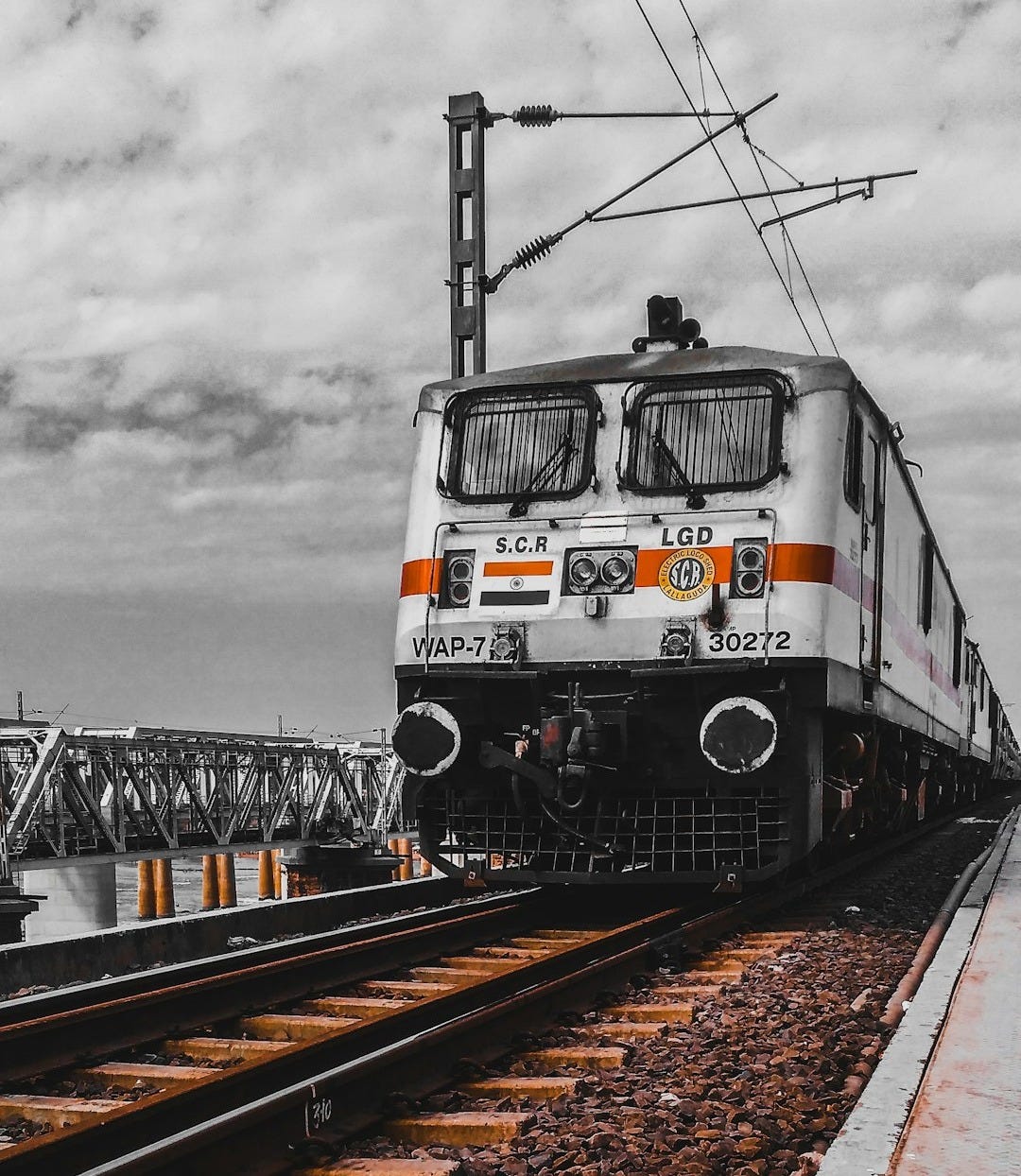
Indian Railway - Powered by the Sun
The renewable revolution rocketed forward this week with Railway Energy Management Company Limited (REMCL) awarding 1 GW of Round-the-Clock renewable energy capacity at a groundbreaking tariff of just ₹4.35/kWh. Six developers emerged victorious: ACME Solar Holdings [NSE: ACMESOLAR] (130 MW), ReNew Power [NSE: RENEW] (200 MW), Bhalki Solar Power (200 MW), Purvah Green Power (CESC subsidiary) (180 MW), Jindal Green (150 MW), and Ayana Renewable Power (140 MW).
This is transformational! Indian Railways—one of the world’s largest electricity consumers—will now receive firm, 24/7 clean power through a combination of solar, wind, and battery storage systems. The tender mandates minimum 75% annual availability for the first three years, rising to 85% thereafter, ensuring railway operations run on truly reliable renewable energy. Project commissioning is expected within 30 months from PPA signing.
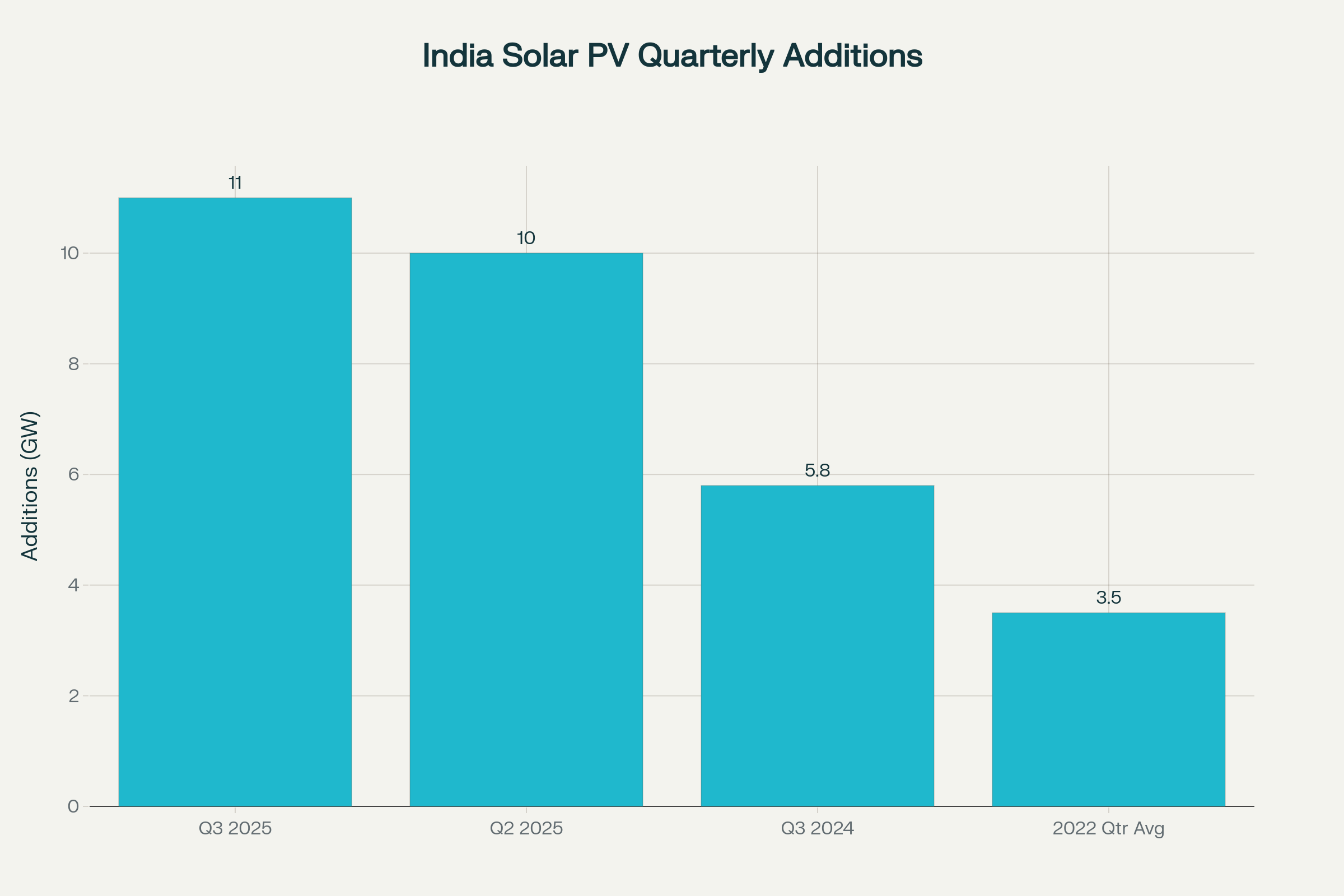
The macro picture is equally stunning: India added 11 GW of solar PV in Q3 2025 alone—the second consecutive quarter exceeding 10 GW, trebling the average quarterly additions from 2022. Solar now accounts for 127 GW of installed capacity—second only to coal’s 224 GW. Investments in renewable energy during Q3 2025 surged 112.6% year-on-year to US$5.2 billion, bringing 2025’s nine-month total to US$18 billion—far surpassing full-year totals for 2022-2024 combined!
3. Infrastructure, Agriculture & Economy
Fitch-owned BMI upgraded India’s FY26 GDP growth forecast by 50 basis points to 6.5% on November 26, citing robust Q2 performance, GST rate rationalization, and rising vehicle registrations. The optimism extends to FY27 with growth projected at 6.1%, supported by fresh AI-related investments and government spending. This comes on the heels of India’s retail inflation plunging to a historic 0.25% in October 2025—the lowest since the current CPI series began in 2013!
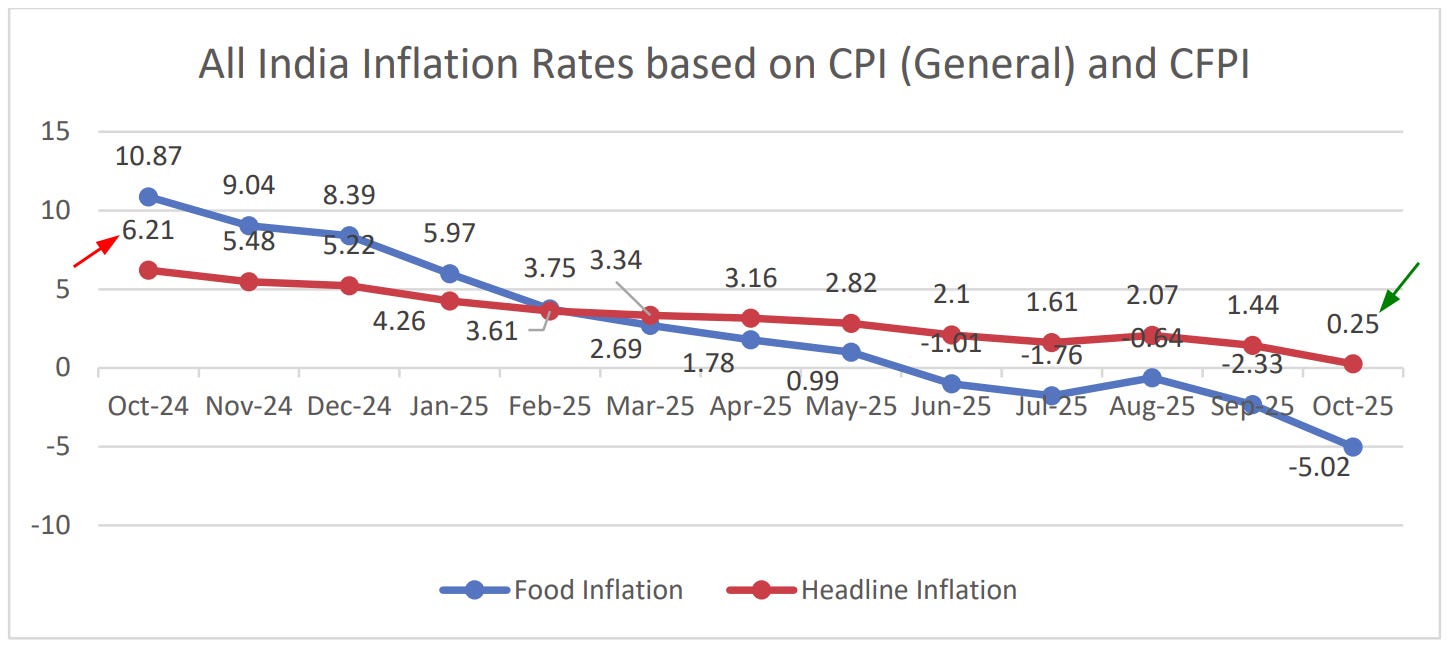
Food prices fell 5.02% year-on-year, driven by exceptional monsoon harvests and government supply-side measures including duty-free pulse and edible oil imports. The bumper kharif harvest has created a deflationary environment that, combined with GST reforms, is boosting consumer purchasing power. However, as The Daily Brief by Zerodha astutely notes, there’s a fascinating disconnect: while actual inflation is near zero, household surveys show consumers believe inflation is around 7.4%—creating exceptionally high real bond yields of nearly 6%.
On physical infrastructure, the Mumbai-Ahmedabad Bullet Train project achieved another milestone with the 11th steel bridge—a 70-meter span over the Cadilla flyover in Ahmedabad—launched on November 24. The 47 km Surat-Bilimora priority section has completed all civil construction and track-bed laying, with inaugural operations targeted for August 2027.
Full corridor completion from Mumbai to Ahmedabad—covering 508 km at speeds up to 320 km/h in just 1 hour 58 minutes—is scheduled for December 2029.
4. Digital Public Infrastructure & Tech
India’s semiconductor ambitions received a ₹4,500 crore booster shot as Union Minister Ashwini Vaishnaw announced on November 28 a transformative modernization programme for the Semi-Conductor Laboratory (SCL) in Mohali. The investment will scale wafer production 100-fold from current levels while maintaining SCL’s role as a government-owned R&D powerhouse.
Meanwhile, Odisha’s semiconductor ecosystem expanded with the groundbreaking of SiCSem Private Limited—India’s first commercial Silicon Carbide (SiC) compound semiconductor fab—in Bhubaneswar at EMC Park, Infovalley. This ₹4,600 crore facility, in collaboration with UK-based Clas-SiC Wafer Fab Ltd, will manufacture power electronics critical for EVs and clean energy infrastructure.
5. Biodiversity & Conservation (Flora/Fauna)
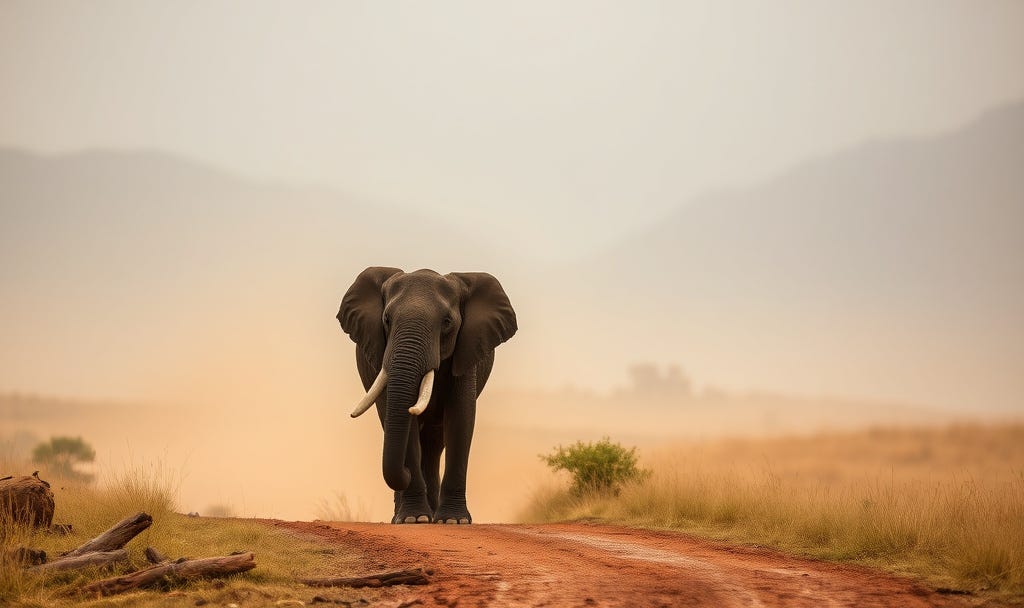
The Synchronous All-India Elephant Estimation (SAIEE) 2021-25—India’s first DNA-based elephant census—estimated 22,446 wild elephants across the country. While lower than the 2017 estimate of 27,312, officials note the figures aren’t directly comparable due to the scientifically rigorous new methodology using DNA-based mark-capture-recapture techniques, similar to tiger estimation protocols. Karnataka leads with 6,013 elephants, followed by Assam (4,159) and Tamil Nadu (3,136). The Western Ghats remain the largest stronghold with 11,934 elephants.
6. Defense (Army, Navy, Air Force)
The Indian Navy’s Swavlamban 2025—the fourth edition of its flagship Naval Innovation and Indigenisation Organisation seminar—concluded triumphantly on November 25-26 at Manekshaw Centre, New Delhi, under the theme “Strength and Power through Innovation and Indigenisation“.
Defence Minister Rajnath Singh delivered an impassioned keynote positioning startups as leaders of India’s defence revolution: “The movement of indigenisation in the country is not just a result of policy”. The event showcased ₹4,100 crore worth of indigenous defence commitments—₹2,700 crore in Acceptance of Necessity cases and ₹1,400+ crore in procurement orders—all materialized through iDEX-led participation.
Out of 565 iDEX challenges announced nationally, the Indian Navy owns 35%—a testament to its innovation leadership. Swavlamban has generated over 2,000 industry proposals, shaped 155 SPRINT challenges, and formally onboarded 213 MSMEs and startups through iDEX. Crucially, 173 challenges—including all 75 announced during Azadi ka Amrit Mahotsav—have been converted into tangible outcomes.
In high-altitude green defense, Defence Minister Rajnath Singh virtually inaugurated NTPC’s 3.7 MW solar plant at Chushul, Ladakh—featuring a pioneering hydrogen-based energy storage system delivering 200 kW of 24/7 power at 4,500 meters altitude where temperatures plunge to -40°C. This is the world’s highest such project, commissioned in a remarkable eight months, designed to supply clean power to remote Army posts in one of Earth’s most challenging terrains.
7. ISRO and Space Tech
PM Narendra Modi on November 27 virtually inaugurated Skyroot Aerospace’s Infinity Campus in Hyderabad and unveiled Vikram-I—India’s first privately developed orbital rocket capable of placing satellites into Low Earth Orbit!
The 200,000 sq ft Infinity Campus can design, develop, integrate, and test multiple launch vehicles with capacity to produce one orbital rocket monthly. Vikram-I is a technological marvel: India’s first all-carbon-fiber launch vehicle with 3D-printed engines, capable of launching 350 kg payloads to low earth orbit (LEO). Most remarkably, it can be assembled and launched within 24 hours from any site.
“India is set to emerge as a leader in global satellite launch systems,” declared PM Modi, praising founders Pawan Chandana and Bharath Dhaka—both IIT alumni and former ISRO scientists—as “big inspirations for the youth of the country”.
India’s private space ecosystem now encompasses over 300 startups, having absorbed $83.1 million in private equity investment through November 2025—nearly equaling the full-year 2024 total. A ₹1,000 crore Space Venture Capital Fund managed by SIDBI Venture Capital is now operational, targeting investments in 40 spacetech startups over FY2025-2030.
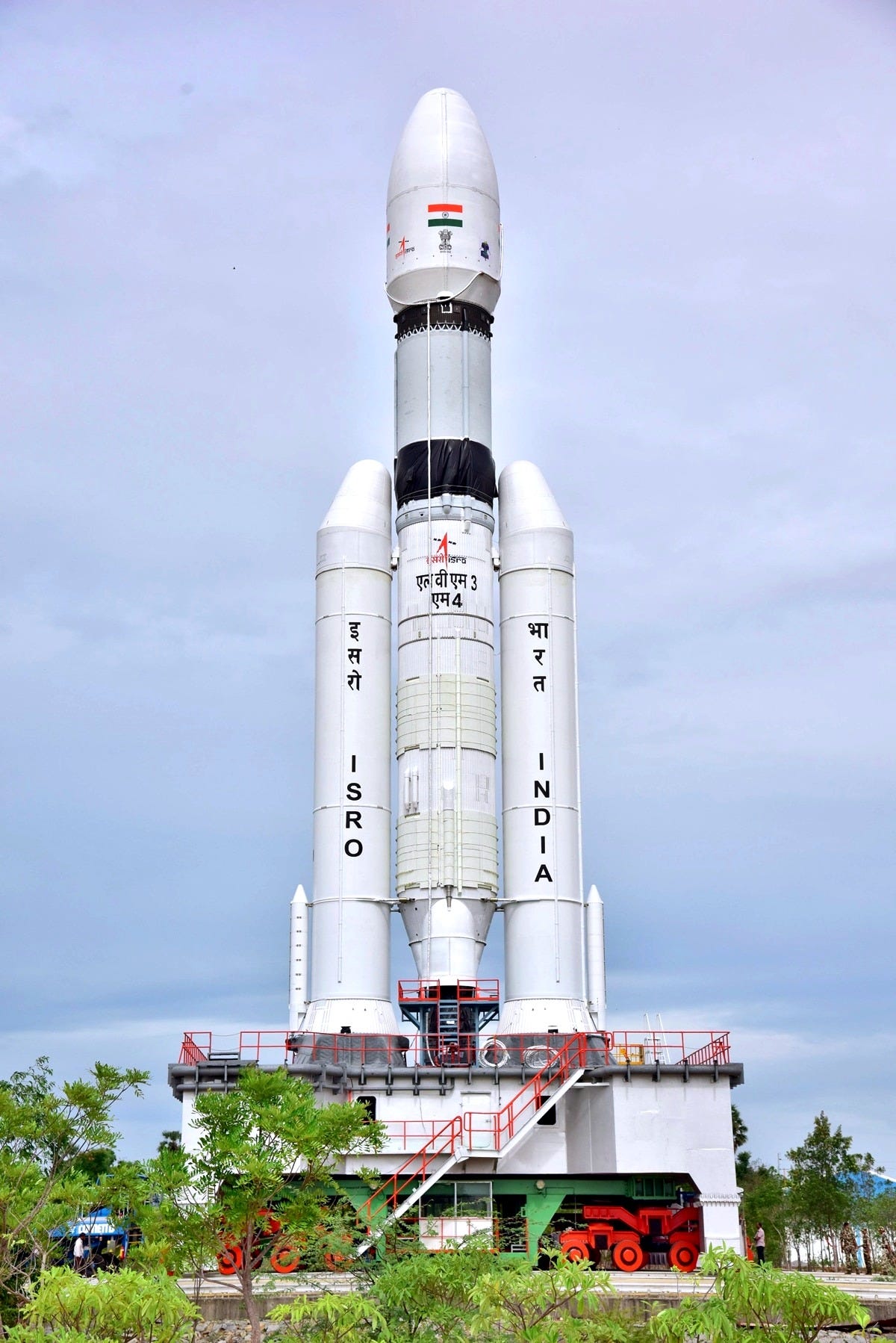
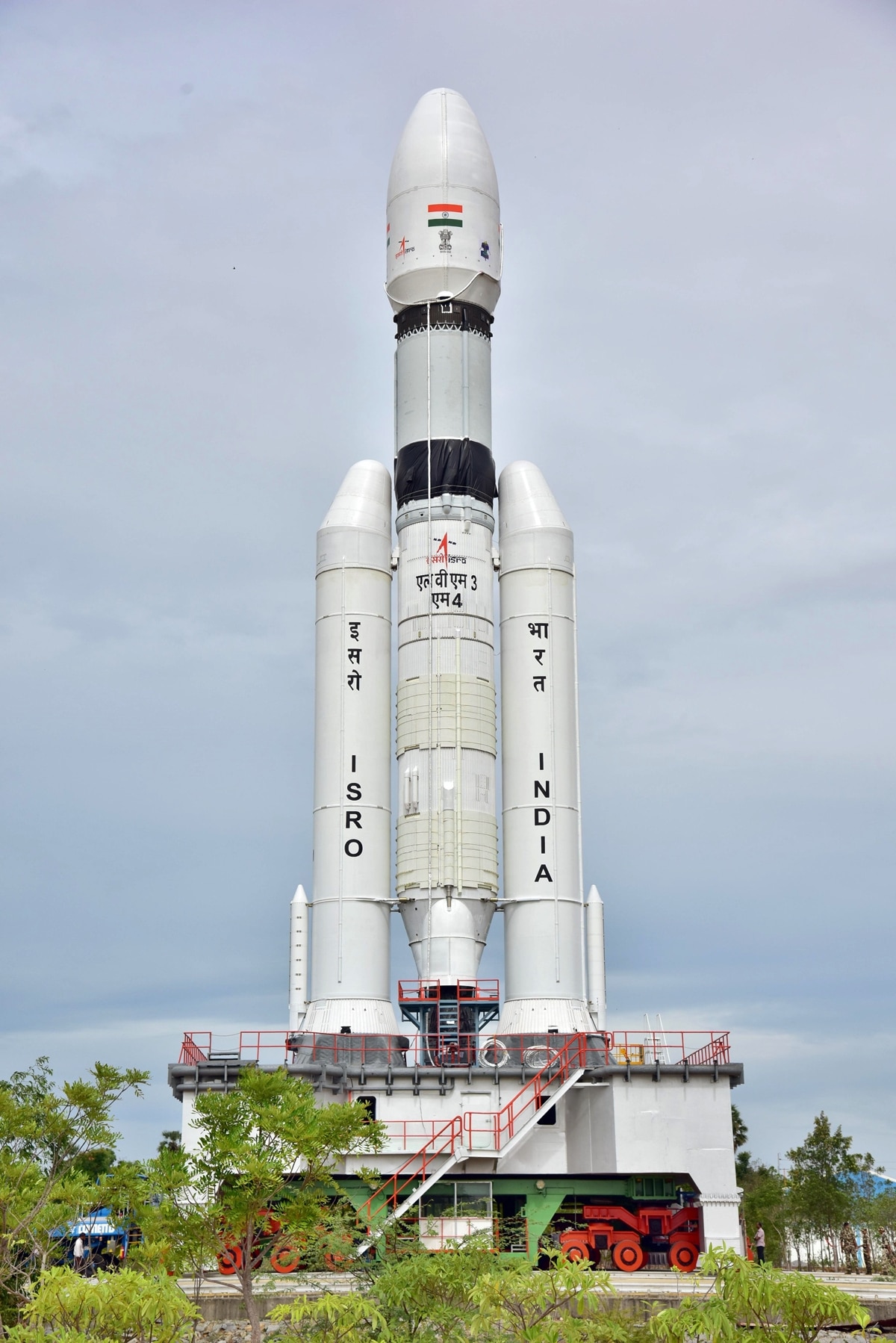
ISRO is preparing the heaviest commercial satellite launch in its history: the 6.5-tonne BlueBird-6 for Texas-based AST SpaceMobile using the LVM3 rocket from Sriharikota, expected in December. This US-licensed satellite will feature the largest commercial phased array in LEO at nearly 2,400 sq ft, supporting 10x data capacity over previous BlueBird satellites.
Quote of the Week
[Sanskrit]: आनो भद्राः क्रतवो यन्तु विश्वत: | ऋग्वेद – 1.89.1
[Hindi]: कल्याणकारक विचार चारों ओर से हमारे पास आयें|
[English]: Let noble thoughts come to us from all directions.
[English Transliteration]: āno bhadrāḥ kratavo yantu viśvato | Rig Veda 1.89.1