

In the damp, moss-draped canopy of the Alakaʻi Wilderness, there was once a silhouette that defied geometric expectation. The Kauaʻi nukupuʻu moved through the ‘ōhi‘a trees like a golden needle, carrying a beak of impossible architecture—a stout lower mandible for drumming against bark and a long, thin, decurved upper bill for extracting life from the hidden crevices of the wood. It was a master of two worlds, a percussionist and a surgeon, dressed in the muted yellow of a dying sun.
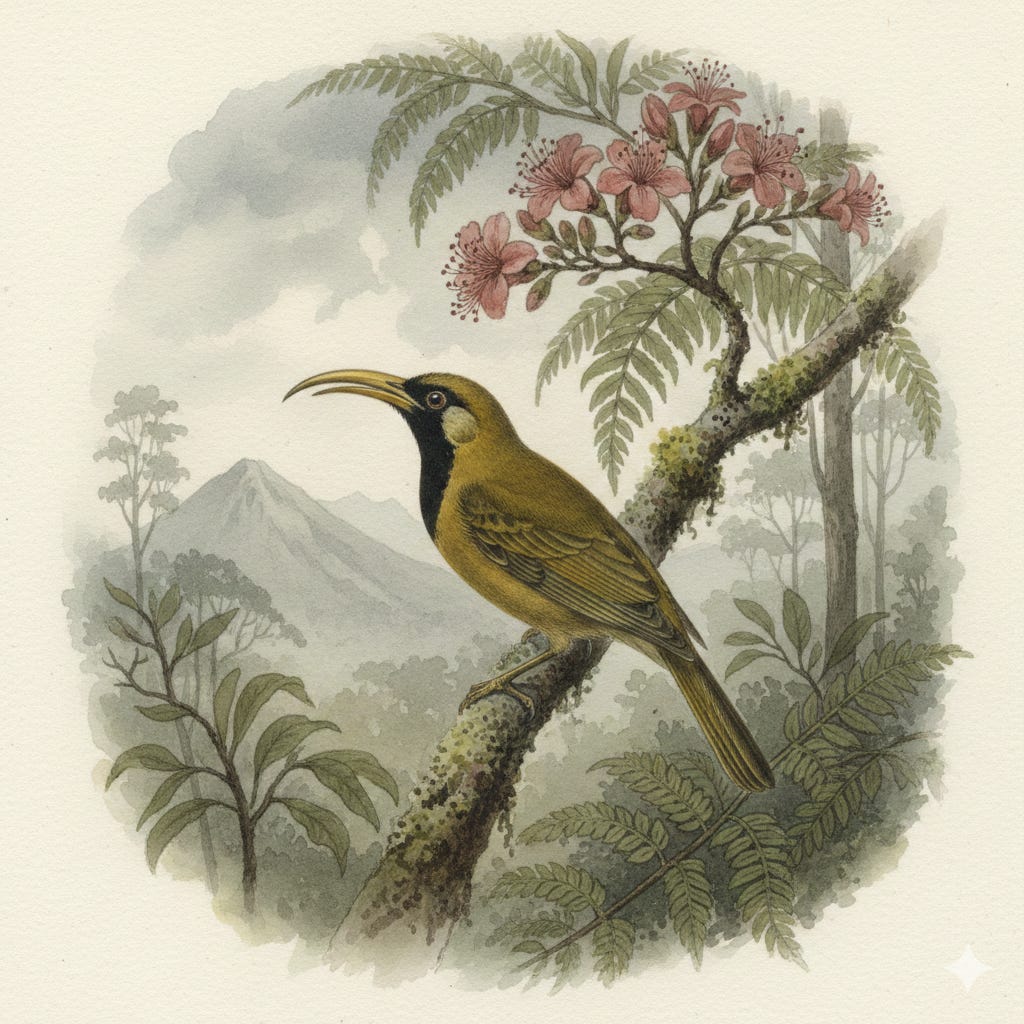
To lose the nukupuʻu is to lose a specific kind of silence. There is no longer the sound of that precise, delicate tapping against the lichen-covered branches, nor the flash of its olive-gold plumage through the persistent Kauaʻi mist. It belonged to the ancient lineage of Hawaiian honeycreepers, a family that adapted with such exquisite specificity that they became a living map of the islands’ botanical secrets. Now, that map has a hole burned through its center.
I imagine the last one clinging to a high ridge as a hurricane approached, its singular song—a warble of soft, descending notes—swallowed by the roar of a wind that no longer recognized its voice. It would have searched for a mate in a forest that had become a gallery of ghosts, its extraordinary beak finding only the hollow rot of trees that had forgotten the touch of its kind.