

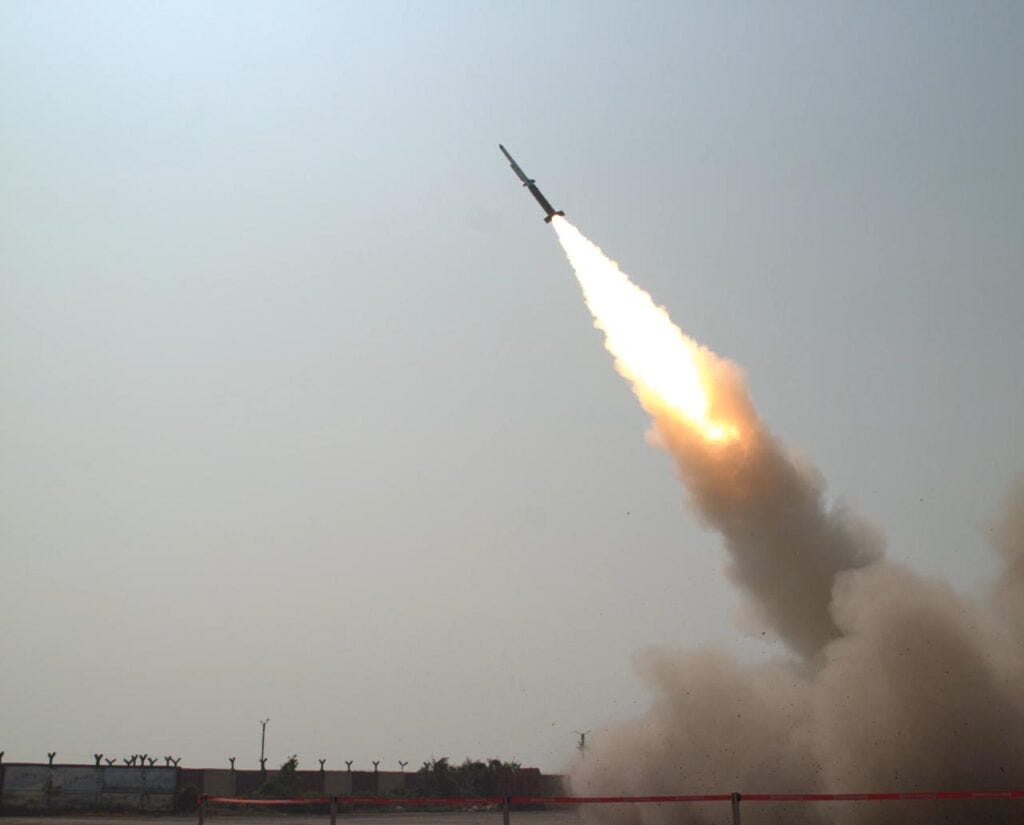
On February 3, 2026, at 10:45 AM, India fired a missile at a coastal test range most people have never heard of. The test lasted seconds. It will shape the next twenty years of Asian airpower.
This is the number that matters: 350 kilometers.
That’s the projected range of the Astra Mk3 — India’s next-generation air-to-air missile, now unlocked by the Solid Fuel Ducted Ramjet (SFDR) technology demonstrated at Chandipur. To put that in physical terms: an Indian fighter jet patrolling over Punjab could engage targets deep inside adversary airspace before the adversary pilot even knows they’re being targeted.
This isn’t just a new missile. It’s a structural shift in who controls the air over the subcontinent.
The Ducted Ramjet Club: Why Only Four Nations Have It
Let’s start with the most important fact:
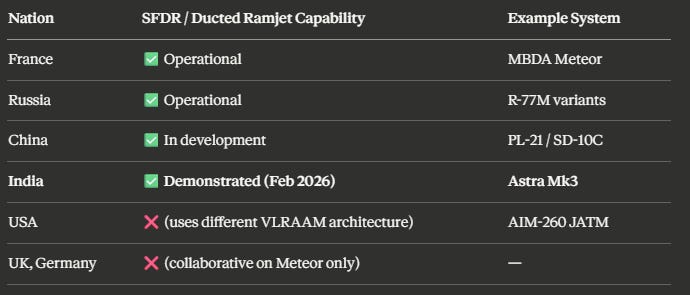
The United States — the world’s most advanced aerospace power — does not have an independently developed ducted ramjet missile in service. They chose a different path. India chose the harder one, and on February 3rd, they proved they can walk it.
This is not incremental progress. This is a category change.
Why Solid Fuel Ducted Ramjet Technology Is So Hard to Build
Most missile propulsion is simple: carry fuel and oxidizer, burn them, go fast. It works. It’s also inefficient — you’re hauling dead weight (the oxidizer) the entire flight.
Ramjets are different. They use the atmosphere itself as the oxidizer. The missile scoops in air at high speed, compresses it, injects fuel, and combusts. No oxidizer mass penalty. Dramatically higher efficiency. The problem: you can’t use a ramjet from a standing start. You need to already be going fast.
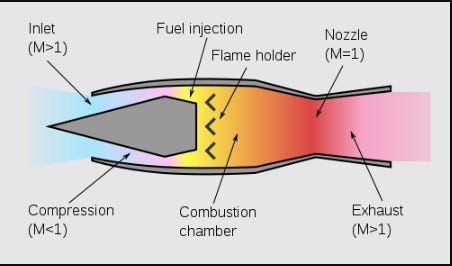
The solution is the ducted ramjet: line the combustion chamber with solid fuel that acts as a booster. The solid fuel accelerates the missile to ramjet-operating speeds, burns out, and the ramjet takes over — seamlessly, in the same chamber.
This sounds elegant. It is brutally hard to execute:
The solid fuel must burn at exactly the right rate — too fast and you waste propellant, too slow and the ramjet transition fails
Combustion temperatures exceed 1,400°C — requiring materials that simply didn’t exist a generation ago
The transition from solid-fuel mode to air-breathing mode must be seamless; a momentary flameout ends the engagement
Nozzle geometry must optimize thrust across radically different altitudes and pressures
Every one of these is a solved problem in the France and Russia. India solved them early this year.
The Kaveri Engine: 35 Years of Failure That Built India's Missile Program
To understand what February 3rd means for us, you need to understand what came before it.
Since 1989, India has been trying to build an indigenous jet engine — the Kaveri — for the Tejas light combat aircraft. The program has been, by any objective measure, a failure to achieve its original goals:
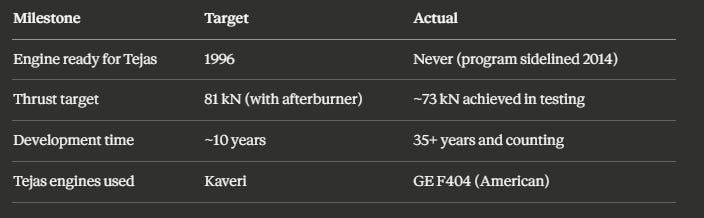
The Kaveri’s story has been used — fairly — as evidence of DRDO overreach. Grand promises. Missed deadlines. Eventual quiet shelving.
But here’s the interpretation almost everyone missed: India didn’t waste 35 years. It paid tuition.
Jet engine development is not a problem you solve by being smart. It’s a problem you solve by accumulating thousands of engineers who have personally failed at specific sub-problems, built intuitions about why, and tried again. The United States spent 50+ years and hundreds of billions perfecting the F100 and F110 engines that power its fighters. Pratt & Whitney and GE didn’t figure out turbine blade cooling in a decade — they iterated across generations of engineers.
The Kaveri built that institutional base in India. The SFDR test is the first major return on that investment.
The Kaveri’s failures weren’t a detour. They were the foundation.
India vs. China: The Missile Gap the Astra Mk3 Closes
The strategic reality that makes the SFDR timing critical is fact that China has not been standing still:
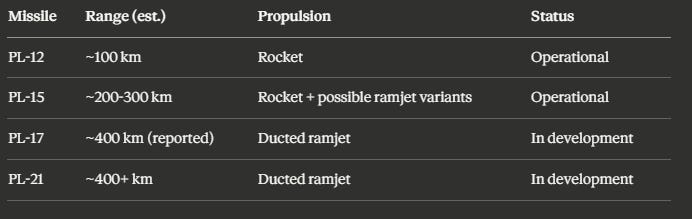
The PL-15 — already operational with the Chinese air force — outranges every current Indian air-to-air missile. In a real engagement over the Himalayas, Chinese fighters could fire first, from further away, with more energy at terminal phase.
This is the missile gap India cannot accept.
The Astra Mk3, with SFDR propulsion, closes it. A 350km Indian missile against a 300km Chinese missile restores parity. Pair that with India’s Su-30MKI and forthcoming Tejas Mk2 platforms, and the calculus shifts further.
The Himalayas also create a specific physics advantage for long-range missiles: high-altitude launches give missiles more range and speed due to thinner air. India’s geography — defending from high-altitude bases — multiplies the Astra Mk3’s already formidable specifications.
What “350 Kilometers” Actually Means
Abstract numbers need grounding. Let’s look at the geometry:
Scenario: India-Pakistan western border. Indian fighter at 40,000 feet over Amritsar. Astra Mk3 with 350km range.
Engagement zone extends to: ~250km into adversary territory (accounting for launch altitude and missile flight profile)
Pakistani early warning time: Minimal. A Mach 4 missile closing from 200km gives approximately 90 seconds of warning after radar detection.
Countermeasure window: Near-zero for most current combat aircraft
Scenario: Himalayas, high-altitude patrol at 50,000 feet. Astra Mk3 in thinner air.
High-altitude launch extends range further — potentially 380-400km effective
Terminal velocity higher due to thin air drag reduction
Adversary aircraft over Tibet plateau are within engagement range of Indian CAP positions
This is the operational reality the SFDR test just made possible. It’s not theoretical. It’s a targeting geometry shift that Chinese and Pakistani air force planners will be studying this week.
India’s Defense Technology Trajectory: What Comes After SFDR
The SFDR breakthrough isn’t an isolated event — it’s a data point on a curve that’s been bending upward for a decade. Look at the pattern:
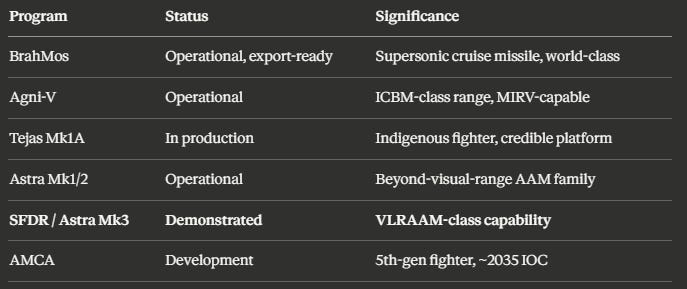
The velocity of this trajectory has changed. India is no longer in the phase of learning how to build complex systems. It’s in the phase of deploying them.
There is one honest caveat: India still cannot build its own fighter engine. The AMCA will almost certainly use foreign powerplants for its first variants. Full propulsion sovereignty — the Kaveri’s original promise — remains a decade away at minimum.
But the SFDR test proves something important: India’s defense scientists have mastered the hardest parts of propulsion engineering. Combustion thermodynamics. Materials science at extreme temperatures. Transition dynamics between propulsion modes. These skills transfer. The jet engine problem is, at its core, the same class of problem. India is closer than it’s ever been.
A Few Predictions
Here’s what I expect to see over the next 36 months, in rough order:
Astra Mk3 integrated flight tests within 12-18 months — full missile, not just propulsion demonstration
Su-30MKI integration cleared within 24 months — India’s primary long-range interceptor gets its long-range missile
Export inquiries from at least two nations — India needs defense export revenue, and a proven VLRAAM is a compelling product
PL-15 response doctrine update by Indian Air Force — tactics for operating under Chinese long-range missile threat will be revised once Mk3 gives India a symmetric counter
Kaveri derivative announcement for marine or industrial use within 3 years — the thermal and materials work from SFDR feeds directly back
If any of these don’t happen, I’m wrong about the pace. But the technical foundation is now real. The institutional momentum is visible. The strategic imperative is urgent.
India doesn’t just need this missile. It needs to field it.