

1. Deep Science: India’s High-Temp Carbon Capture & "POMbrane" Breakthroughs
India’s scientists spent this week turning blue-sky research into gritty industrial hardware, exactly the kind that bends the emissions curve while boosting competitiveness.
CSIR–NIIST in Thiruvananthapuram unveiled a spectacular Indo‑Japanese partnership with Noritake Co. Ltd. to deploy jointly‑patented ceramic sorbents that capture CO₂ at 300–400°C straight from industrial flue gas, eliminating costly cooling stages (such as used in traditional amine solutions). This isn’t just clever chemistry; it slashes energy use and operating costs for carbon capture, making it far easier for Indian steel, cement, and power plants to decarbonise without sacrificing output.
At CSIR‑CSMCRI in Bhavnagar, researchers working with IIT Gandhinagar showcased a new class of crystalline “POMbranes” with nanometre‑scale (thousands of times thinner than a strand of hair) pores that deliver roughly 10x better separation performance than conventional polymer membranes while remaining flexible and scalable. These membranes let textile and pharma plants reuse water more efficiently and cut energy‑hungry distillation, a massive win for both industrial competitiveness and India’s freshwater‑stressed river basins.
POMbranes are inspired by aquaporins, a family of pore-forming proteins that act as natural plumbing systems in cells! This is bio-mimicry at its best.
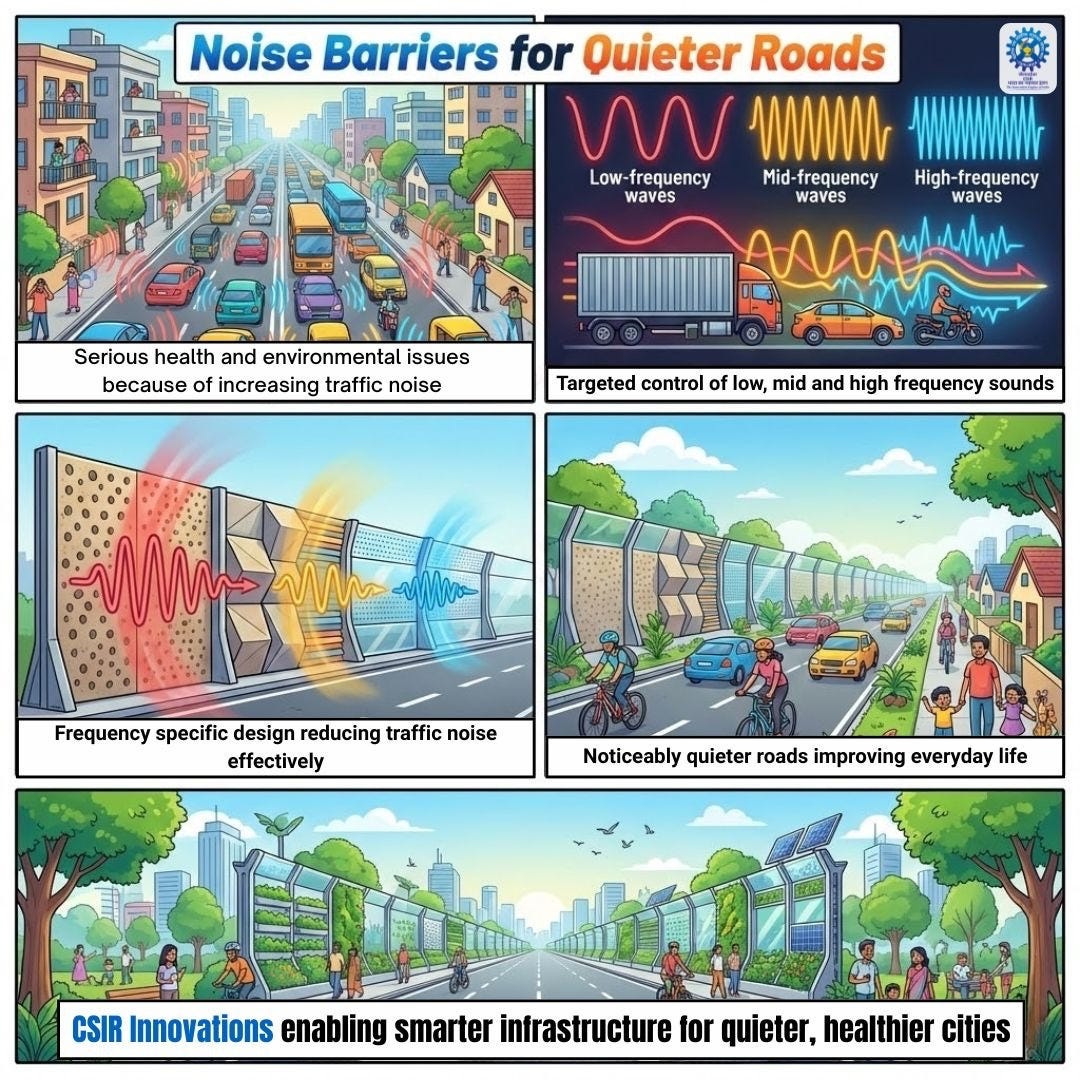
CSIR‑CRRI’s smart noise‑barrier research moved from lab curiosity to urban health tool, as field results showed that engineered barriers along flyovers can cut noise enough to save up to ₹5.5 crore per 1,000 people per km annually in avoided health costs. This is lab‑to‑land at its finest: a single stretch of barrier turns down stress hormones, heart‑disease risk, and lost productivity for tens of thousands of city residents at once.
CSIR‑NIIST and other CSIR labs underlined how Indian science is now building technologies that dovetail perfectly with national policy, from carbon‑capture aligned with a fresh ₹20,000 crore budget outlay for climate technologies to membranes that fit neatly into India’s “waste‑to‑wealth” and industrial‑water‑reuse push. Every new patent is trying to be more than just a paper — it could be a future factory line, a retrofitted smokestack, a cleaner river.
2. Energy Transition: The ₹12.2 Lakh Crore Capex Blueprint
The Union Budget 2026 doubled down on clean‑energy‑led growth by planning a powerful ₹12.2 lakh crore central capital expenditure push, with a clear emphasis on infrastructure, renewables‑heavy manufacturing, and critical‑mineral value chains that underpin solar, batteries, and grid hardware. This is not abstract macroeconomics—every rupee of capex seeds turbines, transmission lines, and gigafactories that make India an electrostate (more on this next week) rather than an imported‑fuel addict.
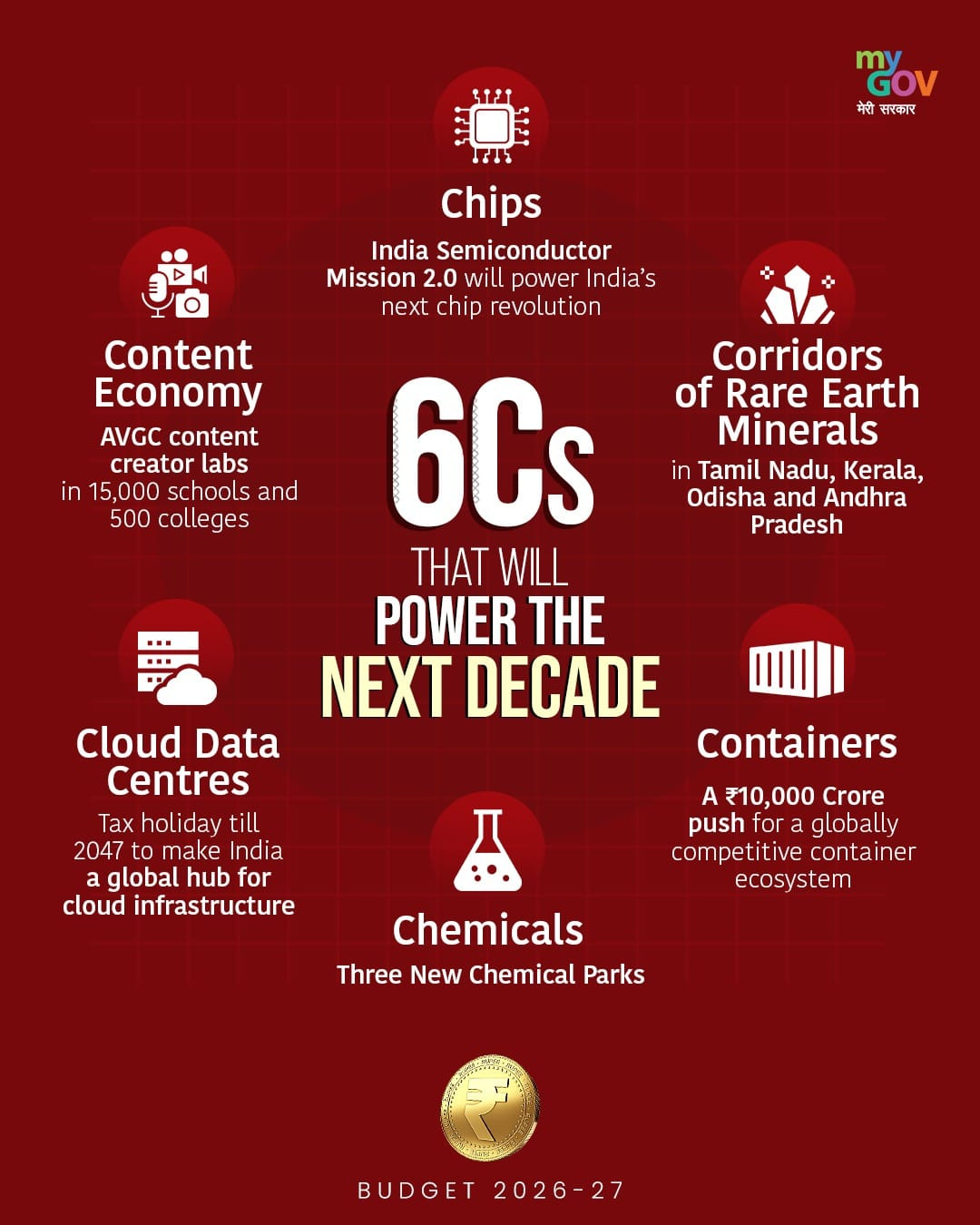
On top of that, the Budget steps up capex‑linked grants to states to just under ₹5 lakh crore, explicitly nudging state governments to accelerate renewable parks, green industrial corridors, and urban‑transport electrification. When Lucknow, Surat, or Coimbatore draws on these grants, they are effectively tapping central firepower to decarbonise local grids and transport while creating high‑quality jobs.
Crucially, the Centre commits to keep the fiscal deficit on a glide path towards 4.3–4.4% of GDP over FY26‑27, even while it pours concrete and steel into green infrastructure. That discipline matters: by keeping borrowing credible, India keeps sovereign yields in check, making it cheaper for NTPC [NSE: NTPC], Tata Power [NSE: TATAPOWER], NHPC [NSE: NHPC], and state utilities to raise private capital for ever‑larger solar, wind, and hydro projects.
The Economic Survey 2025‑26 adds the intellectual backbone, arguing that India must chase “strategic indispensability” in manufacturing, including green tech, so that global supply chains need Indian batteries, power electronics, and solar glass rather than treating the country as just another buyer. In climate terms, that means every new cell line, inverter plant, or power‑electronics fab in India doesn’t just clean up our own grid—it hard‑wires Indian hardware into the world’s decarbonisation story.

3. Macro-Economy: Chasing "Strategic Indispensability" via Infrastructure
On 1 February, India didn’t just release another Budget; it unveiled a meticulously engineered roadmap to keep building even as global macro headwinds howl.
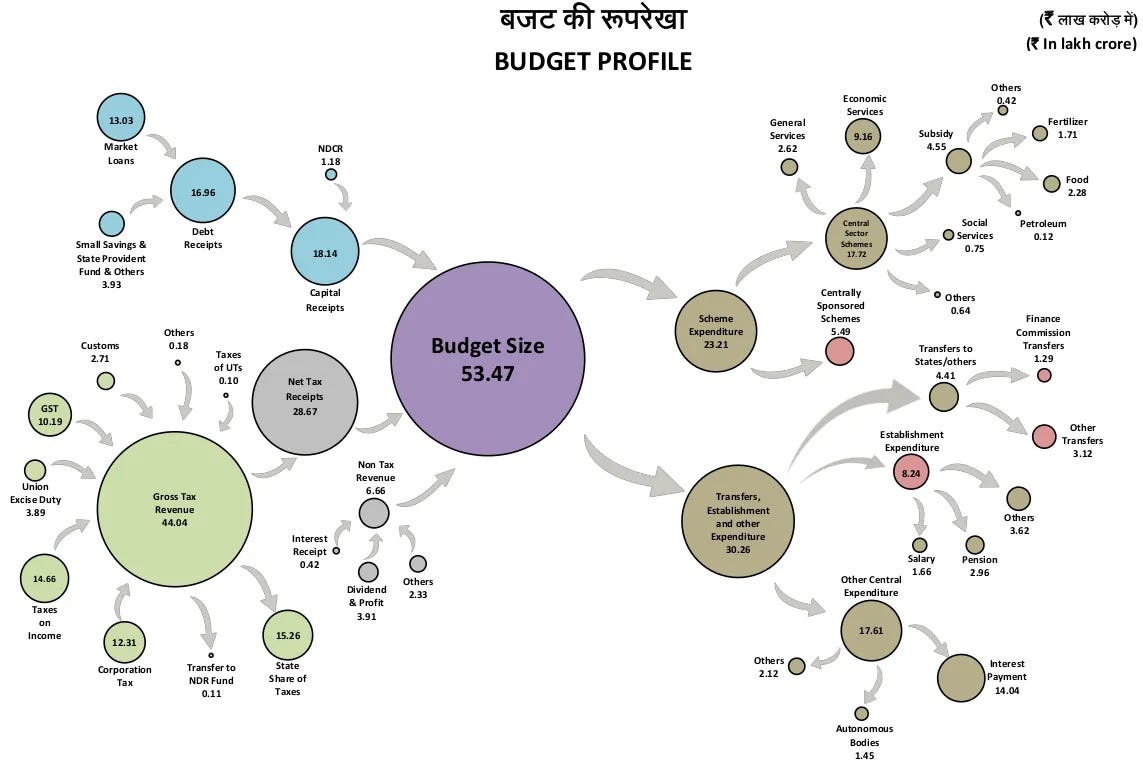
The Budget 2026 design is beautifully three‑pronged: maintain high capital spending, slowly narrow the deficit, and preserve enough fiscal flexibility to respond if the global storm intensifies. In practice, that means pressing ahead with highways, railways, logistics parks, and urban‑transport systems while keeping borrowing to about ₹17 lakh crore next year—only roughly ₹1.37 lakh crore higher than this year despite ambitious plans. Every newly completed expressway, DFC link, or port logistics project this capex pays for will lower logistics costs for farmers and small manufacturers, making Indian goods more competitive in a choppy world.
The Budget’s tilt towards electronics, semiconductors, data centres, logistics, and biopharma—highlighted by market commentators this week—signals a decisive bet on high‑productivity, tradable sectors that can soak up India’s expanding workforce. This isn’t just about GDP numbers; it is about making sure a young graduate in Coimbatore or a technician in Noida can work on chips, cloud or cold‑chain infrastructure instead of being trapped in low‑productivity informal work.
The Economic Survey complements this by spotlighting five big structural challenges:
trade fragmentation,
stressed state finances,
lagging manufacturing competitiveness,
capital shortages for businesses,
and skill gaps.
Its answer—build depth in strategic manufacturing, deepen financial markets, and overhaul the skill pipeline—translates, on the ground, into better‑capitalised MSMEs, more resilient state budgets, and young Indians trained for the exact jobs that new factories and infrastructure projects are creating.
Even in food security, the macro and the micro connected in a spectacular way this week as India achieved 100% digitisation of ration cards. This single systems upgrade means the same rupee of food subsidy now feeds more real people instead of vanishing into ghost beneficiaries, freeing fiscal space for everything from rural roads to irrigation canals.
4. Digital Statecraft: 100% Digitization of the World’s Largest Food Pipeline
By confirming 100% digitisation of ration cards and Aadhaar linkage for over 99% of them, the government has effectively turned the world’s largest food‑security programme into a high‑precision, low‑leakage digital pipeline. This isn’t just paperwork going online; it means a migrant worker moving from Bihar to Gujarat can, with One Nation One Ration Card, access grain entitlements without falling through bureaucratic cracks. Till date, 201 crore (2.01 billion) portability transactions have been facilitated through this digitization, simplifying the lives of those who cannot afford bureaucratic bottleneck when faced with the question of feeding their family.
The Economic Survey also leaned hard into the idea of Digital Public Infrastructure (DPI) as India’s secret weapon in an uncertain world, framing platforms like Aadhaar, UPI, and DigiLocker as the rails that let citizens and firms transact, borrow, and build despite global turbulence. When new DPI features roll out on top of this base—whether it is more granular welfare portability or easier credit access for small businesses—they will sit on top of an already‑scaled, already‑trusted stack, letting India iterate at software speed rather than bureaucracy speed.
5. Blue Economy & Biodiversity: Seaweed Farming as Living Infrastructure
On 2 February, India joined the world in marking World Wetlands Day, and it did so as one of the planet’s most aggressive expanders of Ramsar‑listed wetlands. While the headline this week was the Economic Survey and Budget, wetlands quietly sat at the intersection of those two: capital spending on river rejuvenation, urban‑flood management, and coastal resilience channels money into the very ecosystems—marshes, mangroves, floodplains—that buffer cities against extreme weather.
The Survey’s emphasis on climate resilience and infrastructure makes wetlands policy more than a feel‑good environmental story; it is a hard‑nosed macro hedge. A restored mangrove belt outside Mumbai or Kolkata acts like living storm‑surge infrastructure, just as a revived urban lake in Bengaluru or Hyderabad becomes a free storm‑water reservoir that spares taxpayers future spending on grey infrastructure.
India’s science‑policy machine also pushed ahead on blue‑economy conservation this week via the Indian International Seaweed Expo and Summit 2026 in Kochi, which brought together scientists, policymakers, industry leaders, and innovators to scale sustainable seaweed farming. Seaweed cultivation doesn’t just create rural coastal jobs; it sequesters carbon, improves near‑shore water quality, and opens up new value chains in food, fertilisers, bio‑stimulants and even biomaterials.
Taken together, these moves show India treating ecosystems as serious economic infrastructure—wetlands as flood‑control assets, seaweed beds as climate‑smart industry platforms—rather than scenery. That is the Anthropocene mindset we need: nature as partner, not obstacle.
6. Space Economy: Scaling ISRO for "Strategic Indispensability"
This week didn’t feature a major launch window, but space quietly threaded its way through the macro story in two crucial ways.
First, the Budget 2026 continues the pattern of steady, reliability‑focused funding for ISRO, ensuring that India’s space programme can keep scaling satellite constellations for communications, navigation, and—critically—Earth observation. Those observation satellites feed directly into agriculture advisories, flood warnings, and infrastructure planning, turning every new satellite into a force multiplier for farmers, city engineers, and disaster‑response teams on the ground. I have written about this and many astonishing features of ISRO, in India Positive’s 1st monthly deep dive that you can read here:
India Was the Poorest Nation to Launch a Space Program. Here's How ISRO Outpaced Europe.

How India Launched a Space Program at $107 Per Capita GDP
Second, the Economic Survey’s call for strategic indispensability in manufacturing and high‑tech sectors implicitly includes space hardware—from precision components and sensors to launch‑vehicle subsystems. As private Indian spacetech startups (more on this in the ISRO deep dive part 2, coming soon) slot into this vision, they will increasingly build for both domestic missions and export markets, making India not just a low‑cost launcher but a full‑stack space‑tech supplier in the global clean‑growth economy.