

Beneath the newest stretch of the Delhi-Dehradun Economic Corridor, two tunnels burrow through the embankment. They were not engineered for cars. They were built for elephants.

Deep Science and Innovation
A Rs 10,000 Crore Bet on the Long Game
The Central Government approved Startup India Fund of Funds 2.0 on April 13, with a corpus of Rs 10,000 crore channeled through SEBI-registered Alternative Investment Funds via SIDBI. The original 2016 Fund of Funds deployed approximately Rs 7,500 crore across 100+ AIFs. This round is larger, and deliberately structured differently.
The critical design choice: capital explicitly ring-fenced for deep tech startups with “longer R&D cycles.” That phrase is doing real work. Commercial venture capital systematically underinvests in science-heavy bets, the ones that take eight years and a hundred failed experiments before a deployable product emerges. The government is writing a check that says: we will fund the wait. Returns flow back to the Consolidated Fund, making this a revolving public investment rather than a one-time disbursement. Deep tech is compounding.
Energy and the Green Transition
NTPC Green Crosses 10 Gigawatts
NTPC Green Energy [NSE: NTPCGREEN] declared commercial operation of 150 MW of solar capacity in Rajasthan on April 18, pushing the group’s total installed capacity to 10,276 MW. That is enough capacity to power roughly 8 to 9 million Indian homes, crossed on a Friday afternoon in Rajasthan. The project is held by Project Sixteen Renewable Power, a subsidiary of ONGC NTPC Green, built on the Ayana Renewable portfolio that ONGC and NTPC jointly acquired in March 2025. The remaining 150 MW from the same 300 MW project is pending commissioning.
Two of India’s largest public sector companies now operate a joint clean energy arm. ONGC, which built its balance sheet on crude, is now a co-owner of solar farms in Rajasthan. That structural pivot, quiet as it has been, is one of India’s most consequential industrial transitions in a generation.
[DATA VIZ: NTPC Green quarterly capacity additions 2023-2026, with the 10 GW milestone marked. Overlay: ONGC-NTPC Green’s contribution post-Ayana acquisition, showing how one M&A decision changed the trajectory.]
India’s Grid Gets Standards Worth Having
The Central Electricity Authority published the Technical Standards Amendment Regulations 2026 on April 14, taking effect April 1, 2027. Large-scale BESS projects of 50 MW or more must now provide black-start capability: the battery storage system must be able to restart a grid from a complete blackout, independently, without needing another power source to get it going first. Solar modules must retain 70% output at year 15. All renewable facilities must enable remote dispatch from load dispatch centers and retain 90 days of operational data.
India has spent the last decade adding capacity. Now it is building the standards that will make that capacity behave like a grid rather than a collection of generation assets. MW is a supply story. Standards are a reliability story. India is finally writing both chapters simultaneously.
Infrastructure and Economy
A Highway That Fits Around Elephants
PM Modi inaugurated the Delhi-Dehradun Economic Corridor on April 14: 213 kilometers, over Rs 12,000 crore, cutting the Delhi-to-Dehradun journey from six-plus hours to 2.5 to 3 hours. The route runs through Delhi, Uttar Pradesh, and Uttarakhand, with 10 interchanges and 3 railway overbridges.
The number that deserves the headline is not the travel time. It is this: a 12-kilometer elevated corridor threading through Rajaji National Park, with 8 animal passes and 2 dedicated elephant underpasses. India built through a wildlife reserve without breaking it. The elevated road keeps the forest floor continuous. The underpasses keep elephant movement corridors intact. Infrastructure that accommodates wildlife rather than replacing it is not standard practice anywhere in the world. India is building the template.
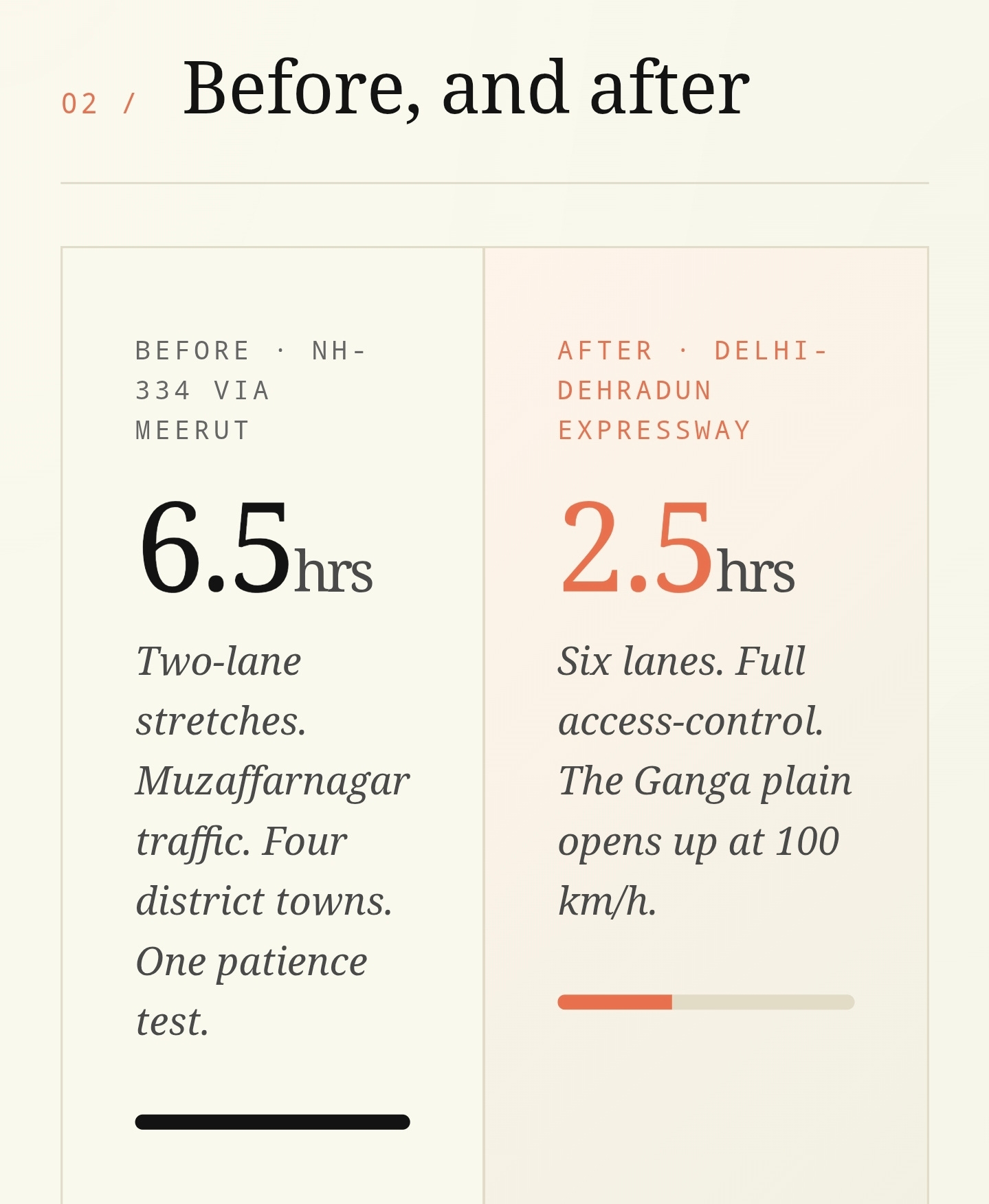
The old highway cost six hours and a herd's right of way. The new one costs neither. A road that chooses stilts over dominion is a quiet admission: the tuskers were here first, the forest still is, and the fastest way forward is sometimes straight up.
Delhi-Mumbai Expressway: One More Segment
The Godhra-Vadodara stretch of the Delhi-Mumbai Expressway opened for trial traffic on April 13, adding another completed segment to India’s longest access-controlled highway. Each activation compresses freight time between Mumbai and Delhi. The full corridor, when complete, will be the logistics spine of the country’s western economic corridor.
Biodiversity and Conservation
The Karimeen Is Losing Its Own Home
Veli-Akkulam estuary in Thiruvananthapuram, Kerala: 0.85 square kilometers, historically dense with native karimeen (pearl spot), barbs, and indigenous catfish. A new study documents what has happened since. Mozambique and Nile tilapia, Amazon sailfin catfish, and invasive water hyacinth mats have reorganized the estuary around generalist invaders. Food web energy transfer efficiency collapsed from 10.9% in 2008-10 to 7.69% in 2022-23. A simpler food web means fewer fish, smaller catches, and a fishing community watching its livelihood reorganize around species nobody wants to eat. The system is becoming simpler, less connected, more fragile.
Urban runoff, sewage, nutrient pollution, and periodic closure of the estuary mouth are the enablers. Scientists call for ecosystem-based management: invasive species removal, habitat restoration, catchment-scale intervention. The karimeen, the fish that appears on Kerala wedding banana leaves, is ecologically displaced in its own home waters. This is not a distant biodiversity headline. It is happening at the edges of a state capital, in a lagoon you can drive past on your way to the airport.
Defense
Dhruvastra Is Ready. It Took Four Decades.
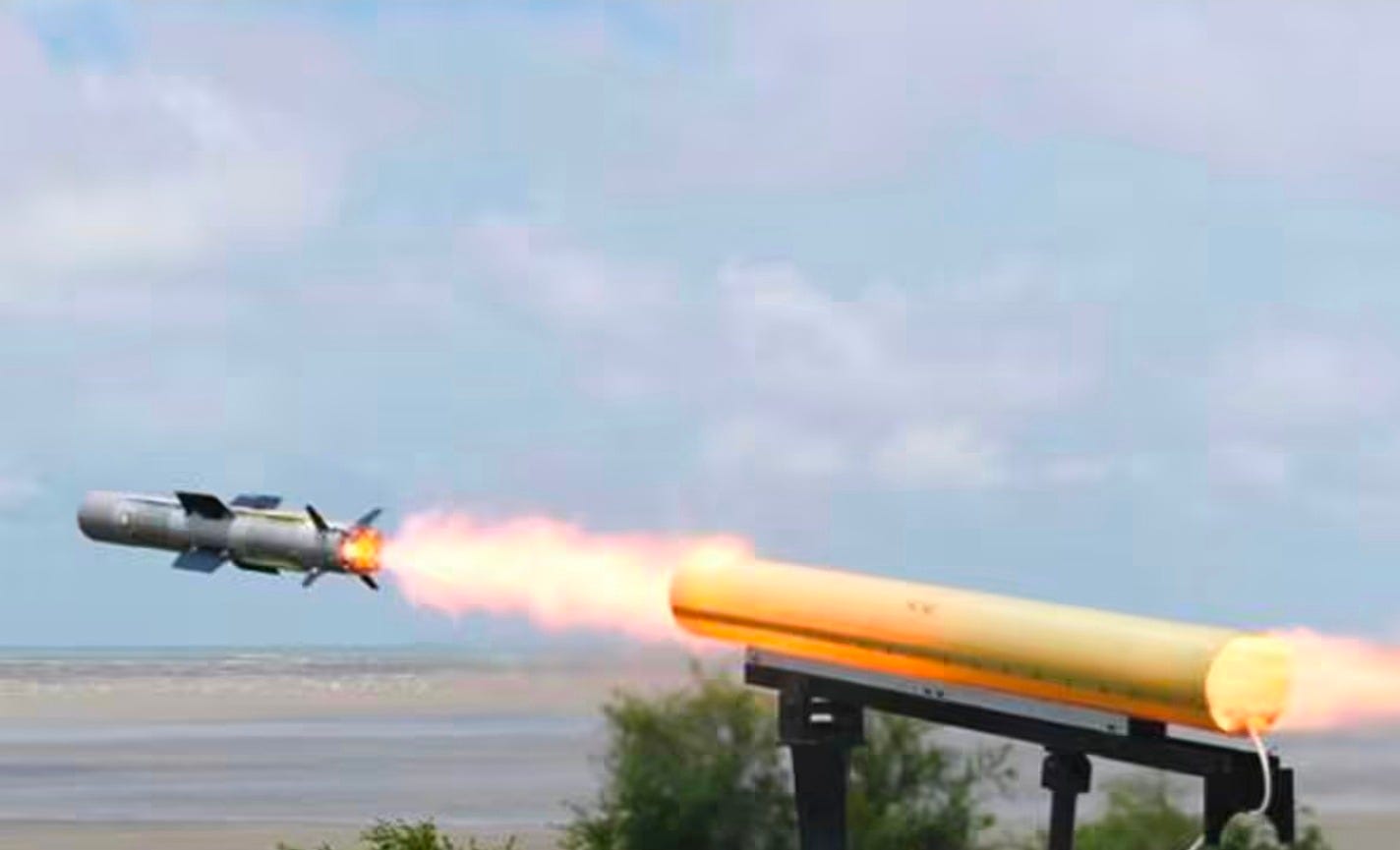
DRDO declared Dhruvastra, India’s third-generation fire-and-forget helicopter-launched anti-tank guided missile, induction-ready for the Indian Air Force on April 12. The missile traces its lineage to the Integrated Guided Missile Development Programme that APJ Abdul Kalam conceived in the late 1980s. Quick stats:
Range: up to 7 kilometers.
Armor penetration: 800 mm.
Weight: 43 kilograms, optimized for high-altitude deployment.
Compatible with HAL Rudra and HAL Prachand attack helicopters.
The Defence Acquisition Council cleared Rs 700 crore for 200+ units in September 2023. Initial procurement estimates: 500 missiles, 40 launcher systems, at under Rs 1 crore per unit. India previously imported Konkurs and MILAN for this role. The imports are no longer required. A missile program born under one prime minister, matured under six, and now ready for the regiment.
India Greenlights a Mountain Rescue Drone
The Indian Air Force received approval on April 14 to develop an indigenous Combat Search and Rescue drone under the Make-I framework: government funds 70%, Indian industry 30%. Operational parameters: sea level to 16,000 feet (extendable to 20,000), minimum 200-kilometer operational radius, 45-minute loiter time, 400-kilogram payload (four passengers or stretchers), runway-independent, satellite-navigation-independent.
A UAV that operates in the mountains without GPS and without a runway, carrying four stretchers, is not only a military asset. Every state that has seen floods, glacial lake outbursts, or avalanche rescues in the past decade has a use for this machine.
DRDO Takes the Arsenal to Bihar
DRDO ran a 4-day defense technology exhibition at Motihari, Bihar from April 15 to 18: BrahMos, Akash, Pralay, Arjun MBT, Indian Light Tank, ATAGS, Pinaka rockets, Uttam AESA radar, Kaveri engine, and drone detection systems. The theme: peace, truth, and science, converging toward a secure and self-reliant India. Taking this exhibition to Motihari and not to Delhi or Bengaluru is a deliberate signal. Aatmanirbharta is most legible when you can walk up to a missile and touch it.
ISRO and Space
India Publishes Its Space Junk Ledger
ISRO’s Indian Space Situational Awareness Report for 2025, covered widely in mid-April, confirmed that 36 Indian rocket bodies safely re-entered Earth’s atmosphere and burned up by December 31, 2025. All LVM3 upper stages have deorbited except three from recent missions.
2025 was the most active year in the history of orbital launches. Globally: 328 launch attempts, 4,198 operational satellites placed in orbit. The upper atmosphere is getting crowded. Very few spacefaring nations publish a public accounting of their debris. ISRO’s zero orbital debris by 2030 target is being tracked against hard data, mission by mission. In a year when Starlink alone was adding satellites by the hundreds, India accounting publicly for its rocket bodies is the kind of unglamorous responsibility that long-term space civilization will require from everyone. India is practicing it first.