

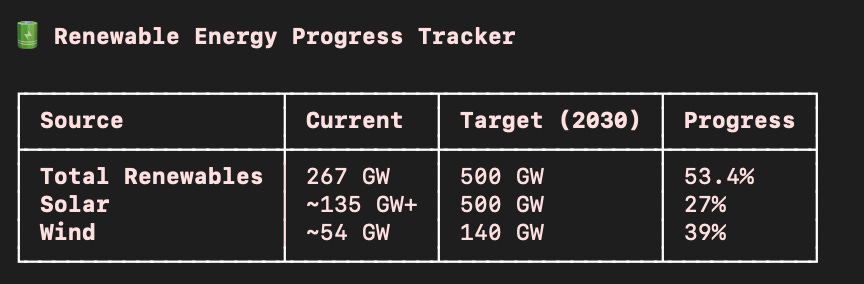
India crossed 267 GW of renewable energy this week. That’s 53% of total capacity—ahead of schedule by years. While the world debated climate pledges, 2.7 million Indian households installed rooftop solar. Here’s what the data actually says about India’s industrial transformation.
Energy & Green Transition
India’s Renewable Energy Milestone: 267 GW Non-Fossil Capacity Achieved
India’s installed non-fossil fuel capacity reached 267 GW, with renewable energy now accounting for 52% of total installed power capacity—a threshold that places the nation ahead of previous targets. This was detailed by Union Minister for New and Renewable Energy Pralhad Joshi at the World Economic Forum in Davos on January 21, 2026, underscoring that India’s energy transition has been deliberately engineered as an industrialization and employment driver, not merely a climate obligation.
The nation added approximately 50 GW of renewable energy capacity in 2025, backed by investments of ₹2 lakh crore ($24 billion USD). Of this 50 GW, 35 GW came from solar installations alone, marking the fastest growth rate in the sector’s history.
India added 50 GW of renewables in 2025—35 GW from solar alone. That’s not a climate transition. That’s industrial warfare.
Decentralized Renewable Programs Driving Rural Adoption
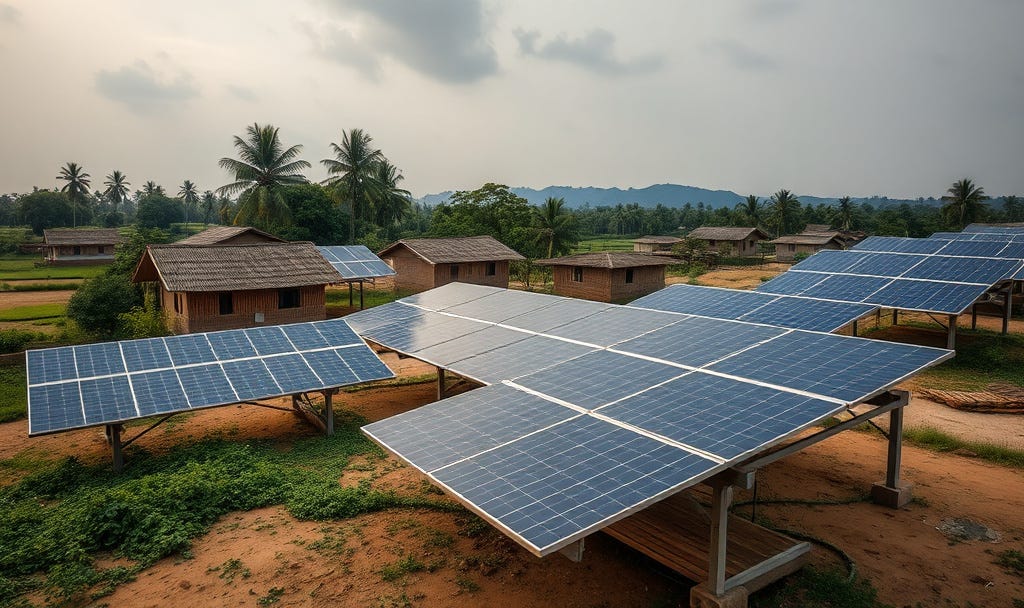
Two flagship schemes demonstrated the shift toward distributed energy access. The PM Surya Ghar: Muft Bijli Yojana enabled rooftop solar installations across 2.7 million households in two years, with a target to reach 10 million households and generate 30 GW of distributed capacity.
Concurrently, the PM-KUSUM scheme solarized irrigation systems for 2.1 million farmers, reducing dependence on subsidized grid power and enabling surplus electricity sales—effectively converting agricultural consumers into energy prosumers.
Distributed Solar Impact:
2.7M households with rooftop solar (PM Surya Ghar)
2.1M farmers with solar irrigation (PM-KUSUM)
30 GW target distributed capacity by 2027
Manufacturing
Manufacturing Momentum: Strategic Sectors in Focus
India’s composite PMI climbed to 59.5 in January 2026 — the highest in 11 months — as manufacturing PMI reached 56.8 (highest since October) and services activity strengthened to 59.3.
New export orders expanded at their fastest pace in four months despite the U.S. implementing 50% tariffs on Indian exports in 2025, indicating resilience in India’s manufacturing ecosystem.
The government targets 3x export growth by 2035, with manufacturing positioned as the primary growth lever across 15 priority sectors including semiconductors, metals, and advanced manufacturing.
Budget 2026 is expected to expand the Production-Linked Incentive (PLI) scheme across strategic sectors and introduce measures for localization, technology adoption, and export credit support. The PMI numbers precede policy — they suggest industrial recovery is organic, not subsidized.
(Source: S&P Global PMI, Economic Survey)
Geopolitics & Defense
India to Host Global Big Cats Summit, Strengthens Conservation Diplomacy
At COP30 in Brazil, Environment Minister Bhupender Yadav announced that India will host the Global Big Cats Summit in New Delhi in 2026. This initiative, rooted in the International Big Cat Alliance (IBCA) framework articulated by Prime Minister Modi, reflects a sophisticated recognition that apex predator conservation is an index of climate and ecosystem health. India’s tiger population has doubled ahead of schedule, with Asiatic lion numbers steadily rising, supported by expanded protected areas and wildlife corridors.
Military Satellite Constellation in Development
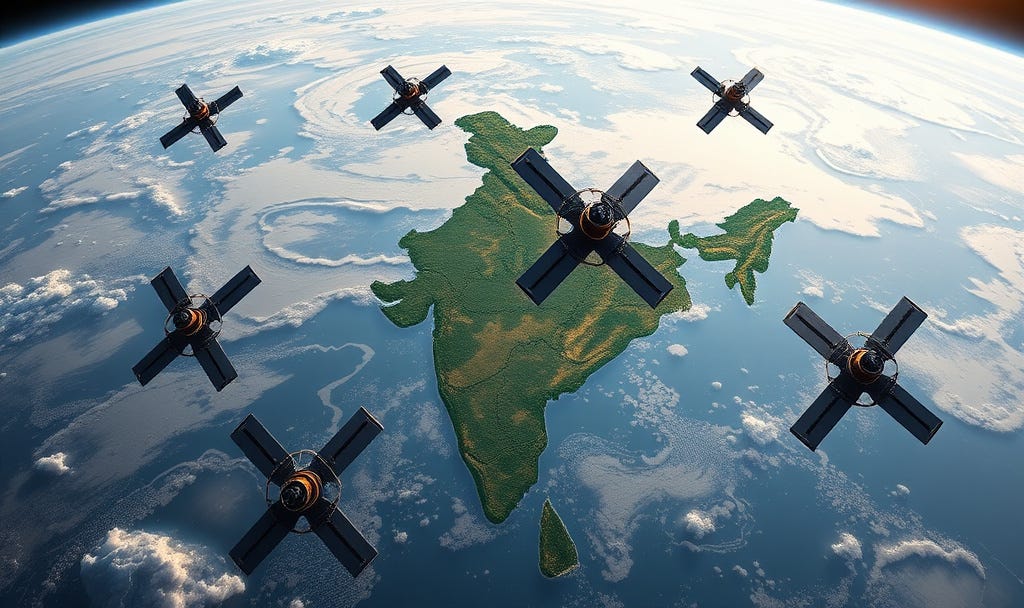
India cleared a ₹26,000 crore plan to deploy 52 military surveillance satellites with all-weather, round-the-clock capabilities. As we covered on our first deep dive into ISRO, the space agency has the capability to develop 21 satellites, while the remaining 31 will be built by private Indian space companies—the largest defense space public-private collaboration in India—with first launches expected in 2026 and full constellation operationalization by 2029. This underscores India’s strategic autonomy in intelligence, surveillance, and reconnaissance infrastructure.
Environment & Conservation
Groundwater Rejuvenation Initiative Gains Scale
The Jal Shakti Abhiyaan: Catch the Rain initiative demonstrated tangible hydrological progress. As of January 22, 2026, India has created 19.19 lakh water conservation and rainwater harvesting structures, restored 3.61 lakh traditional water bodies, and completed 20.33 lakh watershed development works. These interventions, combined with 1.64 billion intensive afforestation efforts, represent a systemic approach to reversing groundwater depletion and supporting agricultural resilience in climate-stressed regions.