

A Late Night Rendevous
At approximately 2 AM on May 9, 2025, a Su-30MKI fighter from the Indian Air Force banked at cruising altitude over the southern Punjab plains of Pakistan. Below, the lights of Bahawalpur flickered in the desert. The city of 800,000 people had also served, for decades, as the administrative and spiritual home of Jaish-e-Mohammed, one of South Asia’s most lethal terrorist networks. The pilot launched BrahMos missiles from multiple bearing angles. The missile traveled at Mach 3 — faster than a rifle bullet by a factor of eight — carrying a warhead the size of a small car. It did not miss.
India had been building toward this night for 27 years.
The Proof That Changed Everything
Operation Sindoor, India’s military response to the April 22, 2025 Pahalgam terrorist attack that killed 26 civilians, lasted exactly 72 hours but its strategic aftershocks will reshape Asia’s military balance for decades.
In those three days, India struck 9 targets inside Pakistan and Pakistan-Administered Kashmir, including four deep inside Pakistan proper:
Bahawalpur,
Muridke (the headquarters of Lashkar-e-Taiba),
Shakar Garh,
and a site near Sialkot.
The weapons deployed read like a catalog of India’s new arsenal:
SCALP-EG cruise missiles from Rafale jets;
Crystal Maze precision munitions against hardened structures at Muridke;
Rampage air-launched ballistic missiles against Pakistani Air Force (PAF) runways;
Harop anti-radiation loitering munitions against radar sites;
and, cutting through everything, BrahMos.
India fired approximately 15 BrahMos missiles in the night operations alone, striking at least 11 Pakistani Air Force bases — including Nur Khan in Rawalpindi, Bholari in Sindh, Sargodha, and Jacobabad. India’s S-400 Triumf air defense systems, positioned along the border, threatened Pakistan’s airborne early warning aircraft, stripping away their air picture. By the time Pakistan requested a ceasefire on May 10, the IAF had achieved what Swiss defense analysts later called “operational air superiority.” [1]
Arms buyers do not purchase on specifications alone. They purchase on proof. The moment BrahMos flew over Bahawalpur in anger, it stopped being India’s most impressive engineering product and became the world’s most operationally validated supersonic cruise missile. Every defense ministry in Southeast Asia noticed — and then called their procurement offices.
[DATA VIZ: Map of Operation Sindoor showing 9 strike targets, missile types used per target, and range rings for BrahMos (450km), SCALP-EG (560km), and Rampage (190km)]
The Arsenal: What India Built Over 27 Years
BrahMos: The World’s Fastest Production Cruise Missile
BrahMos is a joint venture between India’s Defence Research and Development Organisation (DRDO) and Russia’s NPO Mashinostroyenia, with India holding a 50.5% controlling stake. It entered service in 2005. Since then, it has outrun every comparable weapon system on earth — and its next generation will widen the gap further.
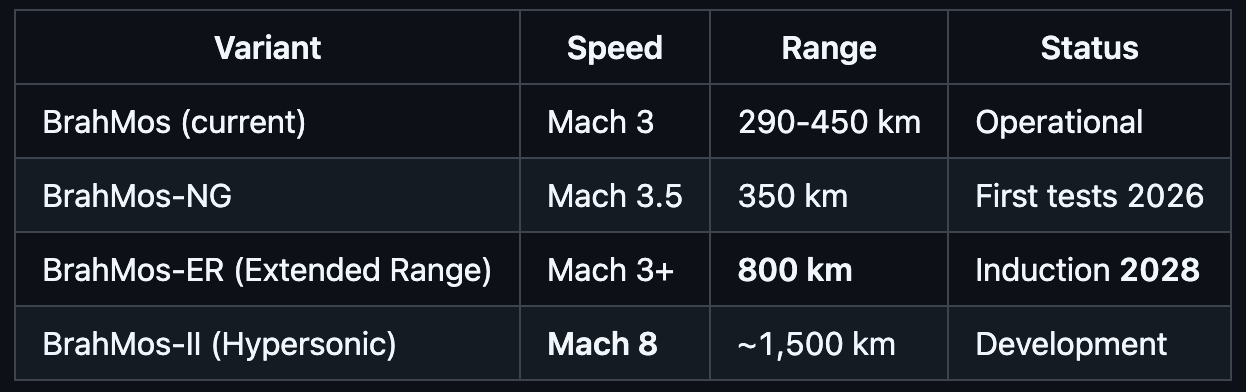
The 800 km Extended Range variant completed successful trials in 2025, with a multi-phase 2026 trial schedule progressing.
At 800 km, a BrahMos launched from a Su-30MKI over Indian airspace can reach any target in Pakistan or anywhere along the Aksai Chin frontier, without the aircraft ever crossing the line. That geometric reality changes the risk calculus for any adversary planning a first strike: Indian jets need not approach defended airspace to destroy targets inside it.
[NSE: HAL] (Hindustan Aeronautics Limited) produces the Su-30MKI airframes that carry BrahMos.
[NSE: BEL] (Bharat Electronics Limited) makes the radar systems and electronics suites.
[NSE: BDL] (Bharat Dynamics Limited) manufactures missile components and fuzes.
These are not peripheral beneficiaries of a government program. They form the industrial spine of an ecosystem that now ships operational weapons to three foreign countries.
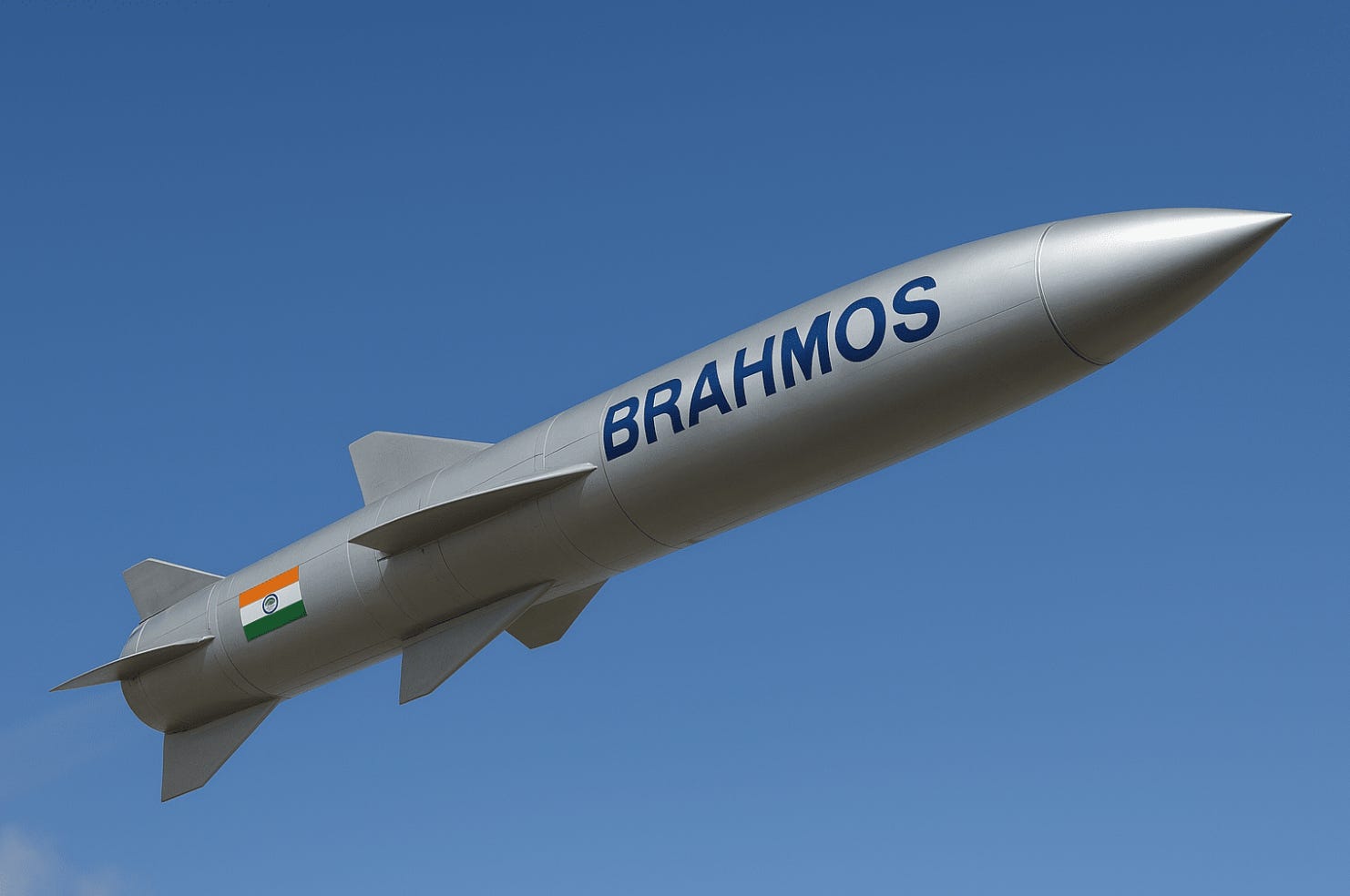
In May 2024, the BrahMos Aerospace Integration and Testing Facility (BAITF) opened in Lucknow. Its production rate: approximately 100 missiles per year from this facility alone, a 20% increase in total BrahMos output. That is enough annual output to fully replace India’s reported BrahMos expenditure in Operation Sindoor in roughly a year, with capacity left over for exports. A factory in one of India’s oldest cities, producing the world’s fastest cruise missile at industrial scale.
Astra: Beyond Visual Range and Beyond Every Comparison
India’s Astra missile family is what air forces use before pilots are close enough to see each other. A Beyond-Visual-Range Air-to-Air Missile (BVRAAM) wins the air war before the engagement begins. By 2028, India’s Astra Mk3 will hold the longest operational range of any BVRAAM on earth.
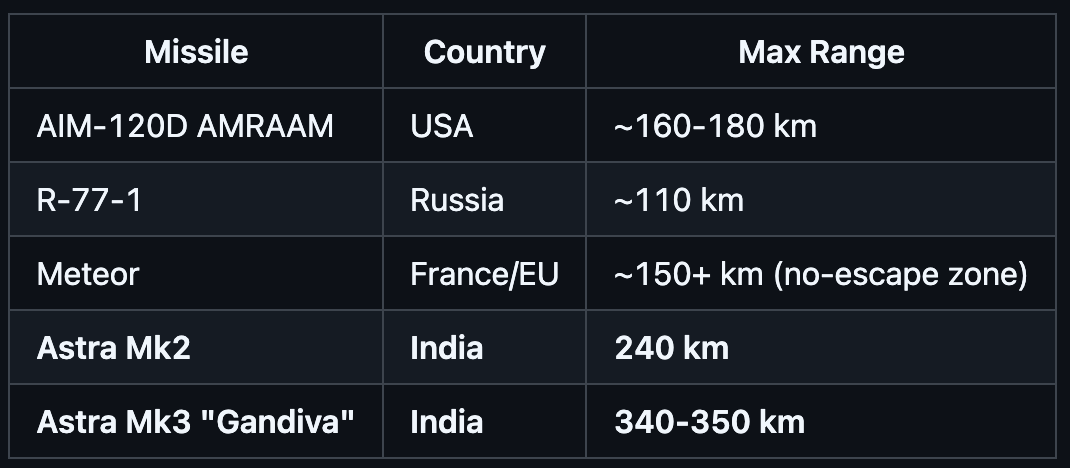
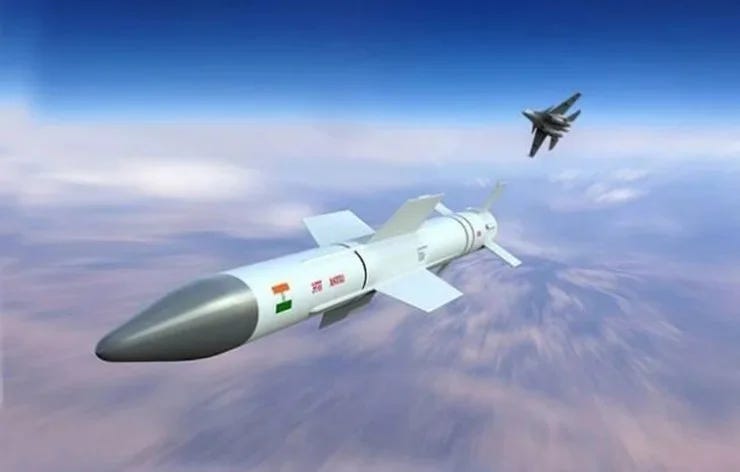
Astra Mk2 begins series production in July 2026. The system integrates with Tejas Mk1, Tejas Mk1A, Su-30MKI, Rafale, and eventually the Advanced Medium Combat Aircraft (AMCA). Every platform India is inducting in the next decade will carry this missile.
Astra Mk3, named “Gandiva” after Arjuna’s divine bow in the Mahabharata, uses Solid Fuel Ducted Ramjet (SFDR) propulsion, a technology that sustains combustion using ram-compressed air as oxidizer rather than carrying onboard oxidizer. I had written a deep dive on the Mk3 back in March:

This lets the missile maintain Mach 4.5 across its entire flight, compared to conventional rockets that peak immediately and then coast. SFDR’s final experimental test came on December 13, 2024, at ITR Chandipur off the Odisha coast. India now joins the United States, Russia, and France as the only countries with operational SFDR technology.
What this means for a pilot on the receiving end: Gandiva at 340 km with Mach 4.5 sustained flight gives approximately 60 seconds of flight time to its target at maximum range. There is no subsonic glide phase to intercept. Once fired, evasive maneuvering options collapse rapidly.
Please subscribe (for free) to keep reading. I talk about India’s other missile programs, such as the Pralay and QRSAM, and go deep into the surge in defense exports, the nuclear layer of Indian missiles, and the factories that are producing these awesome examples of firepower.