

Some weeks are about announcements. This one was about arrivals — India’s most consequential breakthroughs in recent memory, clustered into a single seven-day window.
A 70-year nuclear strategy became real at Kalpakkam. 1,506 kilometres of freight corridor finally stitched Mumbai’s port to Uttar Pradesh. India’s third nuclear submarine slipped into commission. A 1,000-km quantum communication network — built in under two years — was demonstrated to the world.
This is what institutional patience looks like when it actually pays off.
⚛️ Energy & The Green Transition
India’s 500 MWe Fast Breeder Reactor Achieves First Criticality at Kalpakkam
At 08:25 PM IST on April 6, the Prototype Fast Breeder Reactor (PFBR) at Kalpakkam, Tamil Nadu achieved first criticality — the moment when a reactor sustains a self-sufficient chain reaction for the first time. It sounds technical. It is technical. But what it means is this: India, which holds the world’s third-largest thorium reserves at ~225,000 tonnes, has just unlocked the technology to eventually use them.
The PFBR is entirely indigenous — designed by IGCAR (Indira Gandhi Centre for Atomic Research) and commissioned by BHAVINI. It is a sodium-cooled 500 MWe fast breeder reactor: it consumes uranium-plutonium MOX fuel while producing more fissile material than it consumes. Physicists called Homi Bhabha’s three-stage nuclear programme the Akshay Patra — the inexhaustible vessel. Stage 2 just began.
A technical deep dive on the Kalpakkam Fast Breeder Reactor, why our Thorium reserves matter, and how Thorium is used in such reactors, dropping soon! - Rohit
India is now the only country other than Russia operating a commercial fast breeder reactor. The roadmap targets 22.38 GW of nuclear capacity by 2031–32 and 100 GW by 2047, up from ~8 GW today. Those numbers seemed aspirational before April 6.
This isn’t just an energy story — it’s seven decades of strategic patience materialising as electricity. India’s vast thorium reserves, long untouchable without Stage 2 technology, are now one step closer to the grid. The Akshay Patra lives.
CleanMax Delivers 185 MW Wind-Solar Hybrid in Gujarat — in 12 Months Flat
CleanMax commissioned a 185 MW wind-solar hybrid project at Kalavad, Gujarat, serving 17 corporate customers — including Apar Industries and Borosil Renewables [NSE: BORORENEW] — under a group captive model. Some quick numbers:
Delivered in approximately 12 months.
Annual CO₂ offset: 3.61 lakh tonnes.
Revenue contribution in FY2027: ₹1.65 billion+.
Backed by 25-year fixed-tariff PPAs.
CleanMax’s total installed capacity now stands at 844 MW.
This is important not just for the speed of delivery but also the group captive model — where multiple corporations pool demand to fund renewable infrastructure — is how India’s energy transition gets financed from the demand side, not just the supply side. Each delivered project de-risks the next.
🔬 Deep Science & Indigenous Innovation
National Quantum Mission Demonstrates a 1,000-km Quantum-Secure Communication Network
QNu Labs, a Bengaluru-based startup supported under India’s National Quantum Mission, demonstrated a 1,000-km Quantum Key Distribution (QKD) network — one of the longest operationally demonstrated anywhere in the world. The announcement came via PIB on April 8, with the validation conducted in partnership with VIAVI. NQM launched in October 2024. This milestone arrived in under two years. The full target — 2,000 km within 8 years — India is tracking well ahead of schedule.
QKD is not encryption in the conventional sense. It’s encryption based on the laws of physics: interception fundamentally disturbs the quantum state, making eavesdropping detectable in principle. A national QKD backbone is the foundation for unhackable financial, defense, and diplomatic communication. China’s comparable network spans 4,600 km. India is building fast.
What’s QKD? I am curious too! Drop a comment below if you want a deep dive. - Rohit.
🛣️ Infrastructure & Economy
The Western Dedicated Freight Corridor is Fully Operational — All 1,506 km from JNPT to Dadri
India’s Western Dedicated Freight Corridor is complete. All 1,506 kilometres connecting JNPT (Jawaharlal Nehru Port Terminal), Maharashtra to Dadri, Uttar Pradesh — operated by DFCCIL — are now live. The final section (JNPT–New Saphale/Vaitarna) was trial-run March 31 and commissioned shortly after; nationwide coverage broke April 6–7.
Both of India’s Dedicated Freight Corridors — Eastern (completed October 2023) and Western — are now operational. Double-stack container trains can run at higher speeds along a spine that was previously one of the world’s most congested rail corridors. It took longer than planned. But it arrived.
The DFC doesn’t just move freight faster — it liberates the existing passenger rail network. The compound effect on logistics costs (projected to fall significantly) will compound in manufacturing competitiveness data for years. Infrastructure is an economic multiplier.
💻 Digital & Fintech
UPI Turns 10 — 22.64 Billion Transactions in March 2026 Mark a New All-Time High
UPI processed 22.64 billion transactions worth ₹29.52 lakh crore (~$354 billion) in March 2026 — both figures are all-time highs, with volume up 11% from February. Annual 2025 total: 228.5 billion transactions, +33% year-on-year. Merchant transactions now account for 55%+ of total volume, a decisive shift from peer-to-peer transfers to commercial use.
UPI turns 10 on April 11. Transaction volume has grown 12,000x since launch.
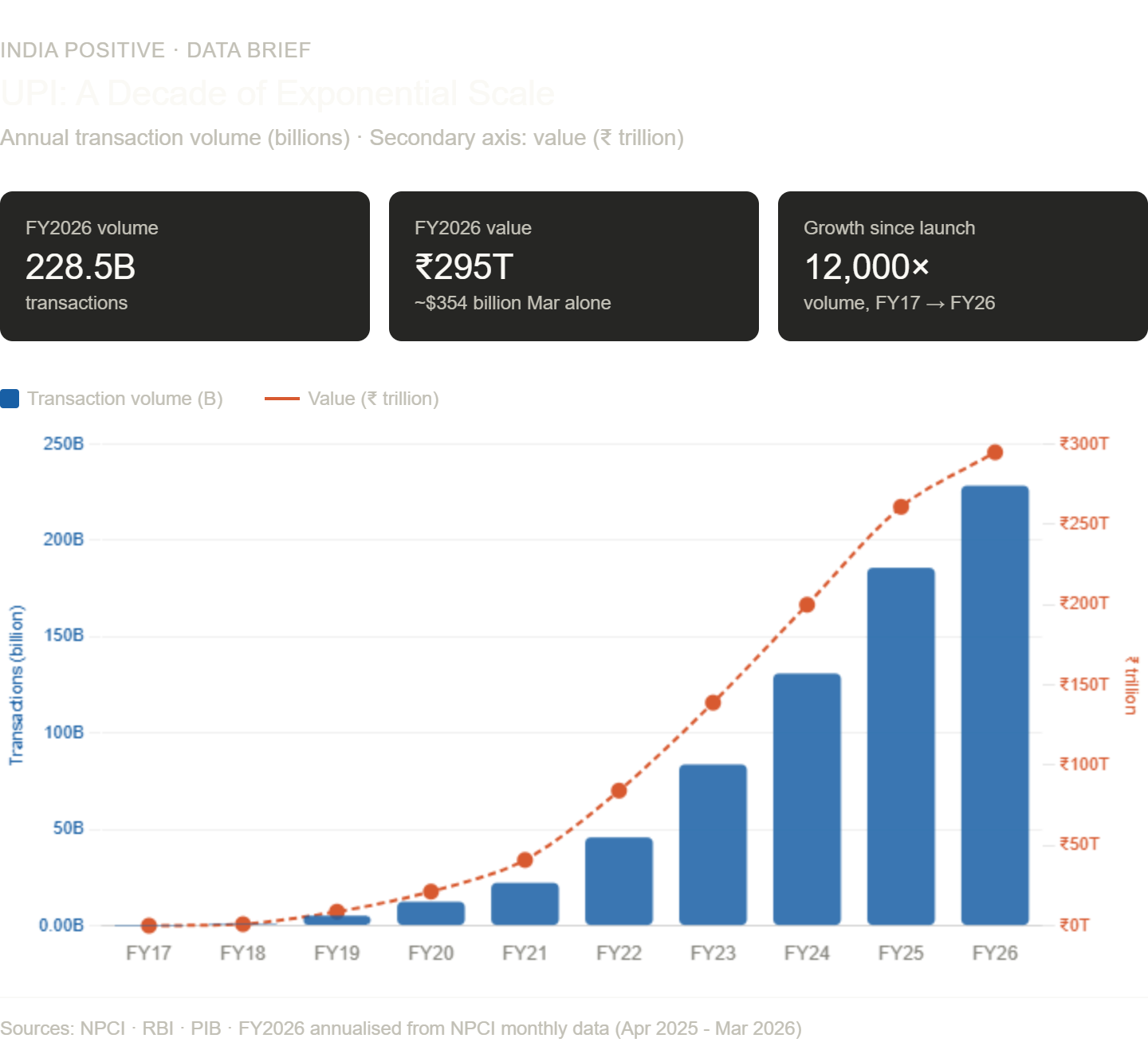
What started as an NPCI experiment in 2016 is now the world’s largest real-time payments network by volume. The 55%+ merchant share signals that UPI has crossed from payment rail to economic infrastructure — the difference between a road and the supply chains that depend on it.
KreditBee Raises $280 Million, Enters the Unicorn Club at a $1.5 Billion Valuation
KreditBee, the Bengaluru-based digital lender, raised $280 million in Series E ($220M primary + $60M secondary) at a $1.5 billion valuation. Investors include Motilal Oswal Alternates, Hornbill Capital, MUFG-backed Dragon Funds, Premji Invest, and Advent International. FY25 revenue: ~₹2,700 crore. Net profit: ₹473 crore.
Profitable unicorn. In fintech. In 2026. KreditBee serves credit-underbanked populations using AI underwriting — extending formal credit to borrowers the traditional system couldn’t price. Scale + profitability + social reach is the trifecta India’s fintech stack is increasingly demonstrating.
Equinix Opens Fourth Mumbai Data Centre — $95 Million, AI-Ready, 100% Renewable
Equinix opened MB3, its fourth International Business Exchange data centre in Mumbai (Chandivali, Powai), with over $95 million in Phase 1 investment. Initial capacity: 1,370+ cabinets, scalable to 5,475 at full build-out. Runs on 100% renewable energy; liquid cooling enabled for AI-intensive workloads.
As AI inference demand spikes globally, India is building the physical substrate to capture it on its own soil. Data centres are the new power plants — and $95M of foreign capital choosing Mumbai over Singapore or Frankfurt is a signal worth noting.
🐘 Biodiversity & Conservation
Vantara Launches the World’s First University for Wildlife and Veterinary Sciences
Vantara University was founded at Jamnagar, Gujarat by Anant Ambani — described as the world’s first integrated university for wildlife conservation and veterinary sciences. Programmes span wildlife medicine, nutrition, behavioural sciences, genetics, epidemiology, One Health, conservation policy, and naturalistic habitat design. Foundation ceremony incorporated soil, water, and stones from biodiversity-rich landscapes across India.
Wildlife conservation in India has historically been underfunded in human capital terms — we have the reserves, the biodiversity, the policy will, but relatively few globally competitive training institutions. If Vantara University delivers on its ambition, it could produce a generation of conservation scientists fluent in both Indian ecosystems and global wildlife science. [ANI]
Four Greater One-Horned Rhinos Rewilded into Dudhwa Tiger Reserve
Four greater one-horned rhinos (1 male, 3 females) were released into Dudhwa Tiger Reserve, Uttar Pradesh, bringing the free-ranging population there to 8 individuals. The rhinos spent years in a 27 sq km fenced rehabilitation zone before release — part of a 15-year reintroduction programme co-led by WWF-India. A Mongabay India long-form published this week examines their role as ecological engineers: their grazing suppresses unpalatable grasses and maintains open grassland habitat for dozens of other species.

Rhinos don’t just inhabit landscapes — they build them. Each release at Dudhwa is not a conservation headline; it’s a rewiring of the Terai ecosystem. The Kaziranga model, now being replicated in Uttar Pradesh.
🛡️ Defense
India Commissions INS Aridhaman — Third Nuclear Submarine, Nuclear Triad Now Complete
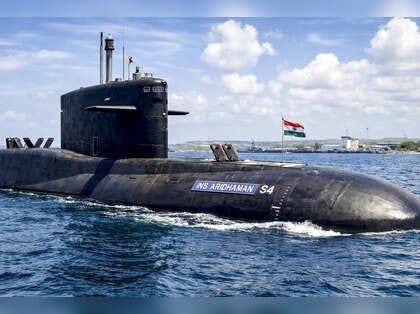
INS Aridhaman (S4) was commissioned at Visakhapatnam on April 3, presided over by Defence Minister Rajnath Singh. India’s third SSBN (nuclear-powered ballistic missile submarine): ~130 metres long, displacing ~7,000 tonnes submerged, with 8 missile tubes configured for K-15 Sagarika (750 km range) or K-4 (~3,500 km range) missiles. Entirely indigenous programme, from design to commission.
With three SSBNs, India now approaches the threshold of credible continuous at-sea deterrence — a capability requiring 3-4 submarines to guarantee at least one is always on patrol.
India’s nuclear triad — land, air, sea — is no longer theoretical. The sea leg is now substantive. For a country with a no-first-use doctrine, credible second-strike capability is the bedrock of deterrence stability. This was built at home, from the keel up. Strategic depth, indigenously forged.
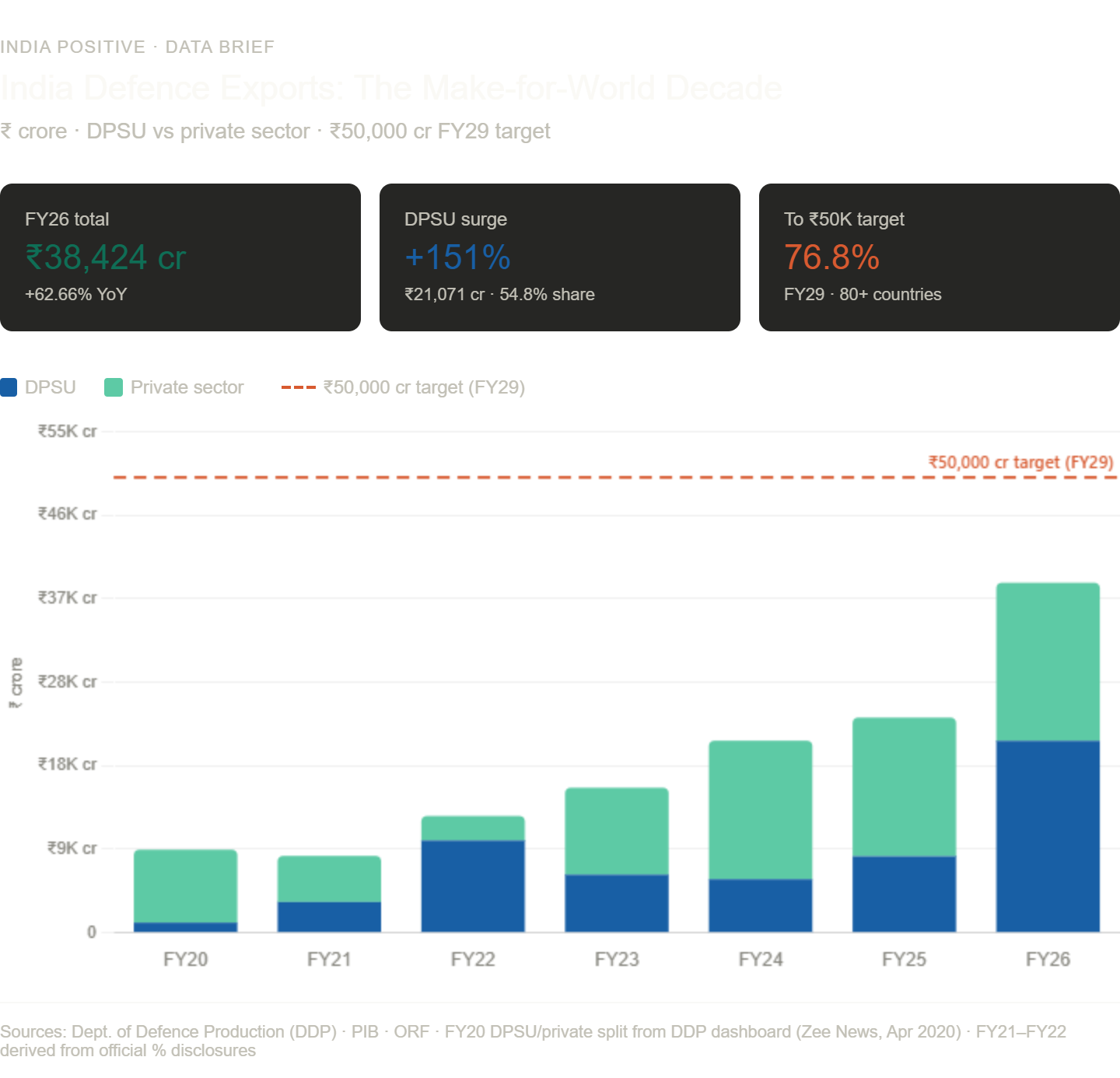
India’s Defence Exports Hit Record ₹38,424 Crore in FY26 — Up 62.66%!
Defence exports reached ₹38,424 crore (~$4.6 billion) in FY2025–26 — up 62.66% from ₹23,622 crore in FY25. DPSUs contributed ₹21,071 crore (+151% YoY). Private sector: ₹17,353 crore (+14%). India now exports to 80+ countries, with the United States as the top destination. Exporting companies grew from 128 to 145.
A decade ago, India was the world’s largest arms importer. Today it exports to 80 countries including the US. That is not merely industrial achievement — it is a geopolitical repositioning. The 151% jump in DPSU exports suggests India’s state-owned defence manufacturers have finally found their commercial footing.
Project Kusha Advances — India’s Indigenous S-400 Alternative, at Half the Cost
DRDO‘s Project Kusha (Extended Range Air Defence System) advanced this week, with M1 tier (150 km range) missiles completing initial trials successfully. M2 (250 km) and M3 (350–400 km) variants are in testing. IAF has placed orders for 5 squadrons, induction expected 2028–2030.
The numbers: 5 Kusha squadrons cost ~₹21,700 crore vs ₹45,000 crore for 5 S-400 squadrons. Per interceptor: ₹40–50 crore vs ~₹100 crore. Same capability envelope. Half the price. Indigenously owned — including the intellectual property, the supply chain, and the right to upgrade it without asking anyone’s permission.
India’s S-400 batteries are world-class air defence — but they come with supply-chain dependence on Russia in a complicated geopolitical era. Project Kusha isn’t just about saving money. It’s about strategic autonomy in the most literal sense: controlling your own sky.
🚀 ISRO & Space
ISRO Conducts Second Integrated Air Drop Test for Gaganyaan — Mission on Track
ISRO conducted IADT-02 at Satish Dhawan Space Centre, Sriharikota on April 10 — a simulated Crew Module weighing approximately 5.7 tonnes (matching the mass of the actual module) validated the recovery and splashdown system that will bring India’s astronauts home from orbit. IADT-01 was August 24, 2025. This is the follow-on validation.
Gaganyaan’s first uncrewed mission is confirmed for H2 2026 — carrying Vyommitra, India’s half-humanoid robot — with the crewed mission targeting 2027: three members, 400 km orbit, 3-day mission.
Wrap up this weekly roundup of desi, data-driven optimism with a deep dive on ISRO’s future projects, including the Gaganyaan, here:
From Saving Lives to Building Space Stations: The Sovereign Ambition of the New ISRO.

In case you missed it, click here to read Part 1 of this deep exploration of ISRO.