Week of May 30 to June 5, 2026
Just after sunrise on June 1, 2026, every solar power project under construction in India crossed an invisible threshold: every solar cell going into every panel, for every project connected to the Indian grid from that day forward, had to be made in India. The Approved List of Models and Manufacturers (ALMM) List-II came into force. A decade of solar import dependence, with Chinese cells powering the Indian sun, is ending.
This was India's week of strategic depth: a new railway zone born in Andhra Pradesh, a Hyderabad-built missile rewriting IAF capability over the Bay of Bengal, an Australian company pledging $30 billion to wire up India's AI future, and the largest annual FDI inflow in the country's history quietly confirmed in a government spreadsheet.
ENERGY
INDIA STARTS BUILDING THE GRID IT ACTUALLY OWNS
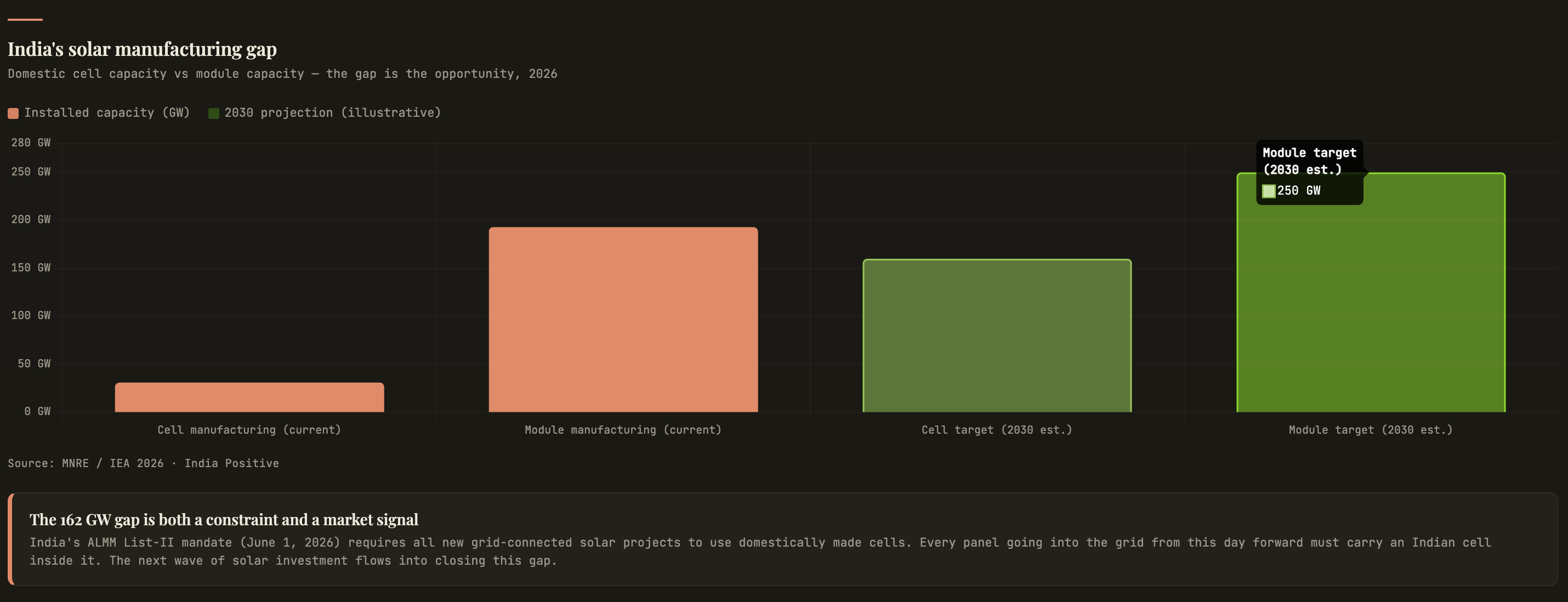
The ALMM List-II mandate is a declaration. India's domestic solar cell capacity sits at 31 GW, against a module manufacturing base of 193 GW, a mismatch that reveals just how much of the country's clean energy ambition has been assembled from foreign-sourced components. The new rule creates an immediate constraint and, in that constraint, a market signal: the next wave of solar investment in India will flow into cell manufacturing, not just assembly. The 162 GW gap between module capacity and cell capacity is both a problem and an opportunity. The companies that close it first will supply the world's fastest-growing solar market from inside it.
POWERGRID [NSE: POWERGRID] issued an EPC tender on June 2 for 400 MW/1.6 GWh of standalone battery storage across three sites in West Bengal: a 200 MW/800 MWh facility at DPL, 100 MW/400 MWh at Kharagpur, and 100 MW/400 MWh at Hooghly. That 1.6 GWh is roughly the daily consumption of 200,000 average Indian households stored in grid-scale batteries, power that can be dispatched in the minutes and hours when solar goes dark and demand peaks. It is the mechanical answer to intermittency, and India is building it in bulk.
The macro frame for all of this arrived on May 28, when the International Energy Agency reported that India's energy investment is on track to reach $170 billion in 2026, growing at 11 per cent annually over the past five years.
Solar investment alone has compounded at 25 per cent per year across that period. To put the $170B in human context: India is now spending more on energy infrastructure each year than Germany, France, and the UK combined. The country that used to be described as an energy laggard is, in terms of capital deployed, one of the two or three most aggressive energy investors on the planet.
India crossed 50 per cent of installed electricity capacity from non-fossil fuel sources in 2025, five years ahead of its Paris Agreement target. The ALMM mandate, the POWERGRID BESS tender, the IEA number are all icing on that cake.
INFRASTRUCTURE
ANDHRA GETS A RAILWAY ZONE, AND SURAT GETS AN EXPRESSWAY
At Visakhapatnam, a new bureaucratic reality quietly materialized on June 1. The South Coast Railway (SCoR) zone, gazetted on May 4 and confirmed operational from June 1, became India's 18th railway zone, with Visakhapatnam as its headquarters. The zone covers 3,532 kilometres of track and 385 stations across four divisions: Guntakal, Guntur, Vijayawada, and Visakhapatnam, a network longer than the full rail journey from Delhi to Kanyakumari. It spans Andhra Pradesh and parts of Karnataka, Telangana, and Tamil Nadu.
For Andhra Pradesh, this is not a small administrative rearrangement. Since bifurcation in 2014, the state has been managed as a southern appendage of larger zones, with operational priorities set elsewhere. SCoR gives the state a dedicated railway administration aligned with its own development priorities: the Amravati capital build, the Vizag port expansion, the emerging pharma and electronics corridor between Kakinada and Tirupati. An entire southern coastline, with its own locomotive.
On June 5, Prime Minister Modi arrived in Surat to inaugurate Rs.21,000 crore of projects across Gujarat and Daman. In Surat, Rs.12,421 crore of national highway work was commissioned, including two packages of the Vadodara-Mumbai Expressway, a corridor that carries some of the highest freight and passenger volumes in India. The expressway packages will cut Vadodara-Mumbai travel time by over 90 minutes for commuters and, more critically, for the goods that keep India's largest manufacturing-to-port corridor moving. At Daman, the NAMO Airport's new terminal opened, alongside the NAMO Hospital and the Iconic Bridge connecting the two Daman territories.
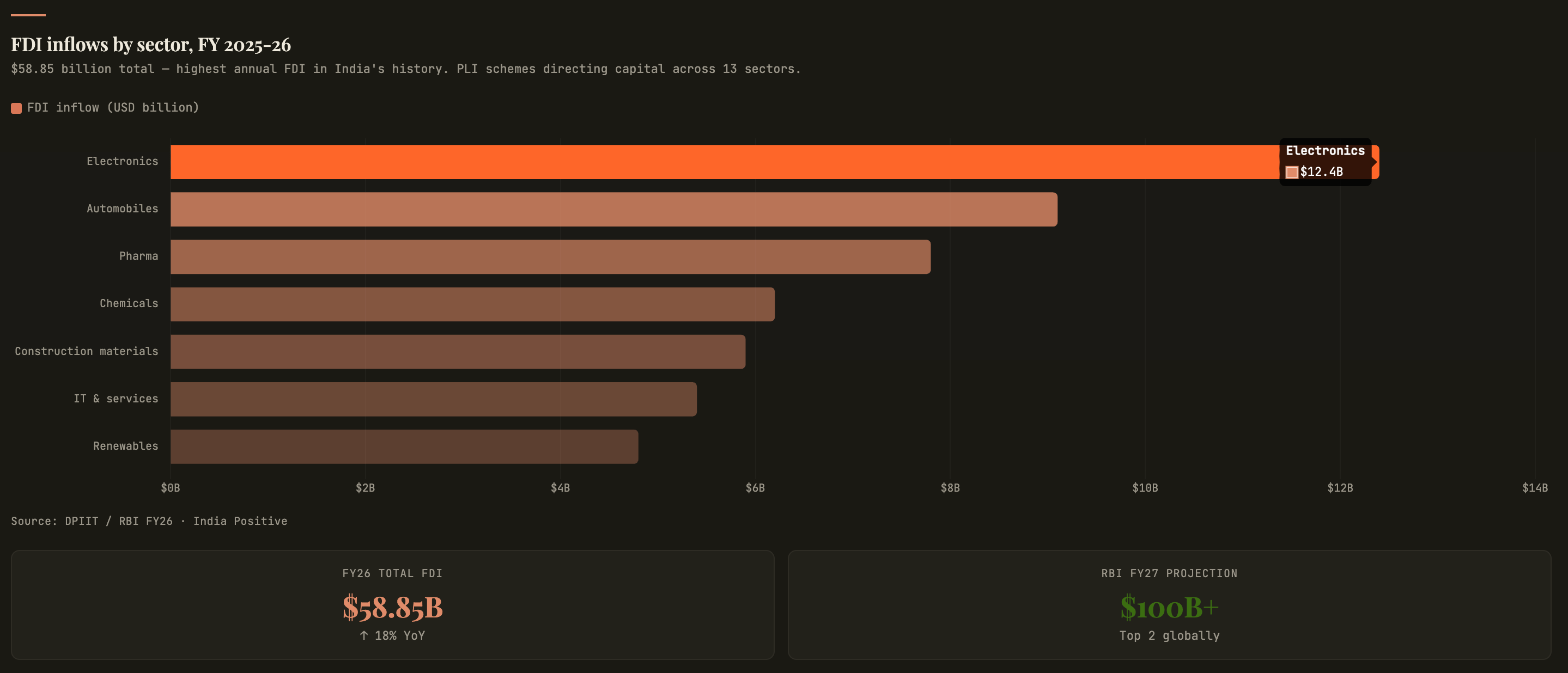
The economic signal arrived separately. On June 3, the government released India's FDI statistics for FY 2025-26: $58.85 billion in total foreign direct investment, an 18 per cent increase over the previous year. Production-Linked Incentive (PLI) schemes across 13 sectors directed the capital flows, with electronics, automobiles, chemicals, and construction materials leading the inflows. On June 5, RBI Deputy Governor Poonam Gupta said gross FDI may cross $100 billion in FY27, a figure that would rank India among the world's top two FDI destinations by country, behind only the United States. The $58.85B figure is not abstract: it is the equivalent of every rupee needed to build six Amravati capitals simultaneously arriving in a single fiscal year, from investors choosing India over every other option on their spreadsheets.
DIGITAL INDIA
AIRTRUNK BETS $30 BILLION ON THE INDIAN CLOUD
On June 5, AirTrunk CEO Robin Khuda committed $30 billion to build 5 GW of AI data centre capacity across India by 2030. The Australian company entered India in April 2026 through the acquisition of Lumina CloudInfra, inheriting a development pipeline of ~600 MW across Mumbai, Chennai, and Hyderabad. The $30 billion commitment builds on that foundation at a different order of magnitude.
India's total installed data centre capacity today is approximately 1.5 GW. The AirTrunk commitment, if executed, more than triples that number with a single player by the end of the decade. At 5 GW, India would host the largest AI compute infrastructure cluster outside the United States and China.
The IndiaAI Mission (funded at Rs.10,300 crore) has already deployed 38,000 GPUs for public and research use, enough compute to run AI workloads for every major Indian university and government research lab simultaneously without queuing. The infrastructure equation requires both: public compute for universities and startups, private hyperscale compute for the large model training that drives commercial AI.
AirTrunk is the private side of that equation, arriving with enough capital to make the commitment credible. Every GPU provisioned in Mumbai or Chennai is a reason for an AI company to build its product in India rather than routing its data through Singapore or Frankfurt.
On June 4, Chandigarh University became the first private university in India to establish an IndiaAI Data Lab, in collaboration with Intel India, bringing AI hardware training directly into undergraduate coursework.
The $30 billion arrives at the top of the stack; Intel and Chandigarh University are building the workforce pipeline at the bottom. Both layers are necessary.
DEFENSE
A HYDERABAD LAB'S MISSILE FLIES OVER THE BAY OF BENGAL
On June 2, a Sukhoi Su-30MKI lifted off over the Bay of Bengal off the Odisha coast, carrying a RudraM-II air-to-surface missile built in Hyderabad by the Defence Research and Development Organisation's Research Centre Imarat (RCI). The missile released under "extreme release conditions," acquired its target, and struck with what DRDO described as "pinpoint accuracy," validating all test objectives. The RudraM-II travels at up to Mach 5.5, carries a 200 kg warhead, and can engage targets at ranges of up to 300 km from the launch aircraft.
That 300 km figure deserves attention. The Russian-origin Kh-31 missiles RudraM-II will gradually replace have a range closer to 100 km. At 300 km, a Su-30MKI can suppress or destroy an adversary's ground-based air defence radar system while operating entirely outside the radar's engagement envelope. The IAF does not have to fly into the kill zone to eliminate it.
This is the operational logic of SEAD (Suppression of Enemy Air Defences), and India now has a domestically built, hypersonic-class missile designed specifically for it.
The Astra Mk2, a 240 km beyond-visual-range air-to-air missile, has also completed primary developmental trials and is on track for 2026 induction. India is, piece by piece, assembling a complete air-dominance toolkit:
BVR engagement with Astra,
SEAD with RudraM-II,
and the Su-30MKI and LCA Tejas Mk2 as the platforms.
The system is becoming coherent in a way that individual announcements do not convey.
Like a paint-by-numbers painting, India is slowly connecting the indigenisation dots: the RudraM-II was designed, built, and tested in India, through Indian labs and Indian industry partners including Hindustan Aeronautics Limited (HAL). Every successful test is one fewer import dependency, one more capability resident on Indian soil.
CONSERVATION
WHAT INDIA'S FORESTS ARE TELLING THE CLIMATE
World Environment Day, June 5, 2026, gave PM Modi the occasion to read out a decade's worth of conservation arithmetic, and the numbers deserve more than ceremonial mention.
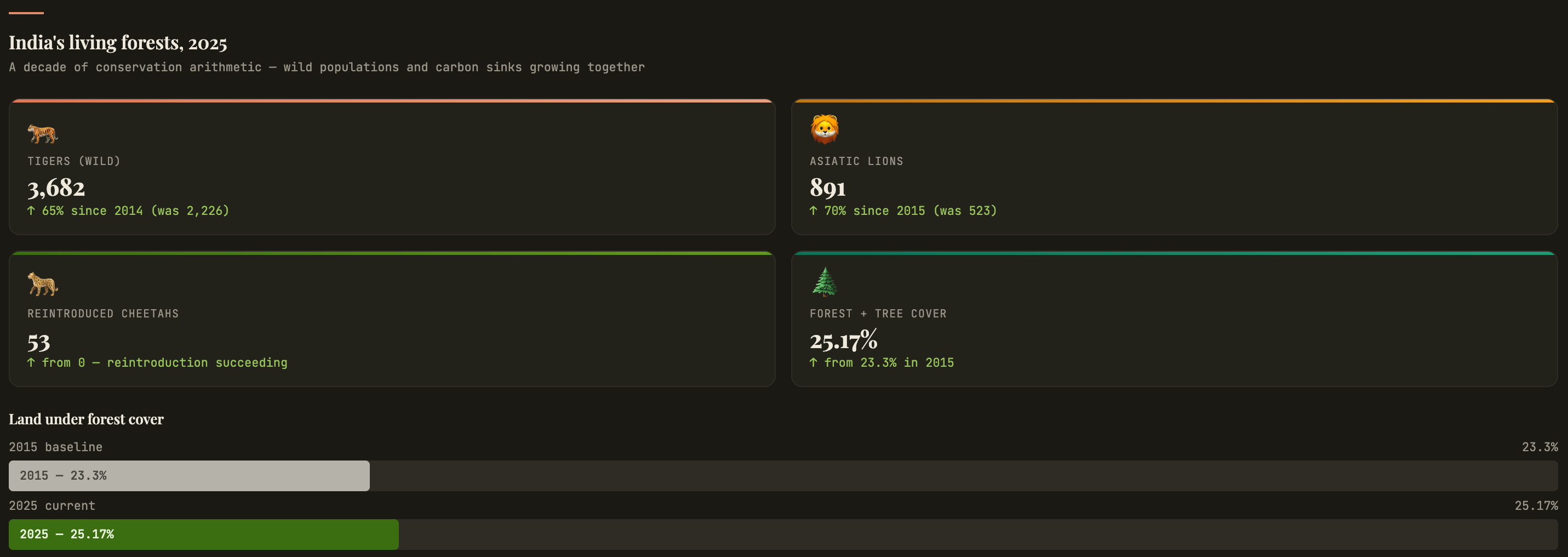
India's tiger population has grown from 2,226 in 2014 to 3,682 in 2025, a 65 per cent increase in a decade, in a country of 1.4 billion people that is also one of the world's most densely farmed landscapes.
Asiatic lions in Gujarat's Gir landscape have grown from 523 in 2015 to 891 in 2025.
Reintroduced cheetahs now number 53.
These are not zoo populations: they are wild animals living in contested, human-occupied landscapes, and they are growing.
The forest arithmetic:
India's forest and tree cover now spans 25.17 per cent of the country's land area, up from 23.3 per cent in 2015.
The country's carbon sink has reached 30.43 billion tonnes of CO2 equivalent, with 2.29 billion tonnes added since 2005 through forest and tree cover growth.
That additional carbon sequestered since 2005 is the equivalent of erasing South Korea's cumulative emissions from the atmosphere twice over.
India's 'Ek Ped Maa Ke Naam' (One Tree in Mother's Name) initiative has planted an estimated 1.19 lakh hectares of new forest annually. The programme is simple: plant a tree in your mother's name, upload the photograph, the government tracks the planting. Hundreds of millions of trees later, it has become a distributed ecological data project run by the people it serves.
The conservation story and the energy story are not separate. India's ability to maintain and expand its carbon sink while simultaneously deploying the world's fastest-growing renewable energy capacity? That combination is what genuine sustainability looks like.
SPACE
VIKRAM-1 WAITS FOR ITS WINDOW
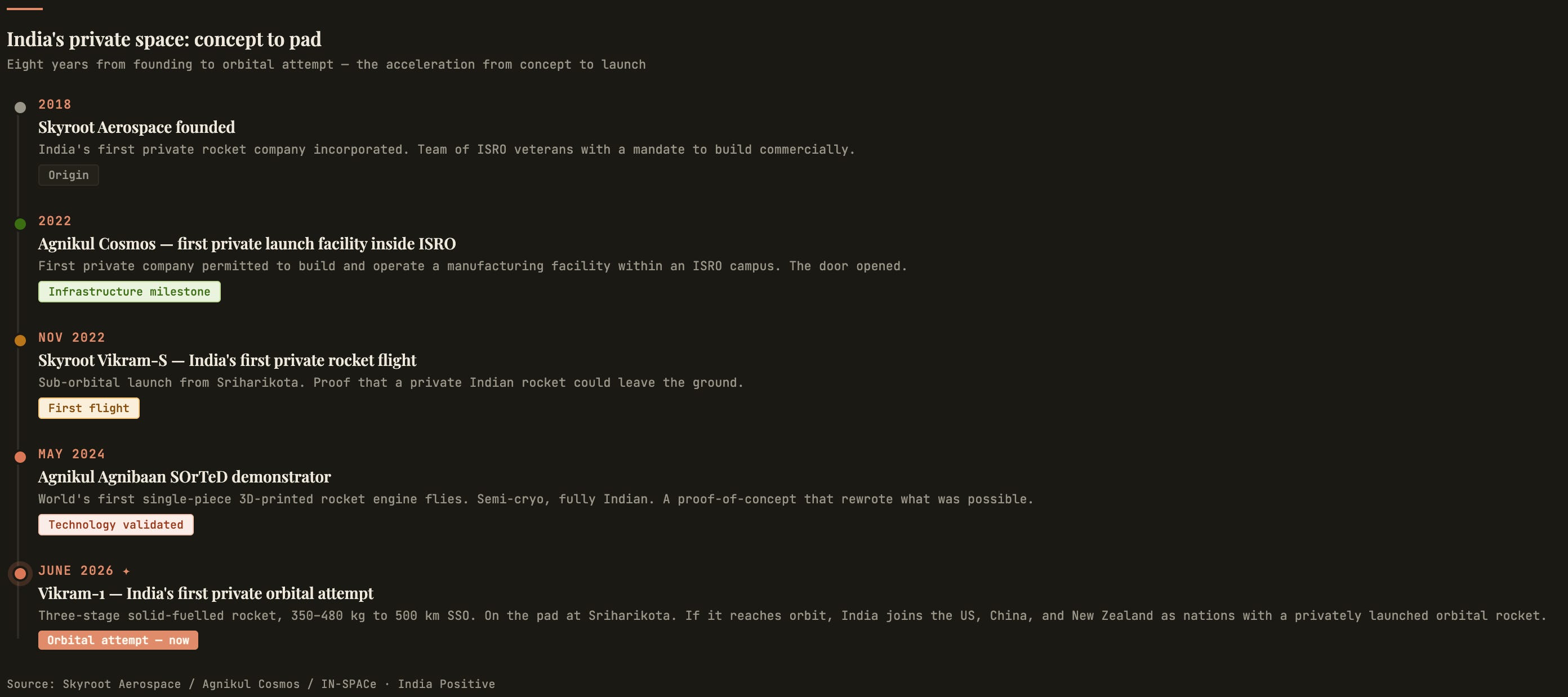
At Sriharikota, Skyroot Aerospace's Vikram-1 rocket stands on the launchpad. The company, now India's first space-tech unicorn at a $1.1 billion valuation, has been working through final regulatory clearances for what would be the first private orbital rocket launch from Indian soil. Vikram-1 is a three-stage, solid-fuelled vehicle capable of delivering 350 to 480 kg of payload to 500 km sun-synchronous orbit. The launch window is targeting June 2026, subject to weather and approvals.
The story is not just about one rocket.
In 2022, Agnikul Cosmos became the first private company to build and operate a launch vehicle manufacturing facility within an ISRO campus. In 2024, Agnikul flew its Agnibaan SOrTeD demonstrator.
Now, in 2026, Skyroot is on the pad for a full orbital attempt. India's private space economy is not approaching. It is arriving, one milestone at a time.
If Vikram-1 reaches orbit, India joins a very short list: the United States, China, and New Zealand are the only countries where a privately built orbital rocket has launched from native soil. The fourth would be India.
As I explore, research and write more about India on India Positive, one repeating refrain (which is music to my ears) is this: India is more frequently occupying the top 3, 4 or 5 across multiple categories. For a young reincarnation of an ancient civilization, that’s heart-warming.