

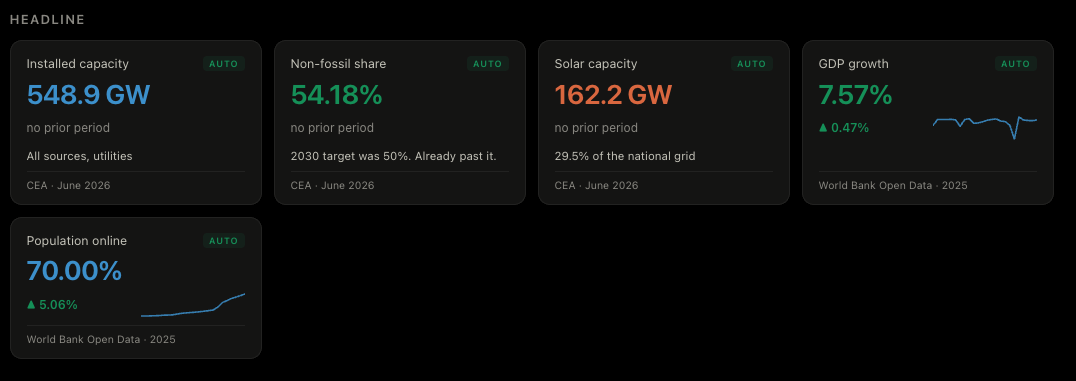
Hey, a quick note on before we dive in. These posts contain many metrics and numbers, and there’s no real way to keep them all in your head or refer to them. So I built an India Dashboard, that tracks Energy, Conservation, Startups, and GDP. This is just the beginning, so send me your thoughts on what else you’d like to see in a dashboard that aims to display the state of the Indian union. I will update the metrics every month.
Somewhere in the ranges above Manali, Parbati-II is running hard. It has been since the monsoon found the Himalayas three weeks ago. On August 1, NHPC’s [NSE: NHPC] hydro fleet put up a number - 167.02 million units in a single day - that no one in the company had seen before. The river had been generous. The next morning, they were more generous still: 169.34 million units, a new record, set within 24 hours of the old one. The river does not know it is breaking records. It is just August in the mountains, doing what it does.
India’s Hydroelectric Muscle
NHPC is India’s largest hydroelectric utility - 7,651 MW of installed capacity across 24 projects, most of them tucked into valleys where no one but the project engineers and the local communities ever goes. The two record-breaking days this week were not luck. They came from the coordinated output of Parbati-II (800 MW, Himachal Pradesh), the restored Subansiri Lower HPS in Assam, and the 510 MW Teesta-V in Sikkim, which had been through its own ordeal after the 2023 glacial lake outburst flood damaged its intake tunnels. Three plants, three river systems and one extraordinary week.
Subansiri Lower took nearly two decades from first proposal to synchronization - longer than most careers in the power sector, longer than some of the engineers who started on it remained in the industry. It sits on one of the most contested stretches of river in Assam, and its construction became a flashpoint for every legitimate question about large dams, displacement, and ecological accountability in the Northeast. That it is now contributing to back-to-back national generation records feels like something more than a capacity milestone.
We tend to tell our energy transition story as a solar and wind story. I am guilty of that too. But hydro is the base-load reality underneath all of it. Without these plants running hard through the monsoon months, the lithium-ion storage we wrote about in The Storage Wave Breaks would not have enough headroom to do what it promises. The monsoon is not just weather. It is four months of stored generation potential arriving as river flow, and this week it delivered on schedule.
Also from the energy desk: on August 4, MNRE issued a clarification on its ALMM List-II, confirming that the domestic content requirement for solar PV cells covers utility-scale, rooftop, net-metering, and captive segments alike. Not glamorous. But the ambiguity had been holding up a significant chunk of rooftop procurement for months, so I will take a clean regulatory clarification anyday.
Readers of Polymathic Pursuit may already know I am a big fan of rooftop solar, and regret the fact that India has not leveraged this sector yet, while the people of Pakistan has taken energy matters into their own hands, and imported 27 GW of rooftop solar in less than 2 years! That’s revolutionary, as things often are when the people unite.
Gleefully, things in India are changing. The ALMM List-II clarification comes on the back of exciting and promising news I reported last week where the ADB approved an $850 million loan to accelerate the PM Surya Ghar: Muft Bijli Yojana, which aims to install rooftop solar for 10 million households and add 30 GW of residential solar capacity by FY2027!
Agni-IV is Live
On the morning of August 6, the Strategic Forces Command and DRDO fired an Agni-IV from the Integrated Test Range at Chandipur, on the Odisha coast, and watched it travel its full 4,000 km range before the warhead reached the target zone in the ocean. All mission parameters were met, radar and telemetry tracked the full trajectory, and the missile was certified operational.
This was the 10th user trial of Agni-IV from a production lot.
A development trial is an engineer’s test - you are finding out if the design works. A production-lot trial is the SFC asking a different question: if we reach into inventory and pull out a random unit, will it fire? The answer, for the tenth time, was yes!
Road-mobile, two-stage solid fuel, 1,000 kg payload, nuclear-capable - the Agni-IV is not a prototype. It is an operational asset in our strategic deterrent, and it has been validated to behave like one.
[DATA VIZ: india-agniIV-reach-aug2026 — political map of South Asia and surrounding regions. Single concentric ring at 4,000 km radius from Chandipur, Odisha (20.9°N, 86.7°E). Ring should cover South Asia, Central Asia, Arabian Peninsula, Southeast Asia. Muted style, dark ring outline on light basemap. Label the ring “Agni-IV range: 4,000 km.” Source: public domain range specification.]
The signal from a production-lot test is deliberate. It is sent to capitals that can read it. What I find worth noting is the pace and consistency - DRDO has been running user trials quietly and without fanfare, and the logic of our strategic deterrent becomes clearer each year as capability moves from laboratory to shelf. We are building a force structure, not just demonstration hardware.
NavIC Comes Back Around
On the same day, August 6 - a busy one in Parliament - Space Minister Jitendra Singh answered a Lok Sabha question about NavIC’s constellation status and gave us the best news the program has seen in two years. NVS-03 is ready to launch. NVS-04 and NVS-05 are in advanced stages of realization. One additional satellite, after NVS-05, will complete the 7-satellite base constellation.
NavIC is India’s homegrown navigation system - our answer to GPS, designed to give us sovereign, unjammable positioning data across the subcontinent and a 1,500 km radius around it. It was working, then NVS-02 suffered a power subsystem failure after launch, and the constellation dipped below the redundancy threshold that makes it genuinely reliable. The arc of what India is building in orbit makes clear why navigation is one of the capabilities we cannot afford to lease from GPS or GLONASS indefinitely. The path back is now clearly laid out.
What I want to know - and Mr. Singh’s parliamentary answer did not tell us - is whether NVS-03 goes on GSLV or LVM3, and whether the launch window is before the end of FY27. Our precision-navigation gap stays open until that satellite is in orbit. Are we looking at six months? Twelve?
Also reported on August 5, via PIB: ISRO conducted 29 Collision Avoidance Manoeuvres in the last 18 months - 20 in 2025, 9 in the first half of 2026. Their Space Situational Awareness team evaluated more than 150,000 close-approach alerts in 2025 to arrive at those 29 manoeuvres. That ratio stops me cold: One hundred and fifty thousand threat assessments to generate 29 interventions. Your orbital asset is one miscalculation away from a debris field, and the margin for error tightens every year as more objects enter LEO. We are managing our orbital slots actively, paying in propellant and planning overhead every time we dodge. India is good at this. But we are paying a cost that will only grow.
A New Building for Old Governance
On August 6, PM Modi inaugurated Kartavya Bhavan - officially Common Central Secretariat Building 3 - at Kartavya Path in New Delhi. It is the first of the Central Vista secretariat buildings to open.
I have complicated feelings about Central Vista, and I suspect I am not alone among my readers. Not about the building itself - but about the terms on which we celebrate it. What is genuinely useful here is consolidation. Central government departments have been operating out of scattered colonial-era annexes and retrofitted office blocks for decades, and the coordination cost of that fragmentation is real if difficult to quantify. Shared digital infrastructure, shared security perimeters, shared meeting rooms - the efficiency argument is straightforward.
Whether the architectural vocabulary of Kartavya Bhavan says what we want modern Indian governance to say about itself - that is a conversation worth having. I am not the right person to close it. But I do think the administrative case for consolidation deserves to be separated from the symbolic debate, because they are answering different questions and we keep confusing them.
Sources: PSU Watch, Electrical Mirror (NHPC generation records) · Business Standard, Organiser.org (Agni-IV trial) · Business Standard, Channeliam.com (NavIC parliamentary update) · Globalsecurity.org, PIB (ISRO CAMs) · pmindia.gov.in (Kartavya Bhavan) · ANI News, Devdiscourse, ASSOCHAM, KPMG.in (FinTech Festival) · Mordor Intelligence (fintech market size) · Chambers & Partners Fintech 2026 (UPI data)