

When the IEA’s World Energy Investment 2026 report landed on May 28, it carried a line tucked into the India chapter that would have seemed improbable twenty years ago: India has become the world’s third-largest nation in installed renewable energy capacity, with 283.5 GW of non-fossil fuel power, trailing only China and the United States. Energy investment across all sectors will reach a record $170 billion in 2026. This neither projection nor a hopeful government estimate. It is a present-tense fact, put in writing by the most cautious energy institution on Earth.
This same week, the National Statistical Office released provisional GDP data: India grew 7.6% in FY2025-26, pushing the nominal economy to approximately $3.91 trillion. And an Avendus Capital report projected India’s AI data centre industry will deploy 700,000 GPUs over five years, unlocking a $23 billion investment surge. Three datasets, converging in seven days.
This is what a country looks like when a decade of bets start paying simultaneously.
Energy: The IEA Calls the Race
India did not quietly surpass Brazil to become the world’s third-largest renewable energy power. It did so at scale and speed. 6.05 GW of new wind capacity installed in FY2026 alone: the highest single-year wind addition in the country’s history, a 46% jump over FY2025, taking cumulative wind to 56 GW. At a standard 25% capacity factor, that new wind generation alone is enough to power roughly 8 million Indian homes added in a single fiscal year. Cumulative solar capacity crossed 150.26 GW as of March 2026. Solar PV investment has grown 25% annually for five years.
The IEA’s framing matters beyond the headline number. Transmission and distribution investment in India will reach $26 billion in 2026, after growing at 15% annually for five years before that. That is a government and private sector together rebuilding the spine of the grid: not just generating more electricity, but ensuring the electrons actually arrive where they are needed.
India hit its 2030 NDC target of 50% non-fossil fuel installed capacity in 2025, five years ahead of schedule.
Economy: $3.91 Trillion in the Books
On May 29, the National Statistical Office released the provisional annual estimates. Real GDP for FY2025-26 reached Rs.322.58 lakh crore, up 7.6% from the previous year. At current prices, the nominal economy reached Rs.345.47 lakh crore, roughly $3.91 trillion, cementing India as the fastest-growing major economy for the third consecutive year.
In per-capita terms, the nominal figure translates to approximately $2,800 per Indian citizen today, up from roughly $600 in 2005. The distance India has travelled in twenty years is not in the percentage, it is in what that number now means for the average family’s purchasing power, access to credit, and their aspirations.
The growth is not one-sector. Manufacturing contributed. Services expanded. Domestic consumption stayed resilient through a globally turbulent period.
The $5 trillion milestone, at this pace, arrives in two to three fiscal years.
Digital and AI: India Builds the Racks
An Avendus Capital report released on May 27 put a specific number on something the industry has been sensing recently: India’s AI data centre buildout will require 650,000 to 700,000 GPUs over the next five years. To put that in perspective, training a GPT-4-scale model requires roughly 10,000 GPUs running for months. 700,000 GPUs deployed across Indian data centres means India could theoretically run 70 such training clusters simultaneously, giving domestic researchers, startups, and defence labs access to frontier AI compute without routing through foreign cloud providers.
Total investment opportunity: $23 billion. Data centre capacity, currently 1.6 GW, will nearly triple to 5 GW by 2030, growing at 26% CAGR. GPU infrastructure is the highest-return segment in the space, with equity IRRs modelled above 28%.
Reliance Industries [NSE: RELIANCE] is anchoring the flagship: a 1.5 GW data centre cluster in Visakhapatnam, Andhra Pradesh, backed by captive renewable energy and battery storage, at an estimated $17 billion investment. Once complete, it becomes the largest data centre complex in the country.
The IEA and Avendus reports, read together, tell the same story from different angles: India’s energy buildout and India’s AI buildout are the same story. Both require massive capital. Both require a rebuilt grid. Both are arriving at the same time.
AI as industrial electricity.
Deep Tech: From App Nation to Hard-Tech Nation
India’s 4,200+ deep tech startups attracted $931 million in investment in 2025, a 37% jump year-on-year, with total deep tech funding since 2020 crossing $2.3 billion. 550+ new deep tech companies entered the market in the past year alone.
The policy architecture has shifted to match. The government doubled the period during which deep tech companies qualify for startup-specific tax, grant, and regulatory benefits from 10 to 20 years. The recognition embedded in that policy change: building semiconductors, space propulsion systems, and biotech platforms does not follow the same commercialisation timeline as a consumer app. India is designing explicitly for the long game.
Defense: A Navy Built at Home
The Indian Navy will commission 19 warships in 2026, the largest single-year fleet addition in the nation’s history, surpassing the 14 vessels inducted in 2025. An additional 45 ships are expected by 2028, with the target of a 200-ship fleet by 2035.
The builders are Indian. Garden Reach Shipbuilders and Engineers [NSE: GRSE] in Kolkata and Mazagon Dock Shipbuilders [NSE: MAZDOCK] in Mumbai are the engine rooms of this expansion:
Nilgiri-class stealth frigates (just writing this line makes me itch for a deep dive on our Navy).
Project 15B destroyers equipped with vertical-launch BrahMos cruise missiles.
Anti-submarine warfare shallow water craft.
The program reads like a hardware catalogue for a blue-water navy, and it is being assembled domestically. Aatmanirbharta in warships is no longer a slogan.
Biodiversity: What the Dragonflies Know
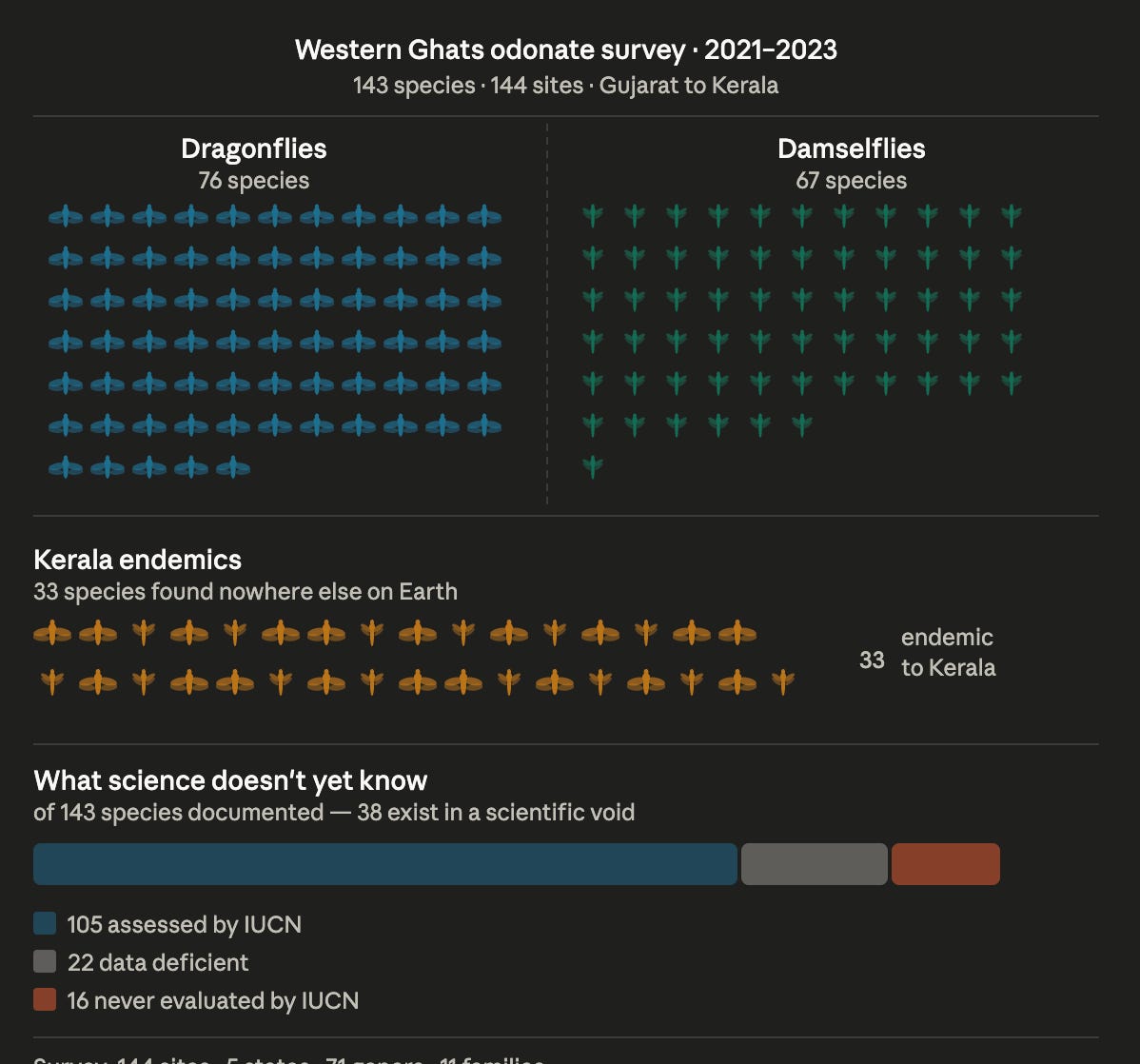
A three-year survey (2021-2023) covering 144 sites across the Western Ghats, spanning Gujarat, Maharashtra, Goa, Karnataka, and Kerala, documented 143 odonate species: 76 dragonflies and 67 damselflies, spanning 71 genera and 11 families. Kerala emerged as the most critical region: 33 endemic odonate species found there are found nowhere else on Earth.
Of the 143 species documented, 22 were data deficient and 16 had never been evaluated by the IUCN. One of the world’s eight most irreplaceable biodiversity hotspots is still being actively discovered, even as it remains under extraction pressure. Dragonflies and damselflies are hyper-sensitive indicators of freshwater ecosystem health. The Western Ghats has more endemic odonates than previously counted, which means it also has more to lose.
In Kiphire district, Nagaland, the United Sangtam Likhum Pumji, the apex tribal body of the Sangtam Naga community, passed a formal resolution banning pangolin hunting and trade across 42 villages. The Indian pangolin is listed Endangered by the IUCN and is among the world’s most heavily trafficked mammals, with demand driven primarily by Southeast Asian traditional medicine markets. Kiphire sits along one of the most active illegal trade corridors in Northeast India. State forest enforcement has repeatedly struggled here. Forty-two Naga villages are now drawing a clear line. Community-led conservation, in the corridor that needed it most.
ISRO: NISAR Delivers
The NASA-ISRO Synthetic Aperture Radar (NISAR) mission, launched from Sriharikota in July 2025 and declared fully operational in January 2026, crossed a $1.5 billion program milestone this week, marking the largest bilateral space investment between India and the United States. The mission is now in full science delivery mode: 10-metre resolution radar maps of ice dynamics, land subsidence, and agricultural deformation patterns across South Asia, updated every 12 days.
ISRO built the S-band radar and provided the launch. NASA provided the L-band radar. This is not a customer-supplier arrangement. It is co-development of a scientific instrument at the frontier of earth observation. The data pipeline is already revealing city-scale land sinking patterns that no optical satellite could detect. The applications for India’s flood forecasting, agricultural yield mapping, and urban infrastructure planning are only beginning to be understood.